An Examination of Philosophical Certainties
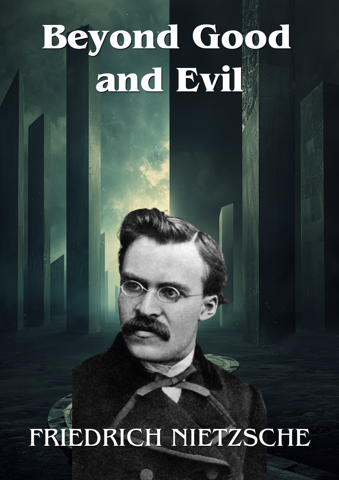
Beyond Good and Evil bears the subtitle Prelude to a Philosophy of the Future. The book does not present a closed moral doctrine in axioms. Rather, Nietzsche investigates which drives, valuations, and linguistic habits lie behind seemingly self-evident philosophical assertions. Already in the first chapter, the focus is on the prejudices of philosophers: where a system promises pure reason, the text asks about perspective, temperament, and interest. Truth thus appears not as trivial, but also not as a possession achieved without prerequisites.
Form and Structure
The edition consists of a preface, nine chapters with a total of 296 numbered sections, and the lyrical aftersong From High Mountains. Short maxims stand alongside longer arguments, historical comparisons, psychological observations, and polemical intensifications. This changing form belongs to the book's movement of thought: statements are tested, set against each other, and illuminated from different angles. Anyone looking only for a linear line of proof can easily lose the connection; it is more helpful to follow guiding questions across several sections.
Central Reading Traces
Recurring themes are the critique of free will as a simple cause, the relationship between philosophy and psychology, the origin of moral valuations, religion, science, hierarchy, culture, and the task of future philosophers. "Beyond" does not mean that every action becomes indifferent or that mere arbitrariness takes the place of judgment. Rather, the book asks who sets values, whom they serve, which forms of life they promote, and which experiences they conceal. Precisely for this reason, it demands a critical reading: Nietzsche's attacks on equality, pity, and democratic ideals should neither be defused nor adopted without examination.
Truth, Perspective, and Psychology
Nietzsche repeatedly treats philosophical doctrines as symptoms of their authors. A thought is not refuted solely by its origin; however, its conditions of emergence become part of the investigation. This approach combines a critique of knowledge with a psychology of valuing. Concepts such as perspective, mask, instinct, and interpretation help to ask why certain explanations seem convincing. The text does not put a simple formula in place of the criticized systems. The talk of the Will to Power also appears in different contexts and must be read section by section. A good edition should therefore clearly preserve the numbers of the aphorisms: they enable comparison, citation, and the rediscovery of motives without detaching individual sentences from their environment.
A Deliberately Uncomfortable Read
The rhetorical power of the book rests on questions, exaggerations, surprising revaluations, and deliberately provocative typifications. This makes the text stimulating, but not automatically convincing. Especially statements about women, peoples, social order, and "noble" people require historical context and factual contradiction. Readers do not have to choose between veneration and complete rejection. One can take the diagnosis of philosophical self-deception seriously and at the same time examine where Nietzsche himself generalizes, hierarchizes, or ascribes unproven psychological motives.
The Present Version of the Text
The German original text is collected, not a translation. The EPUB cites C. G. Naumann, Leipzig 1886, and contains the preface, all nine chapters, sections 1 to 296, and the aftersong. ZIP structure, EPUB mimetype, and content inventory have been checked; all section numbers are present. The scan of the first edition from the Zurich Central Library, designated with the Public Domain Mark, serves as a counter-source. Modern introductions, commentaries, and translations were not included in the text.
Reading Between Individual Passages and the Overall Argument
In an aphoristically structured work, the first impression of a passage is rarely the final word. Repeated terms change their function as soon as Nietzsche directs them against religion, science, or morality in another chapter. A double perspective is therefore useful: first, each section is read in its immediate context, then related numbers are compared with each other. Those working with a translation can additionally check particularly controversial words in the German text. This procedure does not eliminate the tensions of the book but makes visible whether an interpretation stems from the wording, an editorial decision, or later history of influence.
The feature film by Liliana Cavani was created as an Italian-French-West German co-production. Dominique Sanda plays Lou Salomé, Erland Josephson Friedrich Nietzsche, Robert Powell Paul Rée, and Virna Lisi Elisabeth. The recording is important because the title makes visible the international cultural impact of Nietzsche's formula. However, the film is not a direct adaptation of the 296 philosophical sections: it dramatizes the relationships between Nietzsche, Rée, and Salomé around the year 1881. Anyone seeing it therefore receives a biographical fiction, not a substitute for the argument, structure, or wording of the book.
The relationship story depicted also takes place chronologically before the publication of the book in 1886. The shared title should therefore not be understood as a claim that individual chapters were translated into scenes. This distance is precisely useful for comparative reading: the film shows how a philosophical expression can become the interpretative framework for an artist's life, while the book itself operates without a continuous plot. Furthermore, biographical details of the film should not be adopted as historical facts without further sources.
English
Helen Zimmern's translation Beyond Good and Evil: Prelude to a Philosophy of the Future was published in 1907 by Macmillan and is accessible as a public domain text via the Library of Congress. It is suitable for readers seeking an early historical, freely usable English version. Judith Norman's translation for Cambridge, edited with Rolf-Peter Horstmann, offers more recent language and scholarly classification. This modern edition is protected by copyright and is mentioned here only as a reading recommendation, not as a text source.
What Counts in the Comparison of Editions
Not every edition treats spelling, punctuation, and paragraph structure the same. Historical German versions preserve forms like "Vorurtheile," while newly typeset reading texts may modernize. Furthermore, translations must render recurring keywords consistently or deliberately variably. An edition that names the translator, the German source text, and editorial interventions is therefore recommended. For scholarly work, aphorism numbers are more important than page numbers because pages shift between print, EPUB, and translation.
French, Spanish, and Italian
In French, Par-delà le bien et le mal is the established title; the Bibliothèque nationale de France lists Henri Albert, Geneviève Bianquis, Cornélius Heim, and Patrick Wotling, among others. Spanish editions appear as Más allá del bien y del mal; the Alianza edition translated and annotated by Andrés Sánchez Pascual is well-documented bibliographically. Italian readers find Al di là del bene e del male in translations by Ferruccio Masini and Sossio Giametta, among others. In all three markets, it should be checked whether an edition offers only the main text or additionally an introduction, variants, chronology, and notes.
Japanese, Chinese, Korean, and Vietnamese
Japanese catalogs list 善悪の彼岸 in several translations, including Takeyama Michio and Kiba Shinjo. In traditional Chinese, 善惡的彼岸 is common; a Taiwanese edition names Zhu Yang as the translator. As a Vietnamese title, Bên kia thiện ác is verifiable with a translation by Nguyễn Tường Văn. The Korean title 선악의 저편 is findable, but a specific edition should be chosen based on a reliable catalog entry before adopting the translator and year.
Position in the Work
Beyond Good and Evil was published in 1886 after Thus Spoke Zarathustra and before On the Genealogy of Morality. The text takes up questions from earlier writings again but rearranges them around the critique of philosophical premises and moral self-evidences. The nine chapters lead from questions of knowledge and freedom through religion and morality to science, virtues, European cultures, and the question "What is noble?". The structure makes visible that the critique of knowledge, psychology, and the critique of values are not treated as separate projects.
Who the Reading is Suitable For
The book is aimed at readers who are willing to distinguish pointed formulations from sustainable arguments and not to resolve contradictions prematurely. A sensible method is to first read the preface and the headings of the nine chapters, then mark individual sections and collect cross-references. Historical terms, national typifications, and hierarchical valuations require context. An annotated modern edition can help with understanding; for comparisons of wording, the German text remains authoritative. Read this way, the work is less a stock of famous sentences than a demanding exercise in examining the origin of one's own convictions.
Practical Reading Path
For a first pass, the parts on the prejudices of philosophers, the free spirit, and the natural history of morals can be read together. After that, the sections on scholars, virtues, peoples, and nobility can be followed as a second group. A reading journal with section number, key concept, thesis, and objection protects against mistaking a brilliant formulation for the result of the entire book. The concluding aftersong changes the tone and perspective once more; it belongs to the edition and should not be omitted as a mere appendix.
Miva: the next reading experience beyond audiobooks
Listen like an audiobook, then ask anything, anytime.
Start Miva's narrationMiva does not just narrate. It keeps explaining based on what you ask.