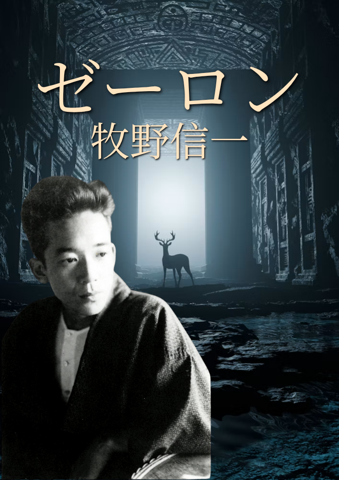
Background:
First published in the October 1931 issue of "Kaizo" and later included in the collection "Kinada-mura" (Ghost Weeping Village), this is one of Shin'ichi Makino's representative short stories. It transforms landscapes near his hometown and private experiences into surreal, otherworldly commotions. The Aozora Bunko work card records its first appearance as: "'Kaizo', October 1931 (Showa 6). Included in 'Kinada-mura' published by Shiba Shoten."
Synopsis:
The narrator becomes embroiled in events surrounding the horse Zeron, as everyday travel and conversations gradually tilt into dream-like chaos. Real-world poverty and self-consciousness never vanish, resulting in a coexistence of comedy and anxiety within the same scenes. Whether the journey chasing Zeron is a real event or a tale for the narrator to escape a stifling daily life remains ambiguous. Anxiety rises immediately following laughter.
Literary Features:
The first-person narrative deviates into tangents through association, layering exaggeration, classical vocabulary, and self-caricature. Rather than following a straight plot, the work is best read as a process where the narrator's mood deforms the landscape.
Elements to Note:
Using "the visionary, the bizarre, and a modernist sense of the uncanny" as an entry point, the reader may wish to track the moments where objects and places turn into evidence, and the points where the first impression of the title shifts.
Reading Guide:
The omissions and structure of the short story become clearer by tracking how the information at the beginning is rearranged through explanation, dialogue, and scene changes. The prose's speed can also be observed through the clues of furigana (rubi) and paragraph breaks.
There are currently no recorded adaptations.
The included text is the Japanese XHTML version published by Aozora Bunko. The source text for the work card is recorded as "Japanese Short Stories Vol. 2," published by Bungeishunju. To appreciate the unique style of this work—where the first-person narrative veers into tangents and layers exaggeration with self-caricature—this edition, which preserves the original rubi, paragraphing, and kana usage, is most suitable. The effect of the introduction—where the narrator's involvement with Zeron leads to a dream-like confusion—is best conveyed through a text that maintains the original paragraph breaks and narrative tone. Since the original magazine and later source texts are different materials, one should read between the work card and the body text without confusing the publication dates. To the extent verified, there is no standardized translation version that aligns translator, publisher, and year; when choosing foreign language versions, priority should be given to those specifying the translator and source text.
Representative of Shin'ichi Makino's fantastical and semi-autobiographical (watakushi-shosetsu) methods, the work inseparably mixes the author's real living sphere with imaginary adventure. The proper noun in the title takes on a symbolism beyond a real animal, reflecting the author's anxiety and desire for liberation. First published in "Kaizo" in October 1931, this short story transforms local landscapes into surreal disturbances. The narrative method—deviating through association and self-caricature—serves as a clue to distinguish this from other works where the author handles similar subject matter. When compared to his other works, Zeron's unique position becomes clear by focusing on the narrator's scope of knowledge, the methods of delaying explanation, and the distance between reality and fantasy.
Miva: the next reading experience beyond audiobooks
Listen like an audiobook, then ask anything, anytime.
Start Miva's narrationMiva does not just narrate. It keeps explaining based on what you ask.