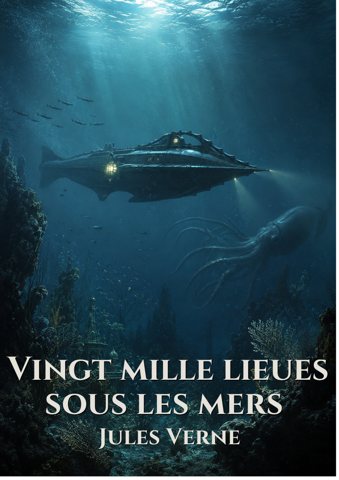
Twenty Thousand Leagues Under the Sea is an adventure and science fiction novel written by Jules Verne and published between 1869 and 1870 in the Magasin d’éducation et de récréation, before being published in volume by Hetzel in 1871. The work belongs to the famous Extraordinary Voyages series and remains today one of the most important novels in world literature.
The story takes place in the 19th century, at a time when several ships report the appearance of a mysterious sea monster attacking vessels in different oceans. To discover the truth, an expedition is organized aboard the American frigate Abraham Lincoln. Among the passengers are the French professor Pierre Aronnax, a natural history specialist, his faithful servant Conseil, and the Canadian harpooner Ned Land. After a violent confrontation at sea, the three men discover that the alleged monster is not an animal, but an extremely sophisticated submarine: the Nautilus.
The Nautilus is led by Captain Nemo, a mysterious and fascinating character, a genius scientist who has broken all ties with human society. Nemo rejects the laws of nations and lives in the deep sea, far from a world he deems unjust and violent. Although he welcomes Aronnax and his companions on board, he refuses to grant them their freedom, condemning them to share his immense journey under the seas.
During this adventure, the travelers traverse the world's oceans and discover extraordinary landscapes: underwater forests, sunken shipwrecks, hidden treasures, polar ice packs, and unknown sea creatures. Verne constantly blends scientific descriptions with romantic imagination, giving the underwater world a dimension that is both realistic and marvelous. However, the novel is not limited to adventure: it also explores deeper themes such as solitude, freedom, revenge, scientific progress, and the critique of colonialism.
Captain Nemo represents one of the most famous figures in literature. At once a visionary scientist, explorer, and a man scarred by the past, he symbolizes revolt against oppression and the violence of great imperialist powers. His scientific genius appears through the Nautilus, a revolutionary machine powered by electricity, capable of exploring oceanic depths with technological advancement exceptional for its time. Many of the inventions imagined by Jules Verne foreshadowed modern submarines and the technical progress of the 20th century.
The style of the work combines adventure, suspense, precise scientific descriptions, and philosophical reflection. Jules Verne uses the geographical and scientific knowledge of his time to build a credible universe, while maintaining a poetic and fantastic dimension. This combination explains the novel's immense influence on modern science fiction, cinema, and adventure literature.
Miva: the next reading experience beyond audiobooks
Listen like an audiobook, then ask anything, anytime.
Start Miva's narrationMiva does not just narrate. It keeps explaining based on what you ask.