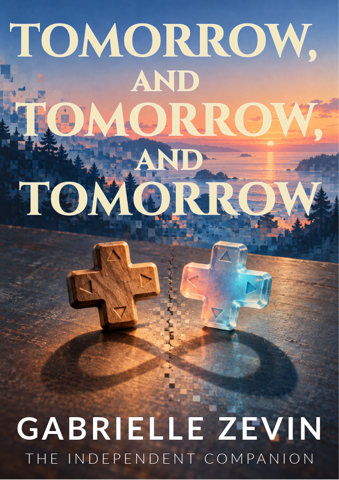
Tomorrow, and Tomorrow, and Tomorrow by Gabrielle Zevin: Sam Masur and Sadie Green transform childhood play into a creative partnership and a celebrated career in video games. Success gives them a world to build together, but it cannot protect their friendship from ambition, unequal power, injury, grief, and everything they cannot say aloud.
This independent chapter-by-chapter guide and book summary covers ten parts with 44 chapters and interludes. This guide tracks the novel’s decades, game projects, shifting viewpoints, and formal experiments, showing how Gabrielle Zevin uses game design to ask who receives credit, how collaboration survives conflict, and why friendship can be a life-defining love story. Use it to connect each game and formal experiment with the evolving questions of authorship, disability, creative credit, friendship, and loss. The ending and decisive late turns remain unspoiled.
Winner — 2022 Goodreads Choice Award, Best Fiction; Amazon Editors’ Best Book of 2022.
Zevin treats friendship and collaboration with the scale usually reserved for romance. By taking games seriously as art, labor, refuge, and argument, the novel captures how people can build extraordinary worlds together and still fail to understand one another.
Sam and Sadie are not a conventional romantic pair, yet their creative partnership carries the intimacy, jealousy, devotion, and damage of a defining love. The guide follows what each game reveals about what they can—and cannot—say directly to one another.
Talent does not erase unequal access, invisible labor, or competing ideas of authorship. Chapter notes track creative decisions, business pressures, and public narratives so readers can see why success deepens some fractures instead of repairing them.
The fictional games are not technical ornament. They offer characters alternate bodies, identities, rules, and chances to begin again. The companion explains how each major game mirrors the novel’s concerns with disability, grief, play, and the limits of second chances.
This guide is ideal for readers of literary friendship stories, game culture, and nonlinear narratives who want to connect each formal section with the characters’ creative and emotional development. It offers more than a plot recap by connecting structure, character pressure, recurring language, and ethical questions while leaving room for your own interpretation.
Edition notice: This is an independent chapter guide and summary, not the original book. It is designed for review and reading support and is best used alongside the full work.
Miva: the next reading experience beyond audiobooks
Listen like an audiobook, then ask anything, anytime.
Start Miva's narrationMiva does not just narrate. It keeps explaining based on what you ask.