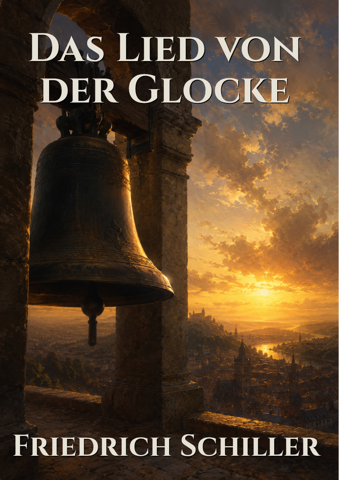
One of Friedrich Schiller's Best-Known and Longest Works
Published in 1799 — Over 400 Verses, One Unbroken Vision
A Bell Cast in Metal and in Meaning
A Central Work of German Culture for More Than Two Centuries
The bell does not merely ring. It calls the living, laments the dead, and breaks the lightning. It has always done more than we asked of it.
Published in 1799, Das Lied von der Glocke ("The Song of the Bell") is among the most celebrated poems in the German language — and one of Friedrich Schiller's most ambitious. In more than 400 verses, Schiller interweaves the technical process of casting a bell with a sweeping reflection on the whole of human life: birth, love, marriage, work, danger, death, and the fragile order that holds a community together.
The bell is never merely an object. From the opening Latin motto — "Vivos voco, mortuos plango, fulgura frango" ("I call the living, I lament the dead, I break the lightning") — it is granted a symbolic and almost sacred significance, accompanying human beings through every decisive moment of existence.
"Step by step, the metals are melted, the mold prepared, the bell poured — and with each stage, an entire human life unfolds alongside it. The craft and the meditation are inseparable."
The Journey of a Life
Schiller moves through the stages of human existence with the rhythm of the casting process itself.
Childhood and youth: The bell greets the newborn at baptism and accompanies first love — tender, full of promise, still untouched by loss.
Marriage and family life: The man ventures into the dangerous world; the woman preserves the home and family. This ideal image reflects the social thinking of Weimar Classicism, and it has not escaped the scrutiny of later readers.
Fire: The poem's most dramatically charged passage. Fire makes the casting possible — and fire destroys. Burning houses, panic, and chaos are described in vivid, urgent language. Every creative force, Schiller insists, contains within it the seed of destruction.
Revolution: The poem's most controversial passage. Schiller alludes indirectly to the French Revolution, condemning not the ideal of freedom but the terror and collapse of order that followed. The line "Where women become hyenas" remains among the most debated in all of German poetry. Schiller feared unchecked violence — and he did not hide it.
The finished bell: Lifted from the mold, solemnly consecrated, it becomes a symbol of peace, unity, and the hope of harmony restored.
Legacy
The Song of the Bell became a central work of 19th-century German culture — widely circulated, memorized in schools, performed publicly, its verses permanently woven into the language. Countless parodies and adaptations followed, testifying to the poem's enormous reach and the ambivalence it could inspire.
Friedrich Schiller — born in 1759 in Marbach am Neckar, poet, dramatist, philosopher, and historian — stands alongside Goethe as one of the defining figures of German literature. His works include The Robbers, William Tell, Mary Stuart, and Ode to Joy, later set to music by Beethoven in the 9th Symphony.
"The Song of the Bell" is a poem about what holds human life together — and about how close that order always is to coming apart. It rings, and we recognize ourselves in the sound.
Miva: the next reading experience beyond audiobooks
Listen like an audiobook, then ask anything, anytime.
Start Miva's narrationMiva does not just narrate. It keeps explaining based on what you ask.