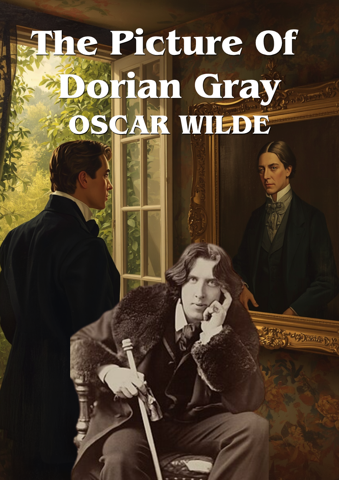
The Picture of Dorian Gray by Oscar Wilde is a philosophical fiction and Gothic horror novel first published in 1890. The story centers on Dorian Gray, a strikingly handsome young man who, upon seeing his newly painted portrait, expresses a wish that the painting would bear the burden of age and sin while he himself remains eternally youthful. His wish is terrifyingly granted. As Dorian embarks on a life of unchecked pleasure and moral corruption, indulging in hedonism and committing increasingly heinous acts, his physical appearance remains unblemished. However, his portrait, hidden away, grotesquely transforms to reflect every one of his sins and the decay of his soul. Wilde masterfully explores profound themes including the nature of beauty, the corrupting influence of vanity, the complexities of morality, and the dangerous consequences of a life devoted solely to pleasure, making it a timeless examination of the human condition.
Reading ease score: 84.0 (6th grade). Easy to read.
In the elegant drawing rooms of Victorian London, a talented painter named Basil Hallward paints a full-length portrait of a strikingly beautiful young aristocrat, Dorian Gray. While posing in Basil’s studio, Dorian meets Basil’s friend, Lord Henry Wotton. Lord Henry captivates the naive Dorian with a seductive, hedonistic philosophy, proclaiming that beauty and youth are the ultimate pursuits in life, both destined to fade all too quickly under the cruel march of time. Overwhelmed by a sudden, intense dread of growing old and ugly while his painted likeness remains forever flawless, Dorian utters a fateful wish: he declares he would give anything, even his very soul, if the portrait would age in his place while he remained eternally youthful. Unbeknownst to those around him, this desperate bargain takes root. Soon after, Dorian falls in love with Sibyl Vane, a young, impoverished actress who performs in a theater in London's East End. However, after falling genuinely in love with Dorian, Sibyl loses her passion for stage acting, realizing that real life holds far greater beauty than theatrical romance. When she gives a poor performance, Dorian coldly rejects her, breaking off their engagement with cruel disdain. Returning home, Dorian notices a subtle, chilling change in his portrait: a cruel sneer has crept across its lips. Shocked and filled with remorse, he resolves to apologize to Sibyl and make amends, only to learn the next morning that she has committed suicide in her grief. Guided by Lord Henry’s artful rationalizations, Dorian reframes the tragedy not as a moral failure, but as a dramatic, poetic event. He hides the portrait away in a locked, abandoned room in his house, where no eye but his own can witness its supernatural transformation. Over the passing decades, Dorian remains outwardly untainted, possessing the fresh, radiant beauty of a youth in his twenties. Yet, in secret, he surrenders himself entirely to a life of decadent hedonism, corruption, and moral decay. Meanwhile, the hidden portrait becomes a grotesque record of his true self, its canvas twisting into a hideous, leprous nightmare reflecting every sin and cruelty he commits. Years later, on the eve of his thirty-eighth birthday, Basil Hallward visits Dorian to confront him about the dark rumors surrounding his corrupting influence on London society. Unable to contain his bitterness, Dorian brings Basil upstairs to the locked room and unveils the monstrosity the painting has become, declaring it to be the true face of his soul. When a horrified Basil begs him to kneel and pray for repentance, an uncontrollable surge of hatred overwhelms Dorian. Seizing a knife, he stabs his old friend to death. To cover up the crime, Dorian blackmails a former friend, the chemist Alan Campbell, into destroying Basil's corpse with chemical reagents. Though Dorian escapes legal suspicion, his guilt and terror deepen, especially after surviving an encounter with Sibyl Vane’s vengeance-seeking brother, James Vane, who is later accidentally killed during a hunting party. Safe from physical retribution, Dorian seeks to reform his life, performing a rare act of mercy toward a young village girl in hopes of redeeming himself. Driven by curiosity, he sneaks up to inspect the portrait, hoping his good deed might have softened its horrifying features. Instead, he finds the face on the canvas even more monstrous, bearing a look of hypocritical cunning. Realizing that his desire for redemption was merely vanity, and that only the painting keeps his sins alive, Dorian picks up the knife he used to murder Basil and stabs the canvas, intending to destroy his conscience once and for all. A terrible cry echoes through the house. When the servants finally break into the locked room, they find a magnificent portrait of their master hanging on the wall, restored to its original, radiant beauty. Laying on the floor beside it is a dead, withered man, hideous and severely wrinkled, identifiable only by the rings on his fingers.
The novel is remarkably accessible, boasting a strong reading ease score that makes it approachable for modern readers. Oscar Wilde writes with clear, expressive prose, relying heavily on lively dialogue and dramatic tension rather than dense, archaic language. While the story incorporates elegant Victorian vocabulary and philosophical banter, the narrative pacing remains swift and engaging throughout. Readers who enjoy psychological suspense or Gothic mysteries will find the language fluid, highly readable, and filled with memorable epigrams.
Oscar Wilde's work remains a classic because it addresses universal human fears regarding aging, vanity, and the hidden self. By combining elements of Gothic horror with sharp social satire, Wilde crafts a story that transcends its 1890 publication date. The concept of a visual representation of one's inner morality resonates across generations, raising timeless questions about art and ethics. Its profound themes and brilliant dialogue ensure its lasting legacy in global literature.
What happens at the end is the ultimate accounting between a man and his soul, a final terrifying moment where the immaculate facade of Dorian Gray collides directly with the hideous reality locked behind the attic door. As the weight of secret blood, corrupted lives, and decades of silent monstrosity becomes too unbearable for a human conscience to carry, the story strips away every illusion of escape or redemption. What waits in those dark, concluding moments is not merely a resolution of the plot, but a shocking, unforgettable reckoning that restores the natural order of life and art in a single violent act. Read these closing pages for yourself.
The novel sits at the intersection of philosophical fiction and Gothic horror. It utilizes classic Gothic elements such as a sinister supernatural artifact, atmospheric Victorian settings, and psychological terror. Simultaneously, it functions as a novel of ideas, using rich dialogue to debate aestheticism, morality, and human nature. This blend creates a unique atmosphere that is both intellectually stimulating and suspenseful.
Oscar Wilde was an iconic Irish playwright, poet, and novelist born in 1854. He was a leading figure in the late 19th-century Aestheticism movement, famous for his wit, brilliant comedies, and distinctive style. The Picture of Dorian Gray stands as his only published novel, showcasing his genius for dramatic storytelling alongside his complex views on art and life.
The central conflict lies within Dorian Gray himself as he struggles against the visible record of his own moral decay. While his physical body remains unblemished, the hidden portrait captures every cruel act and sin he commits. This supernatural tension drives Dorian into increasing paranoia, isolating him as he attempts to conceal his dark secret from society.
Miva: the next reading experience beyond audiobooks
Listen like an audiobook, then ask anything, anytime.
Start Miva's narrationMiva does not just narrate. It keeps explaining based on what you ask.