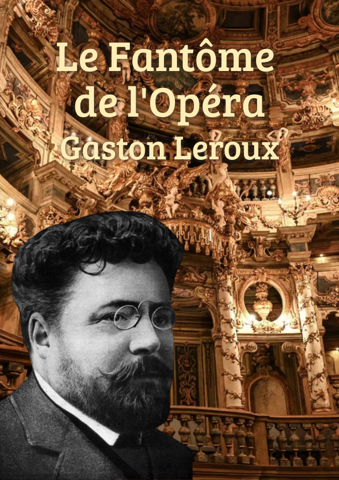
Context:
Gaston Leroux first published The Phantom of the Opera as a serial in 1909–1910, before the 1910 volume edition. His experience as a journalist and legal chronicler informs a narrator who presents the case as a historical investigation. The Paris Opera is not an abstract backdrop: its boxes, its basements, its trapdoors, its corridors, its underground lake, and its administration provide a material reality to the legend. The novel was thus born at the intersection of reporting, detective fiction, melodrama, and theatrical Gothic.
Summary without revealing the ending:
At the Opera, employees and directors attribute several incidents to a ghost who demands a private box, an allowance, and obedience from the management. The career of singer Christine Daaé becomes linked to an invisible voice she associates with the "Angel of Music." Raoul de Chagny seeks to understand her behavior and her fear. The narrative follows attempts to determine whether the threat is supernatural, criminal, technical, or composed of these various possibilities, without reducing the story to a simple love triangle.
Literary Form:
The foreword asserts that the phantom actually existed, and then the narrator gathers testimonies, memoirs, letters, reported accounts, and architectural traces. This imitation of an investigative file allows Leroux to produce two effects at once: every phenomenon can receive a concrete explanation, but the accumulation of voices maintains uncertainty. The reader must observe who saw an event, who only heard it, and who possesses the necessary authority to classify it as superstition, accident, or crime.
Architecture and Spectacle:
The spaces of the theater regulate the circulation of people and information. A voice passes through a wall, a mirror seems to open a passage, a public performance conceals private operations. Changes in scenery, schedules, costumes, and staff hierarchy become pieces of evidence. The contrast between the lit stage and the dark basements also organizes the gaze directed at the body, the mask, beauty, and deformity. Reading the movements carefully is therefore as important as following the revelations.
Direction: Rupert Julian
Country of production: United States
Main performers: Lon Chaney, Mary Philbin, Norman Kerry
Why remember this version: This silent adaptation is one of the most influential cinematic incarnations of the character, notably due to Lon Chaney's makeup and performance.
Difference from the novel: The film transforms the Phantom's final fate into a violent public pursuit, whereas the novel maintains a more private conclusion linked to testimony and compassion. It also centers the plot around visual spectacle and simplifies part of the documentary framework.
Comparing the book and the film:
Cinema immediately shows a face, a costume, or a space that the novel can hide, describe indirectly, or subject to multiple testimonies. It is therefore necessary to compare the order of revelations, the role of the Persian, Christine's knowledge, and the way the crowd intervenes. An adaptation is not an illustrated summary: it redistributes fear, sympathy, and responsibility. Later musical and romantic versions accentuate other aspects further and should not be used to silently complete Leroux's text.
Editorial History:
The selected text is the French version from the public-domain edition, based on the Pierre Lafitte edition. It includes a foreword, twenty-seven chapters, and an epilogue. The table of contents, names, and phrasing must be checked against this specific file. The date 1910 corresponds to the French volume edition; the upload date of the ebook does not replace the work's date. No translator is indicated, since the content collected is in the original language.
Version Differences:
English translations are not interchangeable with the French text. The historical translation by Alexander Teixeira de Mattos, published in 1911 and distributed by the public-domain edition, played a major role in English-language reception, but it should no longer control the metadata for this entry. Modern translations may restore details, adopt different punctuation, or provide notes, while remaining protected by copyright. Abridged editions and rewritings inspired by the musical should be flagged as such.
Cultural Importance:
The Phantom of the Opera established an international image of the underbelly of the Parisian theater and gave birth to numerous adaptations in film, stage, radio, and music. However, its legacy does not depend solely on a masked character. The novel transforms a modern building, its machinery, and its administration into a Gothic labyrinth. At the same time, it questions the power of the voice, the control of the gaze, artistic authority, physical exclusion, and the limits of compassion.
Place in Leroux's Career:
This work extends Leroux's interest in impossible enigmas and closed spaces, visible in the adventures of Joseph Rouletabille. The journalist converts archives, rumors, and technical details into narrative mechanisms. The author's full biography belongs to a separate entry; here, what matters is how his professional methods become a literary form. The narrative asks the reader to test the sources rather than accept a single version.
Legacy:
After reading, one can compare the foreword and the epilogue, follow the mentions of box number 5, or study the circulation of the voice between visible and invisible spaces. One can then compare these same points with a translation and the 1925 film. This method distinguishes the historical novel from the cultural image accumulated around the Phantom and avoids confusing the French text, a translation, a musical adaptation, and a film script.
Miva: the next reading experience beyond audiobooks
Listen like an audiobook, then ask anything, anytime.
Start Miva's narrationMiva does not just narrate. It keeps explaining based on what you ask.