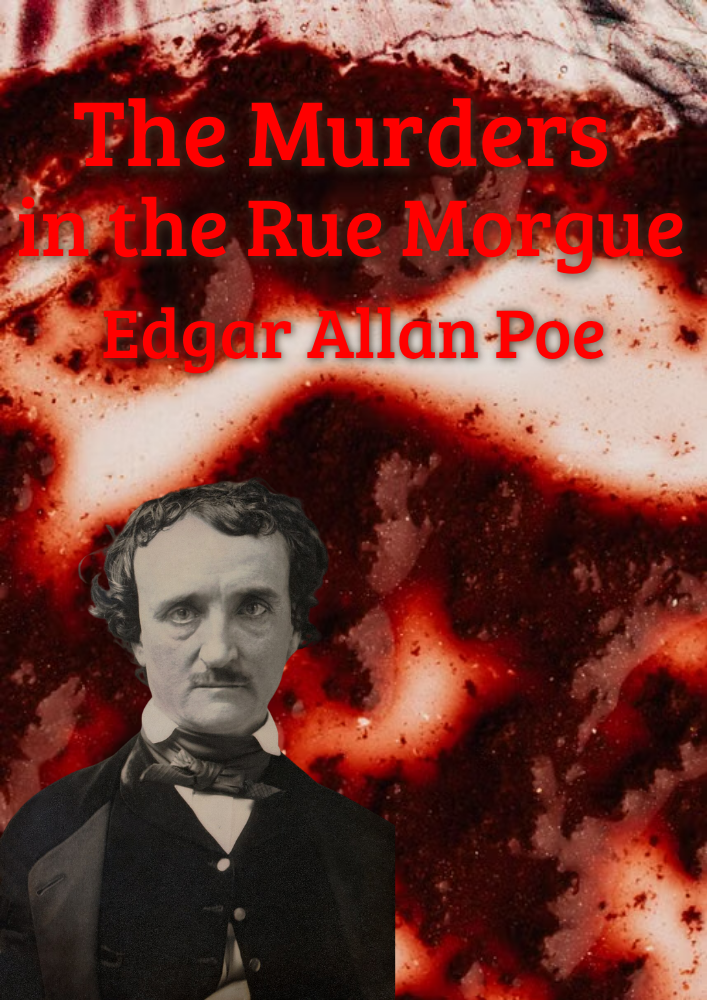
Work Background:
The Murders in the Rue Morgue, by Edgar Allan Poe, first appeared in 1841. Poe joined his interest in puzzles, urban print culture, and controlled narrative effect to invent what he called a tale of ratiocination. Dupin's reconstruction of an impossible crime established conventions later central to detective fiction: the brilliant amateur, baffled police, narrating companion, and solution through overlooked evidence. The unnamed narrator watches C. Auguste Dupin reconstruct an apparently impossible crime from newspaper reports, testimony, physical traces, and the limits of police assumptions. The tale helped establish the analytical detective story. This context explains the work's choice of voice, structure, and genre, while helping readers recognize the literary setting and social institutions surrounding its first publication or performance. Readers may notice how public rules enter private judgment, how repeated images change meaning, and how form controls what can be known at each stage.
Story Overview:
The narrator introduces C. Auguste Dupin, whose analytical habits are tested by the apparently impossible murders of two women in a locked Paris room. Conflicting testimony, unusual physical traces, and police assumptions become the material from which Dupin reconstructs an unexpected sequence. This summary identifies only the central situation and direction without revealing the ending. As speakers, settings, scale, or social positions change, earlier events take on new meanings; the work's effect lies not only in its incidents but also in pacing, point of view, silence, and the distance between what characters understand and what readers can infer.
Director: Robert Florey
Production country: United States
Principal cast: Bela Lugosi, Sidney Fox, Leon Ames, and Arlene Francis
Difference from the book: The film replaces Dupin's analytical reconstruction with a Gothic mad-scientist plot, giving Dr. Mirakle experiments involving an ape and inventing a romantic heroine.
Director: Gordon Hessler
Production country: United Kingdom
Principal cast: Jason Robards, Herbert Lom, Christine Kaufmann, and Adolfo Celi
Difference from the book: Set around a theatrical company performing Poe, the film invents backstage murders and a masked antagonist; it uses the title and motifs rather than reproducing Dupin's investigation.
The selected full text is the verified digital edition numbered 2147. Market titles include: The Murders in the Rue Morgue; Murders in the Rue Morgue; Double Assassinat dans la rue Morgue; Los crímenes de la calle Morgue; 莫爾格街兇殺案. When choosing an edition, distinguish complete, abridged, annotated, modernized, and collected versions, and verify the translator, publisher, and year for each.
Dupin's reconstruction of an impossible crime established conventions later central to detective fiction: the brilliant amateur, baffled police, narrating companion, and solution through overlooked evidence. Poe joined his interest in puzzles, urban print culture, and controlled narrative effect to invent what he called a tale of ratiocination. These qualities place the book at a specific point in the author's career and in the development of its genre. Its influence rests on recognizable questions of language, structure, history, and judgment rather than on a vague label of “classic.” Reading the full text beside another translation, stage production, or film reveals what later editors, translators, actors, and directors preserve, explain, compress, or rearrange, and brings out formal effects that summaries often conceal.
Reading another work from the same author's career also shows which concerns persist and which methods change. The book remains open to interpretation, disagreement, and rereading because readers can return to its actual language and arrangement instead of allowing later reputation to replace the experience of reading.
Miva: the next reading experience beyond audiobooks
Listen like an audiobook, then ask anything, anytime.
Start Miva's narrationMiva does not just narrate. It keeps explaining based on what you ask.