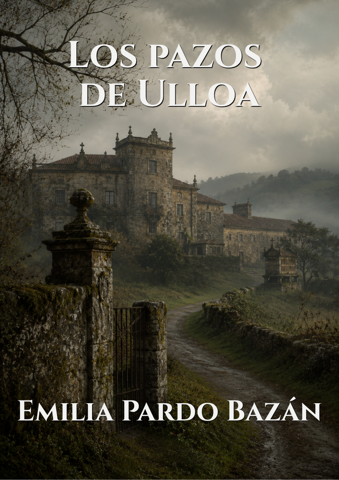
Published in 1886, The House of Ulloa (Los pazos de Ulloa) is considered Emilia Pardo Bazán's masterpiece and one of the fundamental novels of Spanish Realism and Naturalism. Along with its sequel, Mother Nature, it forms a grand fresco of the moral and social decadence of rural Galicia in the 19th century.
The novel follows the arrival of the young priest Julián Álvarez at the House of Ulloa, an isolated and crumbling estate dominated by Pedro Moscoso, a brutal and ignorant nobleman known as "the marquis." What Julián finds there is not the traditional nobility he imagined, but a savage world governed by violence, desire, fear, and political bossism (caciquismo). The steward Primitivo manipulates the entire estate through threats and corruption, while his daughter Sabel—Pedro's mistress—represents an instinctive and earthly force that eventually destroys any possibility of moral order.
More than a simple family story, the novel portrays the collapse of an entire social class. The rural aristocracy appears degraded and empty, incapable of exercising moral or political leadership. The Galician landscape—damp, dark, and isolated—does not function merely as a setting: it acts almost as a biological force that absorbs and transforms the characters. Nature dominates over religion, civilization, and reason.
The character of Nucha symbolizes this central conflict. Educated, delicate, and deeply religious, she attempts to introduce sensitivity and order into the brutal universe of the House, but ends up physically and psychologically consumed by the environment. Opposite her, Sabel embodies an instinctive, sensual, and wild nature that manages to survive within the corrupt rural system. This opposition turns the novel into an exploration of the boundaries between civilization and barbarism.
The influence of Émile Zola is evident in the use of social and biological determinism, but Pardo Bazán modifies French Naturalism by incorporating spiritual and moral elements. For this reason, the novel is not purely deterministic: the characters are conditioned by their environment, yet they still retain remnants of conscience and guilt.
The work also stands out for its political dimension. Through manipulated elections, electoral violence, and clientelist networks, the novel portrays the workings of Spanish caciquismo following the Revolution of 1868. Power does not depend on laws or institutions, but on fear and local control exercised by figures like Primitivo.
Stylistically, The House of Ulloa is celebrated for its linguistic recreation of Galicia. Pardo Bazán blended Spanish and Galician to construct a hybrid literary language that preserved the rural flavor without losing comprehension for urban readers. This linguistic texture contributes to the sense of isolation and authenticity that permeates the entire novel.
The work had an enormous influence on later Spanish narrative and remains an essential reference for understanding Hispanic Naturalism, the rural novel, and the literary representation of structural violence. In 1985, it was adapted into a renowned television series directed by Gonzalo Suárez, further consolidating its presence within contemporary Spanish culture.
Miva: the next reading experience beyond audiobooks
Listen like an audiobook, then ask anything, anytime.
Start Miva's narrationMiva does not just narrate. It keeps explaining based on what you ask.