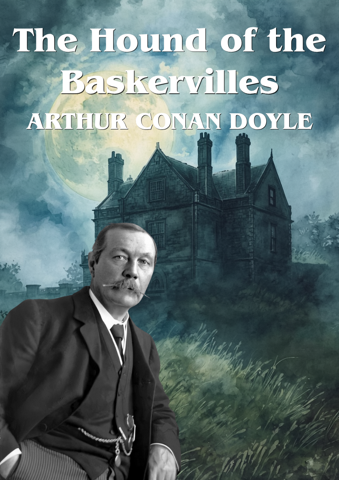
“The Hound of the Baskervilles” is a classic detective novel by Arthur Conan Doyle, originally serialized between 1901 and 1902. It plunges Sherlock Holmes and Dr. Watson into a chilling mystery rooted in a centuries-old legend of a monstrous, demonic hound that haunts the Baskerville family on the desolate, atmospheric moors of Dartmoor. The story begins with the mysterious death of Sir Charles Baskerville, found dead with an expression of terror on his face and the footprints of a gigantic hound nearby. His heir, Sir Henry Baskerville, arrives from Canada to claim his inheritance, only to be immediately confronted by strange threats and the palpable sense of an ancient curse. Holmes, initially skeptical of the supernatural, dispatches Watson to Dartmoor to protect Sir Henry and investigate the eerie occurrences. As Watson delves deeper, he uncovers a web of local folklore, suspicious characters, and unexplained events, all pointing towards a sinister plot. Holmes eventually joins the investigation, determined to unravel the truth behind the legend and expose whether a supernatural entity or a cunning human murderer is responsible for the terror gripping the Baskerville estate. This novel is celebrated for its gothic atmosphere, intricate plot, and the iconic partnership of Holmes and Watson facing one of their most formidable cases.
Reading ease score: 80.9 (6th grade). Easy to read.
The Hound of the Baskervilles opens with a chilling legend that hangs over the Baskerville family and their ancestral estate on the fog-shrouded moors of Dartmoor. For generations, tales have persisted of a monstrous, spectral hound haunting the lineage. When old Sir Charles Baskerville dies suddenly under mysterious circumstances, his face frozen in sheer terror, surrounded by the giant footprints of a massive dog, Dr. James Mortimer seeks the help of the legendary detective Sherlock Holmes. With Sir Charles’s heir, Sir Henry Baskerville, arriving from Canada to claim his inheritance, Holmes is tasked with uncovering whether a supernatural curse or a cunning murderer threatens the new baronet. Initial clues emerge quickly in London, where Sir Henry receives a cryptic warning and notices he is being shadowed. Holmes, remaining skeptical of supernatural forces, dispatches his trusted companion, Dr. John Watson, to accompany Sir Henry to Baskerville Hall to act as his protector and gather intelligence. Upon reaching the gloomy estate, Watson encounters a tense atmosphere and a host of intriguing locals. Among them are the enigmatic naturalist Jack Stapleton and his sister Beryl, who warns Watson of the danger lurking on the moor. Watson keeps Holmes informed of suspicious activities through detailed letters, observing eerie midnight occurrences, mysterious signals across the bog, and the unnerving howls of a beast echoing over the desolate landscape. Unbeknownst to Watson and Sir Henry, Holmes secretly travels to Dartmoor to conduct his own covert investigation from an abandoned stone hut on the moor. When Watson discovers Holmes’s hideout, the detective reveals his conclusions: the mysterious entity is no ghost, but a real, living hound orchestrated by a ruthless mastermind. The culprit is Jack Stapleton himself, secretly a distant Baskerville relative seeking to eliminate all heirs in line before him to claim the family fortune. Stapleton had purchased a vicious, giant hound, a terrifying crossbreed of bloodhound and mastiff, and concealed it deep within the treacherous Grimpen Mire. To make the creature appear demonic and play upon the legendary curse, he coated its jaws and body with a glowing, luminous phosphorus paint. The climax unfolds on a pitch-black, fog-dense night as Sir Henry walks home alone across the moor after dining with Stapleton. As Sir Henry travels down the dark path, Stapleton releases the hellish hound upon him. With long bounds, the huge black beast leaps through the darkness, its fiery jaws and glowing eyes hunting down the terrified baronet. Just as the hound springs upon Sir Henry, hurling him to the ground to attack his throat, Holmes, Watson, and Inspector Lestrade spring from their ambush. Holmes fires five barrels of his revolver into the beast’s side. With a final howl of agony, the giant glowing creature rolls onto its back and falls dead. Although Sir Henry survives the attack, the harrowing shock shatters his nerves, requiring a globe-trotting journey with Dr. Mortimer to recover his health. Meanwhile, Stapleton flees into the dark during the chaotic confrontation. Attempting to navigate the treacherous Grimpen Mire in the fog to reach his hideout, he loses his footing and sinks forever into the deadly, green-splotched bog, bringing a dramatic close to the terror gripping Dartmoor.
Mr. Holmes, they were the footprints of a gigantic hound!The Hound of the Baskervilles Chapter 2: The Curse of the Baskervilles. This iconic line marks the exact pivot where a standard murder investigation transforms into a chilling gothic mystery, establishing the legendary supernatural dread that drives the central plot.
Yet you must admit that the footmark is material.The Hound of the Baskervilles Chapter 3: The Problem. It captures the fundamental tension between rational scientific inquiry and mythic fear, illustrating Holmes's steadfast commitment to empirical evidence even when confronted with demonic claims.
A hound it was, an enormous coal-black hound, but not such a hound as mortal eyes have ever seen.The Hound of the Baskervilles Chapter 14: The Hound of the Baskervilles. This passage delivers the atmospheric climax of the novel, using vivid, nightmare-inducing sensory details to evoke the raw terror inspired by the legendary beast.
If he was vulnerable he was mortal, and if we could wound him we could kill him.The Hound of the Baskervilles Chapter 14: The Hound of the Baskervilles. It captures the crucial psychological turning point in the climax where supernatural fear is shattered by logic, demonstrating the triumphant power of human resolve over superstitious terror.
The Hound of the Baskervilles is remarkably accessible for a classic nineteenth-century mystery novel. Arthur Conan Doyle wrote the text in clean, active prose that prioritizes suspense, atmospheric storytelling, and swift narrative pacing over dense or archaic prose styles. The primary difficulty modern readers might encounter lies in traditional Victorian vocabulary and regional British idioms of the period, but these elements serve primarily to build the gothic flavor of Dartmoor rather than obscure the plot. Because the story is told through the practical perspective of Dr. Watson via journal entries and personal letters, the narrative remains grounded and easy to follow. Readers who enjoy fast-paced detective fiction, vivid environmental descriptions, and procedural investigations will find the text smooth and highly engaging from the opening dialogue at Baker Street to the climax on the moor.
The novel stands as a classic because it perfectly bridges traditional gothic horror with the logical rigor of detective fiction. Arthur Conan Doyle crafted a masterclass in atmospheric writing, using the eerie fog, treacherous quagmires, and ancient stone ruins of Dartmoor to build constant psychological tension. Furthermore, the work showcases the iconic dynamic between Sherlock Holmes and Dr. Watson at its peak. By placing Watson in the field alone for much of the story, the book allows readers to piecemeal the clues alongside him before Holmes brings his brilliant analytical power to bear. The enduring legacy of the novel stems from its unforgettable villain, its memorable monster, and its demonstration that human logic can illuminate even the darkest and most terrifying legend.
What waits at the end of the narrative is the total collapse of a centuries-old family myth under the weight of logical investigation. As thick fog rolls across the perilous moorland, the haunting legend meets its final test in the pitch darkness of Dartmoor. The mastermind behind the terror is forced into the open, every hidden trap buried within the mire is revealed, and the desolate bog itself demands a final reckoning. Read these closing pages for yourself to witness how every piece of the puzzle locks into place.
Holmes sends Watson ahead to Baskerville Hall under the premise that pressing business requires his presence in London, but his true strategy is two-fold. First, Watson serves as a trustworthy physical bodyguard for Sir Henry Baskerville in an environment known to be dangerous. Second, Holmes recognizes that suspects on the moor would act far more cautiously if they knew the famous detective was present in person. By remaining officially absent, Holmes allows Watson to gather candid reports while Holmes himself secretly travels to the moor in disguise, observing the suspects from a concealed vantage point without alerting the killer.
Dartmoor functions almost as an active character within the narrative, providing a heavy gothic atmosphere that heightens the sense of isolation and danger. The sprawling wasteland, filled with ancient stone huts, sudden mists, and the deadly Grimpen Mire, creates a backdrop where supernatural legends feel plausible to the characters. The setting physically traps the characters within its boundaries, making escape difficult for Sir Henry while providing ideal cover for a killer to hide a monstrous hound away from public view.
The ancestral manuscript, brought to Holmes by Dr. Mortimer, establishes the mythic framework and psychological terror that drives the entire narrative. Dating back to the English Civil War, the document details the wicked life of Hugo Baskerville and his gruesome death by a phantom hound, creating a dark legacy that hangs over every successive generation. This document is significant because the antagonist uses its widespread local notoriety to mask a calculated modern murder as the fulfillment of a divine curse.
Miva: the next reading experience beyond audiobooks
Listen like an audiobook, then ask anything, anytime.
Start Miva's narrationMiva does not just narrate. It keeps explaining based on what you ask.