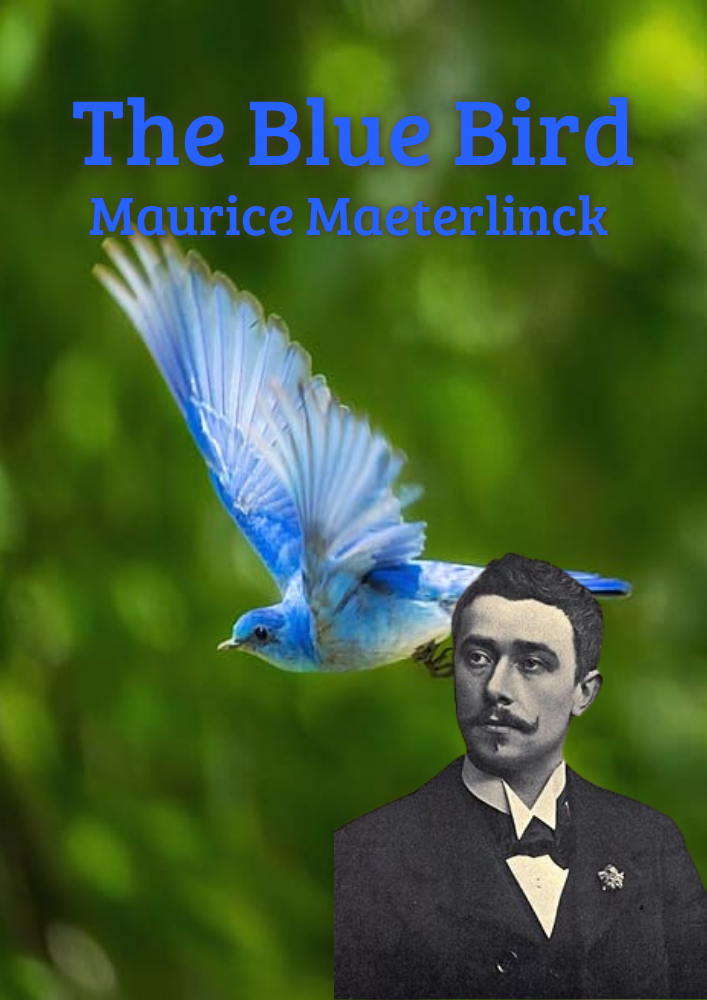
Book Introduction
Background:Maeterlinck's French play L'Oiseau bleu premiered at the Moscow Art Theatre in 1908. Written within Symbolist theatre yet designed for elaborate staging, it sends ordinary children through personified realms of memory, nature, luxury, and the future. This English text is translated by Alexander Teixeira de Mattos. The premiere's association with Konstantin Stanislavski's Moscow Art Theatre placed the work within an ambitious international stage culture rather than a purely juvenile one. Its demanding scenic transformations were part of the conception from the beginning.
Story Summary:Tyltyl and Mytyl leave their cottage to search for the Blue Bird of Happiness for a sick child. Guided by the Fairy Bérylune and accompanied by transformed household companions, they discover that seeing familiar life anew matters as much as reaching distant enchanted worlds. Each realm proposes a possible location for happiness, only to expose the limits of that answer. The return home therefore reinterprets the opening cottage rather than simply cancelling the fantastic journey.
Literary Features:The play is structured as a sequence of stage pictures, with costume, lighting, and transformation carrying much of its meaning. Abstract ideas become characters, while recurring blue light links theatrical spectacle to questions about perception and happiness. Its episodic form invites staging choices that can emphasize fantasy, philosophy, or family drama. Long stage directions guide movement, colour, costume, and changes of light with unusual precision. Dialogue often carries philosophical ideas, but comedy from the animal and household characters prevents the allegory from becoming uniform in tone.
Film and Television Adaptations
The Blue Bird (1918)
Directed by Maurice Tourneur in the United States, starring Tula Belle and Robin Macdougall, this silent film is a notable early screen interpretation. It translates the stage spectacle into tinted cinematic tableaux and necessarily replaces Maeterlinck's extended dialogue with visual action and intertitles.
The Blue Bird (1940)
Directed by Walter Lang in the United States, starring Shirley Temple, Spring Byington, and Nigel Bruce, this Technicolor production reshapes the material around its young star. It simplifies the allegorical sequence, adds musical and family-film elements, and alters characterization while retaining the quest for happiness.
The silent and sound-era films solve the play's dependence on language and stage transformation in different ways. Comparing them shows how cinema can either preserve the sequence of tableaux or rebuild it around a star and a family narrative.
Editions and Translations
The original language is French. Alexander Teixeira de Mattos's English translation includes theatrical preliminaries such as costume and scene descriptions and preserves the multi-act stage structure. Readers should distinguish the play from novelizations, children's retellings, and film-derived editions, all of which may omit dialogue or reorder episodes.
Performance editions may cut scenes because the complete play requires extensive casting and technical resources. A reader interested in Maeterlinck's design should choose a version retaining the translator's note, cast, costumes, scenes, six acts, and all scene divisions.
The Author and the Work
Relationship Between the Author and the Work:The Blue Bird marks the point at which Maeterlinck's Symbolist concerns reached an unusually broad family audience. Instead of abandoning his interest in invisible realities, he embodied them in stage machinery, speaking animals, and personified abstractions. The result connects his experimental theatre with a durable international performance tradition. The play's international circulation through translation, touring productions, opera, film, and children's editions made the blue bird a widely recognizable image of elusive happiness. Its cultural reach should not obscure the deliberate theatrical architecture beneath that image.