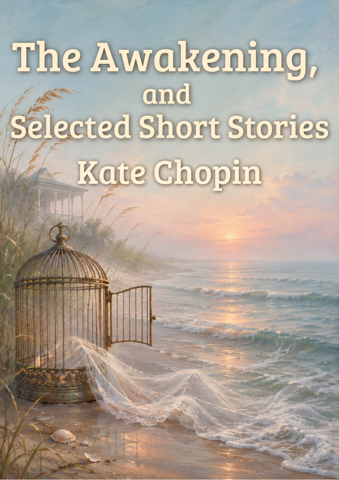
Background:
This collection joins Kate Chopin's 1899 novel The Awakening to eight short stories. The product identity therefore differs from a record containing the novel alone.
The central tension:
The novel follows Edna Pontellier as artistic desire, motherhood, marriage, sexuality, and social expectation become increasingly difficult to reconcile. The accompanying stories broaden the volume's treatment of gender, region, race, labor, and constrained choice.
How the writing works:
Free indirect discourse, recurring sea and music imagery, compressed scenes, regional speech, irony, and the contrast between a novel and shorter forms require the collection to be read as multiple works, not one continuous plot.
This volume should be approached as a collection, not as The Awakening with disposable extras. The novel follows Edna Pontellier's growing awareness that artistic desire, erotic feeling, motherhood, and social identity do not fit the life arranged for her. The eight stories then change the scale: brief encounters with race, class, labor, marriage, and regional custom show how many different lives are constrained by the same Louisiana social world.
Chopin's prose is controlled rather than declarative. Music, sea bathing, rooms, clothing, food, and changes in address register shifts that characters cannot always name. Free indirect discourse keeps readers close to Edna without converting every impulse into a program or slogan. In the stories, compressed endings often withhold moral reassurance and force a reconsideration of the apparently minor detail that opened the piece.
Readers should compare the novel with Beyond the Bayou, Désirée's Baby, A Respectable Woman, and The Storm rather than stopping at the title work. The collection reveals Chopin's range and also exposes the racial hierarchies that a purely celebratory account of female autonomy can overlook. Its value lies in the friction among the pieces, not in making them all illustrate one idea.
Edna's awakening is not a straight path from oppression to liberation. Music, swimming, solitude, desire, painting, and changes of residence give her glimpses of a self not exhausted by wifehood and motherhood, yet each experiment encounters material and emotional limits. Chopin stays close enough to Edna for the reader to feel expansion without requiring every impulse to become a political program. That distance preserves the novel's beauty and its discomfort.
The stories make the volume more demanding. Beyond the Bayou, Désirée's Baby, A Respectable Woman, and The Storm shift sympathy across racial hierarchy, marriage, labor, secrecy, and regional custom. Their compressed endings often refuse the verdict a reader expects. Read beside the novel, they prevent Edna's crisis from standing in for all women or all of Louisiana. The collection becomes a field of conflicting freedoms, showing that one person's escape may depend on conditions another person is never offered.
The volume is best opened without demanding that Edna become either heroine or warning. Chopin's precision lies in showing how liberation can be necessary, partial, selfish, courageous, and insufficient at once. The stories then rearrange those terms in miniature, often delivering their sharpest reversal in the final line or image. Readers who value economical prose and moral complexity will find that the collection expands after it ends: scenes that initially seemed graceful or simple return with new implications about who was free to choose and who absorbed the cost.
Director: Mary Lambert
Production country: United States
Cast: Kelly McGillis, Jon DeVries, Adrian Pasdar
Difference from the book: adapts The Awakening rather than the full collection, changes the title, and turns the novel's interior emphasis into a linear screen narrative.
This record contains The Awakening and eight stories. An edition containing the novel alone is a different product and should be identified as such.
The Awakening became central to feminist literary study, while the stories complicate any single account of Chopin by showing a wider range of voices and social positions.
Miva: the next reading experience beyond audiobooks
Listen like an audiobook, then ask anything, anytime.
Start Miva's narrationMiva does not just narrate. It keeps explaining based on what you ask.