Background:
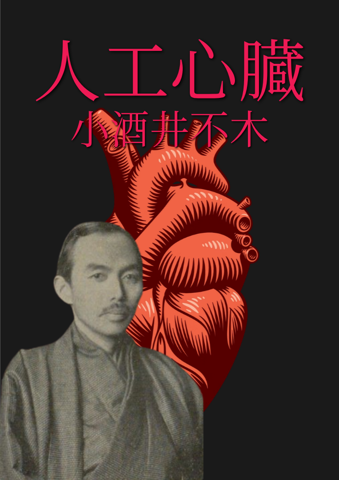
A piece in which Fuboku Kozakai, who was also a medical scientist, transferred the concept of reproducing life phenomena through machinery into detective and macabre fiction. Written at a time when artificial organs were still in the realm of experimental imagination, it simultaneously questions the boundaries between scientific progress and humanity. The Aozora Bunko work card records its first appearance in the January 1926 (Taisho 15) issue of 'Taishū Bungei' (Popular Arts).
Synopsis:
Physiologist Dr. A recounts the history of his artificial heart research to a newspaper reporter. His testimony, progressing from animal experiments to human applications, heightens expectations for life-saving technology while leading the reader to wonder if maintaining life is the same as preserving emotion. If the heart keeps beating, can a person remain the same human as before? The tension is sustained until the end by the question of what Dr. A's success might cause one to lose.
Literary Features:
The work combines a frame story told by a reporter with a long confession from the doctor, cultivating horror through scientific explanations. It is characterized by a structure that places technical terminology concretely while ultimately pivoting focus toward issues of ethics and emotion.
Elements of Note:
Using "medical fantasy, artificial organs, and macabre science" as entry points, we follow the moment where objects and locations turn into evidence, and the points where the title's first impression begins to diverge.
Reading Guide:
By tracking how the information at the beginning is rearranged through exposition, dialogue, and scene transitions, the omissions and structure of the short story become easier to see. Using rubi (phonetic glosses) and paragraph breaks as clues, readers can also observe the tempo of the prose.
There are currently no recorded adaptations in video format.
The included text is the Japanese XHTML version published by Aozora Bunko. The source text for the work card is recorded as 'Kaiki Tantei Shōsetsu Meisakusen 1: Kozakai Fuboku Shū' (Masterpieces of Macabre Detective Fiction Vol. 1: Fuboku Kozakai Collection), published by Chikuma Bunko, Chikuma Shobo. This edition, which preserves rubi, paragraphing, and historical kana usage, is suitable for experiencing the unique style of this work, which combines a frame story with a long confession to cultivate horror through scientific explanation. The effect of the introduction—where Dr. A discusses the transition from animal experiments to human application—is best conveyed when read in a text that maintains the original paragraph breaks and narrative tone. Since the original magazine appearance and the later source text are different materials, it is best to navigate between the work card and the text without confusing the publication eras. As far as can be confirmed, there is no standardized translation that accounts for translator, publisher, publication year, and complete vs. abridged status; when choosing versions in other languages, priority should be given to those that clearly state the translator and source text.
This work clearly demonstrates Fuboku's specialty in linking medical knowledge to mystery and the macabre. Rather than treating pathology or experimentation as mere props, it reads as a story that converges the question of what it means to be "alive" into its conclusion. Kozakai, as a medical scientist, explored the boundaries of humanity and progress during an era when artificial organs were purely speculative. The method used here—using scientific explanation as a gateway to horror—serves as a clue to distinguish how the author handles similar themes in other works. When comparing it to other stories by the same author, focusing on the narrator's scope of knowledge, the method of delaying explanations, and the distance between reality and fantasy will clarify the unique position of 'The Artificial Heart'.
Miva: the next reading experience beyond audiobooks
Listen like an audiobook, then ask anything, anytime.
Start Miva's narrationMiva does not just narrate. It keeps explaining based on what you ask.