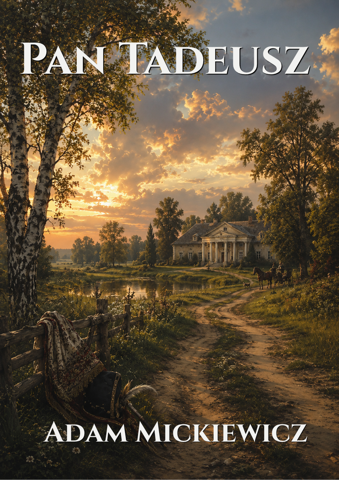
Poland's National Epic
One of the Last Great Epic Poems of European Romanticism
Its Manuscript Inscribed in UNESCO's Memory of the World Register
Adapted by Andrzej Wajda into a Monument of Polish Cinema
Written in exile. Dreamed from memory. A world preserved in verse before it vanished forever.
Published in 1834, Pan Tadeusz is not only Poland's national epic — it is one of the last great epic poems of European Romanticism. Adam Mickiewicz wrote it in exile in Paris, when Poland had long since disappeared from the map, divided between Russia, Prussia, and Austria. It was an act of longing made into literature: a recreation of noble estates, Lithuanian forests, feasts, hunts, and the vanishing world of the Polish-Lithuanian Commonwealth — a civilization that for the generation of exiles had become almost a myth.
The poem opens with one of the most recognizable lines in the history of Polish literature:
"Lithuania! My homeland! You are like health."
What Mickiewicz constructed was not merely a nostalgic idyll. It was an anatomy of a world on the edge of disappearance: feuding noble families, a young hero finding his place in a dying order, and beneath all the humor, nostalgia, and romance — the unspoken drama of a nation living under occupation. Even the descriptions of food became legendary, creating some of the most sensual culinary scenes in European literature. The true hero of the poem is not Tadeusz. It is the lost homeland itself.
"Pan Tadeusz is the last happy image of Poland." —Czesław Miłosz, Nobel Prize-winning poet
The reverberations of Pan Tadeusz have never ceased. The poem became required school reading across generations, was translated into dozens of languages, and its manuscript was added to UNESCO's Memory of the World register. In 1999, Andrzej Wajda brought it to the screen in a monumental adaptation — one of the greatest successes of Polish historical cinema. Its influence crossed borders: the opening of the Lithuanian national anthem is a conscious echo of Mickiewicz's invocation. Painters, composers, directors, and theater artists have drawn from it for nearly two centuries. Quotations from the poem have entered everyday language, and the work itself has shaped the image of old Poland more powerfully than any history book.
Pan Tadeusz is a poem about a country that no longer existed. It made that country impossible to forget.
Miva: the next reading experience beyond audiobooks
Listen like an audiobook, then ask anything, anytime.
Start Miva's narrationMiva does not just narrate. It keeps explaining based on what you ask.