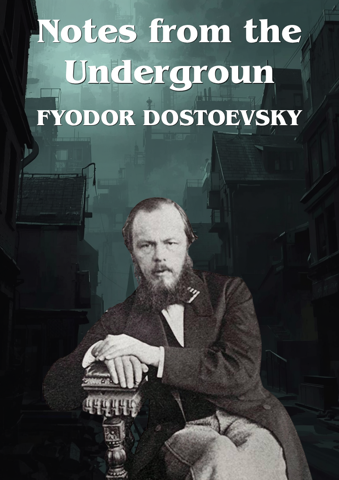
Notes from the Underground by Fyodor Dostoevsky is a seminal novella published in 1864. This profound confession-style narrative delves into the psyche of a bitter, isolated, and unnamed former civil servant residing in St. Petersburg, known only as the 'Underground Man.' Through a series of intense philosophical monologues and fragmented personal anecdotes, the protagonist launches a scathing critique against determinism, rational egoism, and the utopian ideals prevalent in 19th-century Russian society. He provocatively argues that human beings inherently crave suffering and irrationality as essential components for preserving their freedom and individuality. The narrative explores his obsessive rumination over past humiliations, his fraught social encounters, and his paradoxical embrace of spite and inaction, all while despising the very rational self-interest he believes has led to his profound unhappiness and alienation.
Reading ease score: 78.9 (7th grade). Fairly easy to read.
Fyodor Dostoevsky’s Notes from the Underground begins with the inner confessions of a retired forty-year-old civil servant living in St. Petersburg. Speaking directly to the reader from his bitter solitude, his "underground", the narrator introduces himself as an unlovely, diseased, and spiteful man who deliberately refuses medical treatment out of sheer malice. He delves deep into a critique of modern rationalism, targeting the idea that human nature can be perfected through logic, science, and self-interest. The narrator argues that hyper-consciousness leads to total paralysis. Unlike simple men of action, who charge forward when confronted with obstacles, the Underground Man is paralyzed by overthinking, trapped behind a "stone wall" of natural laws and mathematical certainty. Yet, he passionately defends the chaotic, irrational core of human existence. To him, man will never settle for being a mere key on a piano or a peg in a clockwork mechanism. If presented with a perfectly rational society, a mathematical paradise where every desire is calculated beforehand, human beings would deliberately choose destruction, madness, and suffering simply to assert their free will and prove that they are individual human beings rather than deterministic instruments. Moving beyond these abstract philosophy notes, the Underground Man recalls painful memories from his youth, illustrating how his hyper-conscious resentment bled into actual life. He remembers being driven by a volatile mix of intense self-loathing and arrogant pride. He obsessed over perceived slights, such as an officer who once brushed past him in a tavern without acknowledging him, leading to years of plotting a petty, calculated revenge. His social isolation reached a crisis during a farewell dinner for an acquaintance named Zverkov. Although the narrator hated his former schoolmates, he forced his way into their gathering, craving both their acceptance and the opportunity to assert his superiority. Instead, he spent the evening getting drunk, pacing back and forth in silence while they ignored him, and ultimately alienating everyone with insults. When the group left for a brothel, the narrator pursued them, determined to demand an apology or provoke a duel to reclaim his wounded dignity. Upon arriving at the brothel, he found his acquaintances gone and instead met Liza, a young, vulnerable prostitute. Attempting to exercise power and salvage his shattered ego, he launched into emotional, dramatic speeches about her moral degradation, painting a horrifying picture of her inevitable demise if she remained in her current life. Touched by his passionate words, Liza wept and showed him a sentimental letter from a young man who truly loved her, demonstrating her deep desire for redemption. The narrator, caught in his own theatrics, impulsively invited her to his impoverished apartment before leaving. Days later, Liza arrived at his dismal room. Ashamed of his poverty, his dirty clothes, and his abusive treatment of his servant, the Underground Man flew into a rage. He cruelly admitted that his speeches at the brothel were merely a bid for power over her. Yet Liza, recognizing his intense internal agony, responded not with anger, but with compassion, embracing and weeping with him. Uncapable of accepting true love or emotional vulnerability, since to him loving meant tyrannizing, he humiliated her once more by thrusting money into her hand as she left. Realizing his cruelty, he ran out into the snow after her, but she had thrown the money away and vanished forever into the night. Left alone with his overwhelming shame, the Underground Man returns to his dark corner, reflecting that his extreme alienation is merely an exaggerated version of the detachment from real life that plagues modern society. Tired of writing, he attempts to stop his notes, though his restless self-analysis continues indefinitely in the dark.
I am a sick man.... I am a spiteful man. I am an unattractive man. I believe my liver is diseased. However, I know nothing at all about my disease, and do not know for certain what ails me. I don’t consult a doctor for it, and never have, though I have a respect for medicine and doctors. Besides, I am extremely superstitious, sufficiently so to respect medicine, anyway (I am well-educated enough not to be superstitious, but I am superstitious). No, I refuse to consult a doctor from spite. That you probably will not understand. Well, I understand it, though. Of course, I can’t explain who it is precisely that I am mortifying in this case by my spite: I am perfectly well aware that I cannot “pay out” the doctors by not consulting them; I know better than anyone that by all this I am only injuring myself and no one else. But still, if I don’t consult a doctor it is from spite. My liver is bad, well—let it get worse!Notes from the Underground Part I, Chapter 1. This iconic opening immediately establishes the narrator's paradoxical mind and sets up the novella's central psychological exploration of human perversity and rebellion against rational self-interest.
Merciful Heavens! but what do I care for the laws of nature and arithmetic, when, for some reason I dislike those laws and the fact that twice two makes four? Of course I cannot break through the wall by battering my head against it if I really have not the strength to knock it down, but I am not going to be reconciled to it simply because it is a stone wall and I have not the strength.Notes from the Underground Part I, Chapter 3. It serves as the defining philosophical manifesto of the work, illustrating the human impulse to reject absolute logic and mechanical determinism even when facing impossible odds.
If you say that all this, too, can be calculated and tabulated—chaos and darkness and curses, so that the mere possibility of calculating it all beforehand would stop it all, and reason would reassert itself, then man would purposely go mad in order to be rid of reason and gain his point! I believe in it, I answer for it, for the whole work of man really seems to consist in nothing but proving to himself every minute that he is a man and not a piano-key!Notes from the Underground Part I, Chapter 8. It captures the core thesis of the novella, that free will is humanity's ultimate value, and that individuals will resist becoming mere instruments or "piano-keys" of nature at any cost.
In the first place, by then I was incapable of love, for I repeat, with me loving meant tyrannising and showing my moral superiority. I have never in my life been able to imagine any other sort of love, and have nowadays come to the point of sometimes thinking that love really consists in the right—freely given by the beloved object—to tyrannise over her.Notes from the Underground Part II, Chapter 10. This excerpt exposes the devastating practical consequences of the Underground Man's philosophy on a human level, transforming self-consciousness into tragic emotional alienation and cruelty.
While the novella is relatively short, it presents distinct stylistic challenges depending on the section. The opening part consists of dense, frantic philosophical monologues where the Underground Man rapidly shifts between self-deprecation, intense spite, and complex arguments against nineteenth-century rationalism. Following these tangled thoughts requires focused attention, as the narrator deliberately contradicts himself to confuse the reader. The second part transitions into a more conventional narrative format detailing the narrator's past social blunders and encounters in St. Petersburg. Readers generally find the second section easier to follow, though the emotional intensity and psychological cruelty remain demanding throughout the entire text.
Fyodor Dostoevsky's 1864 novella is widely recognized as one of the very first works of existentialist literature. It broke away from traditional nineteenth-century literary tropes by introducing a deeply unlikable, morally ambiguous antihero whose internal contradictions mirror the anxieties of modern life. By attacking the notion that human nature can be perfected through science, logic, and rational self-interest, the text anticipated major twentieth-century philosophical movements. Its brilliant psychological depth, exploration of alienation, and uncompromising look at the darker aspects of human agency ensure its enduring relevance in world literature.
The character is not a direct portrait of a historical individual, but rather a literary response to the radical intellectuals of 1860s Russia, particularly figures like Nikolai Chernyshevsky. Chernyshevsky advocated for rational egoism and the idea that human beings would naturally do good if taught what was logically beneficial. Dostoevsky created the Underground Man as a dramatic caricature to demonstrate the flaw in this theory: the fact that human beings frequently act against their own self-interest out of sheer spite and the desire to preserve personal agency.
The Underground Man's cruelty toward Liza stems from his deep-seated feelings of shame and powerlessness. Having been thoroughly humiliated by his former schoolmates at the dinner party, he uses Liza at the brothel to restore his shattered ego by preaching to her about her tragic future. When she later visits his dismal apartment and witnesses his real poverty and distress, he feels completely exposed. Because he views every relationship as a struggle between master and servant, he reacts to her genuine compassion with hostility, unable to tolerate her seeing him in a vulnerable state.
The Crystal Palace, originally built in London for the Great Exhibition of 1851, serves in the text as a symbol of technological progress, rationalism, and utopian socialism. Chernyshevsky and other thinkers saw it as a model for a perfectly organized, harmonious society. For the Underground Man, however, the Crystal Palace represents an unbearable prison of absolute predictability where every human decision is calculated beforehand, leaving no room for individual desire, choice, or error.
What waits at the end is not a comforting resolution or a sudden transformation, but a raw and unvarnished collision with the truth. As Liza steps into the Underground Man's bleak sanctuary, his intellectual posture crumbles, exposing the devastating distance between his grand philosophical theories and his capacity for real human connection. What follows is an intense psychological showdown where pride, shame, and the terror of vulnerability collide. The final pages force a bitter reckoning, revealing what happens when a mind consumed by spite is offered genuine grace, leaving an unforgettable portrait of a man forever trapped between his craving for freedom and his inability to endure love.
Miva: the next reading experience beyond audiobooks
Listen like an audiobook, then ask anything, anytime.
Start Miva's narrationMiva does not just narrate. It keeps explaining based on what you ask.