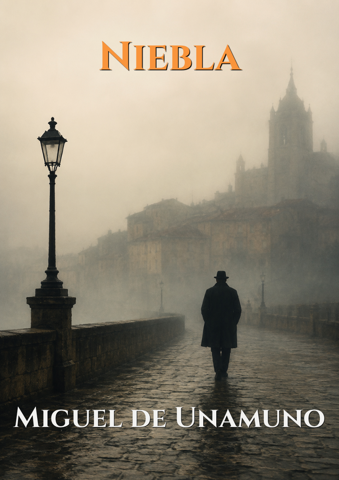
Published in 1914 and written by Miguel de Unamuno, Mist (Niebla) is one of the fundamental works of 20th-century Spanish literature and one of the most influential novels of the Generation of '98. However, Unamuno refused to define it as a traditional “novel” and created a new term for it: “nivola,” a literary form intended to break with the narrative structures of 19th-century realism and naturalism.
The work follows the life of Augusto Pérez, a wealthy, solitary, and introspective young man who, after a chance encounter with Eugenia in the street, becomes romantically obsessed with her. What appears to begin as a sentimental story ends up becoming a profound philosophical reflection on identity, existence, love, freedom, and death.
Augusto lives trapped in a constant internal mist. Unable to understand the meaning of his own life, he abandons himself to endless monologues and existential doubts. Eugenia, far from fully reciprocating his feelings, maintains a relationship with Mauricio, an unemployed and opportunistic man. Despite this, Augusto insists on winning her over, convinced that love can give meaning to his empty existence.
When Eugenia finally agrees to marry him, Augusto believes he has at last found a reason to live. But shortly before the wedding, he receives a letter in which Eugenia informs him that she has fled with Mauricio. Devastated, Augusto decides to commit suicide.
It is then that the work reaches one of the most revolutionary moments in modern literature: Augusto visits Miguel de Unamuno, the author of the book himself. During this metafictional conversation, Unamuno reveals to him that he is not a real person, but a fictional character created by him. Augusto rebels against his creator and poses one of the central questions of the novel: if a character can question their author, could human beings not also be the fictional creation of another superior being?
With this rupture between fiction and reality, Mist anticipated many of the techniques that would later be developed by existentialism, European modernism, and contemporary metafiction. The work is often linked to authors such as Luigi Pirandello, Jorge Luis Borges, or Jean-Paul Sartre for its exploration of consciousness, identity, and the illusory nature of reality.
The “mist” of the title symbolizes precisely the existential confusion of the human being: the inability to clearly distinguish the meaning of life, love, truth, or even one's own identity. Augusto moves in a blurred world where everything seems uncertain and provisional.
On a formal level, Unamuno deliberately breaks with the traditional novel. He reduces descriptions, eliminates much of the external realism, and privileges philosophical dialogue and introspection. He argued that works should emerge organically while being written, like living beings, instead of being constructed following rigid plans. For this reason, he defined the nivola as a “viviparous” work.
In addition to its aesthetic innovation, Mist is a work deeply marked by Unamuno's spiritual concerns: the fear of death, the search for immortality, the anguish in the face of non-existence, and the conflict between reason and faith. Augusto embodies many of the author's philosophical obsessions, especially the human need to find meaning even while knowing that all certainty is impossible.
Considered today one of the peaks of modern Spanish narrative, Mist remains an essential work for understanding the birth of the existential and metafictional novel in Europe.
Miva: the next reading experience beyond audiobooks
Listen like an audiobook, then ask anything, anytime.
Start Miva's narrationMiva does not just narrate. It keeps explaining based on what you ask.