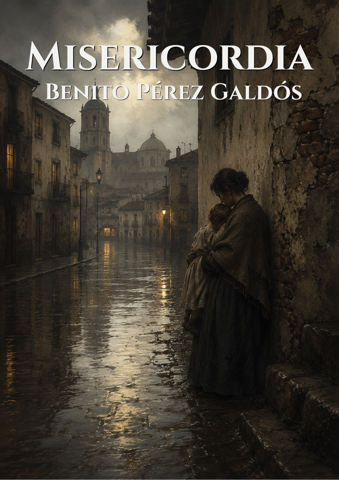
Published in 1897, Misericordia is considered one of Benito Pérez Galdós's final masterpieces and one of the most humane and devastating portraits of poverty in Spanish literature. Written during Galdós's spiritualist stage, the novel abandons some of the harsher naturalism of his earlier works to focus on compassion, dignity, and the moral survival of those living on the margins of society.
The story unfolds in the miserable Madrid of the late 19th century, far from the bourgeois salons and the apparent progress of the Spanish capital. Its protagonist is Benina—known as Nina—an elderly and impoverished maid working for Doña Paca, a ruined woman attempting to maintain the appearances of a social position long lost. While the mistress lives obsessed with prestige and the illusion of respectability, Benina silently sacrifices herself to feed her, even resorting to begging and hiding the true source of the money she brings home.
The emotional core of the novel arises precisely from this contradiction: the socially inferior person possesses an enormous moral grandeur, while those who still retain remnants of privilege live trapped in hypocrisy, selfishness, and self-deception. Galdós thus inverts the traditional hierarchy of Spanish society, turning a beggar into the noblest figure in the entire story.
One of the most memorable characters is Almudena, a blind Moroccan beggar in love with Benina, whose presence introduces an almost mystical and symbolic element within Galdovian realism. The relationship between the two blends tenderness, misery, religious faith, and despair, showing how even in extreme poverty, affection and hope still survive.
Although Misericordia portrays hunger, disease, and decay, the novel does not fall into absolute pessimism. Galdós uses irony, popular humor, and enormous sensitivity to show the humanity of characters society considers invisible. The true theme of the work is not solely material poverty, but mercy as a form of moral resistance against an indifferent world.
The novel also serves as a social and religious critique. Galdós questions a society obsessed with appearances and denounces the failure of institutions to protect the most vulnerable. However, unlike other more combative works like Doña Perfecta or Electra, here the critique arises from compassion rather than direct ideological confrontation.
In literary terms, Misericordia represents a culmination of the Galdovian style. The dialogues precisely reproduce the popular speech of Madrid; the characters possess extraordinary psychological complexity; and Madrid is portrayed as a living organism full of social, spiritual, and human contrasts. The novel combines realism, spirituality, satire, and tenderness in a way that anticipates much of the social narrative of the 20th century.
Over time, Misericordia has come to be considered one of the most important novels of modern Spanish literature. Critics and Hispanists see it as a perfect synthesis of Galdós's artistic evolution: from social realism to moral humanism. The figure of Benina remains one of the most admired female characters in all Spanish-language narrative.
Misericordia, written by Benito Pérez Galdós, tells the story of Benina, a humble and self-sacrificing servant, and her struggle to support her impoverished mistress, Doña Francisca "Paca" Juárez de Zapata. Doña Paca, a widow from Ronda, once lived an opulent life in Madrid. However, due to financial mismanagement, her husband's early death, and her family's squandering habits, she has fallen into deep poverty alongside her adult children, Antonio and Obdulia. To keep the household fed and prevent her mistress from facing total humiliation, Benina resort to secret sacrifices. When her savings are exhausted, she turns to begging outside the Church of San Sebastián. To protect Doña Paca’s pride, Benina fabricates an elaborate lie, claiming she works for a wealthy priest named Don Romualdo, who provides her with food and wages. During her daily rounds as a beggar, Benina forms a deep bond with Almudena, a blind Muslim mendicant from Morocco, and show immense compassion to other marginalized figures in Madrid's underworld, including the ruined nobleman Frasquito Ponte. Despite Benina’s heroic efforts, the household's poverty worsens. While begging in forbidden areas of the city to support her mistress and care for the destitute, Benina is arrested by the police alongside Almudena and detained in the San Bernardino Municipal Asylum. During Benina's forced absence, a shocking turn of events occurs: a real priest named Don Romualdo actually appears, bringing news of a substantial inheritance left to Doña Paca's family by a deceased relative. Miraculously rescued from ruin, Doña Paca and her children move into a luxurious new home and hire new servants, managed strictly by Antonio’s authoritarian, class-conscious wife, Juliana. When Benina is finally released from the asylum and returns with the ailing Almudena, expecting to share in the family's joy, she is met with cold ingratitude. Doña Paca, swayed by Juliana’s concern for social appearance and bourgeois respectability, refuses to let Benina live in the new house, offering her only a meager allowance and turning her away at the door. Frasquito Ponte indignantly defends Benina's saintly character against the family's hypocritical slander, but he suffers a fatal stroke during the argument. Undeterred by the family's bitter betrayal, Benina quietly accepts her fate without resentment. She moves into a humble room in the slums with Almudena, dedicating herself fully to nursing the sick blind man and planning for their future. Months later, Juliana's life in the wealthy home is consumed by severe psychological torment and obsessive anxiety, fearing that her young twin children are deathly ill. Desperate and driven by overwhelming guilt, Juliana seeks out Benina in the slums, begging for her forgiveness and spiritual intervention. Exhibiting supreme, Christlike mercy and moral transcendence, Benina absolves Juliana, assuring her with absolute conviction that her children are healthy and robust, and instructs her simply to go home and sin no more.
I would gladly take you back here again; but we don't fit in the house, and we are very uncomfortable here... You know I love you, that I like your company more than anyone's... but... you see... Tomorrow we'll be moving, and a spot will be made for you in the new house... What do you say?Original: Yo de buena gana te recibiría otra vez aquí; pero no cabemos en casa, y estamos aquí muy incómodas... Ya sabes que te quiero, que tu compañía me agrada más que ninguna... pero... ya ves... Mañana estaremos de mudanza, y se te hará un hueco en la nueva casa... ¿Qué dices?Misericordia Final Rejection Scene. It captures the peak of emotional cruelty and class hypocrisy in the novel, contrasting Doña Paca's shallow excuses and lingering affection with her complete abandonment of the woman who saved her from starvation.
Dressed as a poor woman she has begged for alms to support you ladies and me... and a woman who does that, I do not seduce, I cannot seduce her, I cannot make her fall in love... My beauty is human, and hers is divine; my splendid face is of mortal flesh, and hers of heavenly light... No, no, I have not seduced her, she has not been mine, she belongs to God...Original: Vestida de pobre ha pedido limosna para mantenerlas a ustedes y a mí... y a la mujer que eso hace, yo no la seduzco, yo no puedo seducirla, yo no puedo enamorarla... Mi hermosura es humana, y la de ella divina; mi rostro espléndido es de carne mortal, y el de ella de celeste luz... No, no, no la he seducido, no ha sido mía, es de Dios...Misericordia Franquito's Monologue. This impassioned defense encapsulates the novel's core spiritual thematic contrast between worldly vanity and Benina's saintly, divine selflessness.
The situation became so extremely distressing one day that the heroic old woman, tired of looking to heaven and earth to see if help would unexpectedly fall, having lost her credit in the shops, with all paths closed, saw no other resource to continue the struggle than to swallow her pride and go out to beg for alms.Original: La situación llegó a ser un día tan extremadamente angustiosa, que la heroica anciana, cansada de mirar a cielo y tierra por si inopinadamente caía algún socorro, perdido el crédito en las tiendas, cerrados todos los caminos, no vio más arbitrio para continuar la lucha que poner su cara en vergüenza saliendo a pedir limosna.Misericordia Early Chapter Narrative. This passage marks the decisive turning point in the novel where Benina steps into her role as a humble mendicant, establishing her willingness to sacrifice her own dignity entirely for the survival of those she loves.
I tell you that your children are not going to die, that your children are healthy and robust.Original: Yo te digo que tus niños no se mueren, que tus hijos están sanos y robustos.Misericordia Concluding Chapter Dialogue. Serving as the emotional climax of the work, Benina displays christlike forgiveness and absolute spiritual transcendence, dispensing true mercy without holding any resentment for her past mistreatment.
The work is accessible in terms of its core narrative drive and vivid characterization, but modern readers may find certain stylistic elements challenging. Benito Pérez Galdós writes in the rich, detailed style of nineteenth-century European realism, incorporating extended descriptions of Madrid's streets, churches, and slums. Additionally, the dialogue features authentic Madrid street slang, nineteenth-century colloquialisms, and regional dialects, such as Almudena's unique blend of Spanish and Arabic phrasing. Reading a translated edition with helpful explanatory footnotes can greatly ease the experience, allowing readers to fully appreciate the dramatic tension and deep human empathy without getting lost in historical terminology.
Benito Pérez Galdós's novel is celebrated as a masterpiece because it marks the peak of his spiritual realism, blending sharp social critique with profound psychological insight. Writing at a time when Spain was grappling with social decay and institutional corruption, Galdós created a compelling portrait of urban poverty that avoided sentimental preachy tones. Benina is widely regarded as one of the most memorable creations in Spanish fiction, representing a secular saint whose genuine morality exposes the hypocrisy of respectable society. The book's brilliant narrative structure, its memorable cast of street figures, and its timeless exploration of compassion secure its place in world literature.
The conclusion of the narrative brings a dramatic redistribution of moral authority, shifting focus from material luck to spiritual grace. When the long standing central conflict reaches its peak at the doorway of a new household, the bond between master and servant undergoes a permanent rupture driven by social pride. As the final pages unfold, two opposing worlds collide: the polished, self-serving respectability of Madrid’s rising class and the quiet, radiant dignity of a servant who has given up everything. Readers will witness an unforgettable encounter in the slums, where a single act of supreme mercy answers the bitterest betrayal, leaving a transcendent truth that resonates long after the final page is turned.
The title translates directly to mercy or compassion, which serves as the emotional and philosophical foundation of the entire novel. Rather than describing institutional charity, the title points to the active, unselfish love embodied by Benina throughout her daily trials. It highlights the sharp contrast between empty societal pity and genuine personal sacrifice, showing how real mercy requires stepping into the suffering of others without expecting reward or recognition.
Galdós provides an uncompromising, highly detailed portrait of Madrid that spans its entire social spectrum, from elegant parlors to filthy slums. He mapped real streets, parish churches like San Sebastián, municipal asylums, and impoverished neighborhoods to create an immersive setting. The city acts as an active character in the story, illustrating how urban poverty forces honorable people into desperate choices while high society remains blind to their struggles.
While Benina is a fictional creation designed for Galdós's realist framework, her character draws heavy inspiration from Christlike archetypes and secular humanism. Galdós deliberately crafted her to reflect true sanctity existing outside traditional church institutions, finding holiness in an impoverished servant rather than high ranking clergy. Her character reflects Galdós's conviction that genuine spiritual greatness operates quietly within the most overlooked corners of society.
Miva: the next reading experience beyond audiobooks
Listen like an audiobook, then ask anything, anytime.
Start Miva's narrationMiva does not just narrate. It keeps explaining based on what you ask.