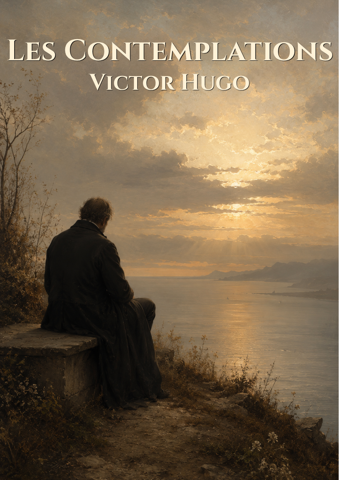
Les Contemplations is one of Victor Hugo’s greatest poetic collections and a major work of French Romanticism. Published in 1856 during the writer's exile, the collection gathers 156 poems written between 1830 and 1855. Through these texts, Hugo transforms his own life into poetic material, making Les Contemplations a deeply autobiographical, spiritual, and meditative work.
The collection holds an essential place in Victor Hugo's career, marking a significant evolution in his poetry. While his early collections were primarily lyrical or political, Les Contemplations became an intimate exploration of memory, love, mourning, faith, and human destiny. Hugo himself presented the work as "the memoirs of a soul." The book thus appears as the poetic narrative of an entire existence, moving through youth, romantic happiness, suffering, loss, and the search for the meaning of life.
The central event that profoundly structures the work is the tragic death of Léopoldine Hugo, the poet's daughter, who drowned in the Seine with her husband in September 1843. This drama irreversibly shattered Victor Hugo and entirely transformed his poetry. Les Contemplations then became not only a book of memories but also a work of mourning and an attempt at dialogue with the dead.
The collection is divided into two major parts: Autrefois (Formerly) and Aujourd’hui (Today). This separation follows not only a chronological logic but, above all, the internal and psychological evolution of the poet. The first part, Autrefois (1830-1843), represents the time of happiness, youth, and hope. The second, Aujourd’hui (1843-1855), begins after Léopoldine's death and corresponds to the time of suffering, meditation, and spiritual quest.
In Autrefois, Hugo evokes his memories of youth, his first loves, his literary beginnings, and the happy moments of his family life. The book Aurore (Dawn) is that of beginnings: the poet speaks of his childhood, his dreams, and the discovery of the world. L’âme en fleur (The Soul in Flower) then celebrates love, notably his relationship with Juliette Drouet, a woman who occupied an essential place in his life. Hugo develops an intimate and luminous poetry where love is constantly mingled with nature. Landscapes, gardens, trees, rivers, and seasons become reflections of romantic emotions. Finally, Les luttes et les rêves (Struggles and Dreams) gradually opens Hugo's poetry to broader concerns: human misery, the suffering of the people, and social reflection.
But it is especially in the second part of the collection that the work reaches its most heartbreaking depth. After Léopoldine's death, Hugo's poetry changes tone radically. The book Pauca Meae constitutes the emotional heart of Les Contemplations. Through these poems, Hugo expresses his pain as a bereaved father and attempts to maintain a connection with his late daughter. Suffering is omnipresent, but it is always expressed with great simplicity. Hugo rejects the excesses of pathos, preferring a sober, internal, and universal emotion.
The most famous poem in the collection, Demain, dès l’aube… (Tomorrow, at dawn...), perfectly illustrates this poignant simplicity. Hugo describes the silent journey of a father going to pay his respects at his daughter's grave. The pain is never shouted; it appears through simple gestures, calm landscapes, and a deeply restrained tone. This sobriety gives the poem exceptional emotional power.
In the following books, En marche (On the Move) and Au bord de l’infini (At the Edge of the Infinite), Hugo gradually seeks to move beyond personal suffering to reach a broader reflection on human existence, God, and the universe. The poet turns toward a form of mysticism. He develops a spiritual vision where nature becomes a sacred language and where the poet appears as an intermediary between the visible and invisible worlds.
This mystical dimension was strongly influenced by the spiritual experiences Hugo lived through during his exile, notably the famous séances (turning tables) organized in Jersey with his family. These experiences reinforced his belief in the existence of spirits, the immortality of the soul, and the possibility of communication with the afterlife. In certain poems, specters, voices, and supernatural revelations thus appear to the poet.
For Hugo, contemplation consists precisely of looking at the visible world in order to discover a hidden truth. Nature then becomes a vast symbolic book that the poet must decipher. The sky, the sea, the stars, the trees, and the light take on spiritual and philosophical value. This conception aligns with the Romantic idea of the poet-seer: Hugo considers that poetry possesses an almost sacred dimension and that the poet is charged with transmitting higher truths to humanity.
The style of Les Contemplations is characterized by great lyrical richness but also by a surprising simplicity. Hugo uses a musical, fluid, and accessible language, capable of shifting from the intimate to the grandiose. Images of nature play an essential role, as do the contrasts between light and shadow, hope and despair, life and death. The collection thus alternates between moments of serenity and metaphysical anxieties.
Memory also plays a fundamental role in the work. Hugo attempts to bring past moments back to life through poetic remembrance. However, these memories often appear in fragmentary form: a few gestures, a voice, a look, or a landscape are enough to revive an entire vanished world. Poetry then becomes a means of fighting against oblivion and against death itself.
Beyond personal mourning, Les Contemplations acquires a universal scope. Hugo transforms his own suffering into a reflection on the human condition. The pain of a father becomes that of all people faced with loss, time, and the fragility of existence. It is this universality that explains the immense emotion the collection has sparked since its publication.
Today, Les Contemplations is considered one of the pinnacles of French poetry. The work brings together all dimensions of Hugo's genius: romantic lyricism, philosophical meditation, spirituality, visionary power, and human commitment. Through this book, Victor Hugo transforms his personal experience into a deeply human and timeless work, where pain gradually gives way to hope.
Miva: the next reading experience beyond audiobooks
Listen like an audiobook, then ask anything, anytime.
Start Miva's narrationMiva does not just narrate. It keeps explaining based on what you ask.