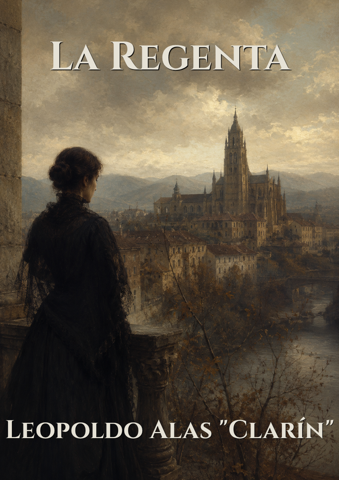
La Regenta (1884–1885) is the masterpiece of Leopoldo Alas “Clarín” and one of the fundamental novels of 19th-century Spanish literature. Set in the fictional city of Vetusta—a transparent stand-in for Oviedo—the novel offers a ruthless portrait of provincial Spanish society during the Restoration.
The protagonist is Ana Ozores, known as “La Regenta” because she was the wife of the former regent of the Court, Víctor Quintanar. Ana is a young, sensitive, and intelligent woman trapped in an unequal marriage with a man much older than her, who is kind but incapable of understanding her emotional and spiritual needs.
Feeling lonely and emotionally empty, Ana becomes the object of desire for two very different men: Álvaro Mesía, an arrogant seducer and symbol of bourgeois superficiality; and Fermín de Pas, the cathedral canon and Ana's confessor, whose repressed passion mixes desire, ambition, and spiritual obsession.
From this triangle, Clarín builds one of the most complex psychological explorations in Spanish literature. The novel is not limited to narrating adultery; it examines social hypocrisy, religious repression, clerical power, female frustration, and the moral corruption of provincial society.
Vetusta appears as another character in the work: a suffocating, conservative, stagnant city full of gossip, where everyone watches and judges everyone else. Clarín portrays this environment with fierce irony and an extraordinary level of detail. The city symbolizes the moral decay, cultural backwardness, and hypocrisy of Restoration Spain.
Ana Ozores represents the conflict between the spiritual ideal and social reality. She seeks purity, love, and transcendence, but is gradually destroyed by desire, social pressure, and emotional isolation. Her tragedy recalls heroines such as Emma Bovary or Anna Karenina, although Ana possesses a more introspective and spiritual dimension.
One of the most innovative elements of La Regenta is its narrative technique. Clarín uses interior monologues, free indirect style, and shifts in perspective to show the intimate consciousness of the characters. These techniques make the novel a work ahead of its time and a precursor to modern European narrative.
The character of Fermín de Pas is especially important. He is not simply a hypocritical priest, but a complex figure in whom political ambition, sexual desire, pride, and the need for control are mixed. Through him, Clarín criticizes the power of clericalism in Spanish society without reducing the character to a caricature.
When it appeared, the novel was harshly attacked by religious and conservative sectors, who considered it obscene and irreligious. For decades it remained relatively forgotten, until in the 20th century it was recognized as one of the great European novels of Realism.
La Regenta has been adapted for film, television, and theater. The 1995 television series helped bring the work to new generations. More recently, the figure of Ana Ozores has inspired contemporary reinterpretations, such as La Rexenta contra Drácula (2022), which transforms the heroine into a fantasy character within a novel written in Asturian.
Today, La Regenta is considered one of the peaks of Spanish literature: a monumental work about desire, religion, loneliness, and the destruction of the individual within a hypocritical and oppressive society.
Miva: the next reading experience beyond audiobooks
Listen like an audiobook, then ask anything, anytime.
Start Miva's narrationMiva does not just narrate. It keeps explaining based on what you ask.