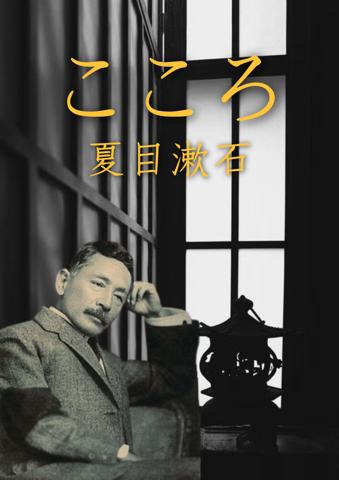
Background: Kokoro is one of Natsume Soseki's most important late-period novels. It was first serialized in the Asahi Shimbun in 1914 and later published by Iwanami Shoten. The story begins when a young student meets a mysterious man he calls "Sensei" in Kamakura. The two gradually build a relationship that is part mentorship and part friendship; however, Sensei always seems trapped by an invisible past, living a quiet life with his wife while making monthly visits to the Zoshigaya Cemetery. The second half of the novel reveals a past entangled with friendship, love, betrayal, and guilt through a long letter left by Sensei. Historical events such as the death of Emperor Meiji and the ritual suicide of General Nogi make this work more than a private tragedy; it is a confession of a generation of intellectuals facing their own ethical dilemmas as the spirit of the Meiji era comes to an end.
Literary Features: The book is divided into three parts: "Sensei and I," "My Parents and I," and "Sensei and His Testament." The narrative moves step-by-step from external observation into the depths of the heart. Soseki does not rely on dramatic events to win over the reader; instead, he allows silence, cemeteries, letters, sickbeds, and late confessions to slowly accumulate pressure. The most unforgettable thing about Sensei is not any grand moralizing, but his inability to trust himself or be fully honest with those closest to him. The tone is restrained, yet it portrays loneliness as a long-term psychological state: one can live in a family, be respected by students, and be accompanied by a spouse, yet still be isolated by secrets.
Introduction: Reading Kokoro today easily brings to mind those harms and apologies between people that are difficult to voice. It is suitable for any reader who has ever felt guilt, hesitation, or a sense of being misunderstood in a relationship. The novel reminds us that what truly torments a person may not be the event itself, but the long self-trial that follows; it also makes readers reflect on whether understanding someone must wait until they are willing to leave a final letter. The student is initially attracted to Sensei's mysterious aura, only to discover later that Sensei's coldness is not arrogance, but a form of self-protection formed after years of carrying a secret. The relationship between Sensei and his wife appears stable, yet is separated by an unspoken past; his visits to K's grave cast a shadow even before the truth is revealed. The testament in the second half takes the story back to his youth, describing a subtle love triangle between Sensei, K, and the landlord's daughter, unfolding layers of jealousy in friendship, cowardice in love, and punishment in self-reproach. This story can be entered without profound literary knowledge; simply by following the characters' choices, hesitations, and silences, one can feel the work slowly pushing a human condition right before one's eyes.
"Kokoro" by Natsume Soseki opens with a young university student, the narrator, who meets an older, intellectual man he respectfully calls "Sensei" at a beach in Kamakura. Drawn to Sensei’s profound wisdom and quiet solitude, the narrator becomes a frequent visitor to Sensei's Tokyo home. Despite their close bond, Sensei remains distant, harboring a dark melancholy and expressing a deep distrust of human nature. He warns the narrator that even good people can turn evil when money or self-interest is involved, hinting at a traumatic secret in his past. When the narrator completes his studies, he returns home to the countryside to care for his dying father. While there, news arrives of the Emperor’s death, accompanied by the ritual suicide of General Nogi, marking the end of the Meiji era. Amid his father's deteriorating health, the narrator receives a thick, urgent letter from Sensei. Realizing Sensei intends to take his own life, the narrator abandons his family's bedside and boards a train to Tokyo, reading Sensei’s testament along the way. The second half of the novel unveils Sensei’s long-kept secret through his letter. As a young student, Sensei was cheated out of his family inheritance by a trusted uncle. Dishonored and bitter, he moved into a Tokyo boarding house managed by a widow and her gentle daughter, Shizuko. Over time, Sensei fell deeply in love with Shizuko, finding solace in her presence. Seeking to help a childhood friend named K, a strict, devoted student of philosophy and religion who had been disowned by his family, Sensei invited K to live with them. Sensei hoped to soften K’s rigid, austere lifestyle. However, K eventually confided in Sensei that he, too, had fallen in love with Shizuko. Overwhelmed by jealousy and panic, Sensei chose betrayal over honesty. Using K’s own strict moral code against him, Sensei publicly mocked K for abandoning his spiritual ideals for romance, telling him that anyone lacking spiritual ambition was a fool. Shortly after, while K was trapped in agonizing doubt, Sensei secretly approached the widow and asked for Shizuko’s hand in marriage without telling K. When the engagement was announced, K calmly congratulated Sensei. But a few nights later, K committed suicide in his room, leaving behind a vague note that blamed his own weakness rather than Sensei’s deception. Though Sensei ultimately married Shizuko, the guilt of K’s death ruined his life. He felt he had betrayed his friend and become the very type of selfish creature he despised. Unable to confess the truth to his innocent wife, Sensei lived for years in isolation, visiting K's grave monthly in silent penance. Concluding that his life was bound to the dying Meiji era, Sensei decided to end his guilt through suicide, asking the narrator to keep his secret forever to protect his wife's memory.
I wish to reject present respect in order to spare myself future insult. Rather than endure a future me that is even more lonely than I am now, I would rather endure my lonely present self.Original: 私は未来の侮辱を受けないために、今の尊敬を斥けたいと思うのです。私は今より一層淋しい未来の私を我慢する代りに、淋しい今の私を我慢したいのです。Kokoro Chapter 2. It encapsulates Sensei's deep-seated isolation and distrust of human relationships, laying bare the central theme of modern existential solitude.
Born into a modern age overflowing with freedom, independence, and self-reliance, we must all taste this loneliness as the price we pay.Original: 自由と独立と己とに充ちた現代に生れた我々は、その犠牲としてみんなこの淋しみを味わわなくてはならないでしょうKokoro Chapter 2. It articulates Natsume Soseki's grander critique of Meiji-era modernization, linking individual emotional suffering to broader cultural transformations.
I began to suspect that he held folded deep within his heart the ultimate means to resolve, all at once, every single doubt, agony, and anguish.Original: すべての疑惑、煩悶、懊悩、を一度に解決する最後の手段を、彼は胸のなかに畳み込んでいるのではなかろうかと疑うたぐり始めたのです。Kokoro Chapter 44. It builds intense psychological suspense and foreshadows K's impending suicide, illustrating how misinterpretation and guilt haunt Sensei for the rest of his life.
While Kokoro addresses complex psychological, ethical, and philosophical themes, its prose style is remarkably accessible, restrained, and direct. Natsume Soseki avoids overly dense stylistic ornamentation, relying instead on clear character interactions, quiet emotional buildup, and a structured three-part narrative. The primary challenge for modern readers lies not in complex vocabulary, but in navigating the emotional weight of its themes, such as isolation, unspoken guilt, and the subtle cultural dynamics of late Meiji Japan.
Kokoro holds a monumental place in modern literature because it captures the psychological burden of modern individualism with unmatched precision. Written as Japan transitioned into the modern age, the novel reflects the conflict between traditional communal values and modern self-interest. Soseki's profound exploration of human loneliness, moral fragility, and the invisible barriers between people transcends its historic setting, offering universal insights into the human condition that resonate across generations and cultures.
What waits at the end of Kokoro is a profound, unvarnished exposure of the human soul. As the student reads the final pages of Sensei’s testament, the distant mysteries of a quiet life collapse into a terrifyingly intimate confession. You will encounter the exact moment a fateful choice was spoken, the silent weight of a room after an irrevocable act, and the haunting realization of how a single secret can slowly consume decades of a man’s existence. It is an uncompromising look into jealousy, guilt, and the devastating price of self-preservation. Read these closing pages for yourself.
The Japanese word kokoro translates variably as "heart," "mind," "spirit," or "feeling," encompassing the entire inner emotional and spiritual life of a person. In Soseki's novel, the title refers directly to the hidden psychological depths, motives, and regrets that individuals carry beneath their public demeanor. It highlights the central mystery of the book: the impossibility of fully knowing another person's heart, as well as the burden of living with the secrets contained within one's own.
The historical backdrop of late 1912 serves as a pivotal structural and thematic element in the novel. The death of the Meiji Emperor and the subsequent ritual suicide of General Nogi mark the formal end of an era defined by rapid modernization, conflict, and shifting moral values. For Sensei, the conclusion of the Meiji era symbolizes the end of his own generation's worldview, providing the historical impetus for him to bring his long period of silent isolation to a definitive close.
Sensei's silence toward Shizuko is driven by a complex desire to protect her innocence and preserve her memory of the past. He believes that revealing his betrayal of K would destroy her peace of mind and taint her perception of their marriage. Consequently, Sensei chooses to carry the full weight of his guilt alone, preferring personal isolation over inflicting spiritual suffering on the person he loves, even though this secrecy maintains an insurmountable barrier between them.
Miva: the next reading experience beyond audiobooks
Listen like an audiobook, then ask anything, anytime.
Start Miva's narrationMiva does not just narrate. It keeps explaining based on what you ask.