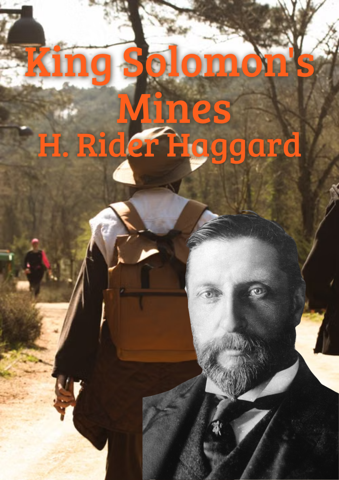
Background:
Published in 1885 during the late-Victorian expansion of British imperial adventure fiction, the novel frames African travel through commerce, mapping, firearms, mineral wealth, and colonial assumptions. Its excitement and technical detail therefore need to be read together with the racial hierarchy and extractive fantasy built into the expedition.
What kind of book is it?
Allan Quatermain joins Sir Henry Curtis and Captain Good on a search for a missing brother, following a dangerous route toward a hidden kingdom and its legendary mines. The journey turns survival, political conflict, and treasure seeking into tests of loyalty while never escaping the unequal worldview of its narrators.
Literary style:
Quatermain's retrospective first-person voice uses maps, practical observation, comic understatement, staged documents, and escalating ordeals to make an implausible journey feel reportorial. The same confident voice also exposes the limits of what the narrator understands about the people and lands he describes.
Reading focus:
A useful way into the novel is to watch how practical knowledge becomes authority. Quatermain reads tracks, water, weapons, bodies, and terrain, while the map promises that unfamiliar land can be converted into a route and eventually into property. Yet survival repeatedly depends on knowledge held by people whom the expedition's language places below its English travelers. That contradiction gives the adventure much of its energy and much of its historical difficulty. The novel also changes scale with unusual speed: hunger and thirst can matter as much as dynastic conflict, while a comic exchange may sit beside violence or mass spectacle. Readers should therefore notice not only what the expedition discovers, but who is permitted to interpret the discovery, whose motives remain opaque, and how treasure alters the moral vocabulary of rescue and loyalty. The hidden kingdom is not simply an exotic backdrop; it is a political society into which the travelers intervene. Reading the book in this way preserves the excitement of route finding and ordeal while making its imperial assumptions visible rather than treating them as neutral scenery.
Director: Compton Bennett and Andrew Marton/Production: United States
Principal cast: Stewart Granger, Deborah Kerr, Richard Carlson
Why this adaptation:
Stewart Granger and Deborah Kerr lead the best-known mid-century location production, whose shift from male expedition narrative to a rescue led by Elizabeth Curtis makes its adaptation strategy unusually visible.
One important difference:
moves the search into an African safari centered on Elizabeth Curtis and replaces much of the novel's hidden-kingdom politics with location adventure.
Edition focus:
Because the novel's effect depends on Quatermain's voice, maps, and staged documents, editions that retain the introduction and all twenty chapters best preserve its expedition structure.
Reading recommendation:
First-time readers may prefer an annotated edition that identifies the novel's southern African references and explains its imperial and racial vocabulary without silently modernizing it.
Cultural significance:
The book established Allan Quatermain and helped define the lost-world adventure. Its influence on popular archaeology and expedition fiction is substantial, but modern reading must also examine how its thrills depend on imperial possession, racial typing, and fantasies of unclaimed wealth.
Relationship between author and work:
It was Haggard's first major success and introduced Allan Quatermain, turning experiences and assumptions associated with southern Africa into the narrative machinery of a lost-world romance.
Miva: the next reading experience beyond audiobooks
Listen like an audiobook, then ask anything, anytime.
Start Miva's narrationMiva does not just narrate. It keeps explaining based on what you ask.