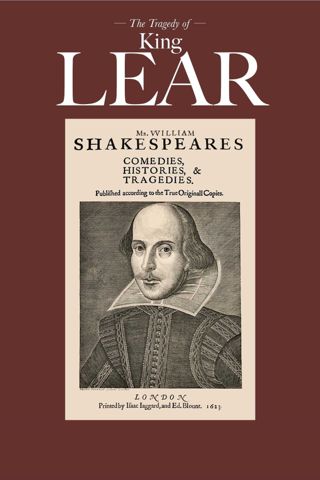
King Lear by William Shakespeare is a profound tragedy, believed to have been written between late 1605 and early 1606. The play is set in pre-Roman Britain and chronicles the titular King Lear's descent into madness after he decides to divide his kingdom among his three daughters based on their public declarations of love. When his youngest and most beloved daughter, Cordelia, refuses to engage in such flattery, Lear disinherits her, setting in motion a devastating chain of events. The narrative explores themes of betrayal, family conflict, power, justice, and the nature of suffering, culminating in tragic consequences for Lear and his kingdom. Renowned for its dark tone, complex poetic language, and deep psychological insight, King Lear is widely considered one of Shakespeare's greatest achievements and a cornerstone of world literature.
Reading ease score: 89.4 (6th grade). Easy to read.
King Lear, the aging monarch of Britain, resolves to step down from the throne and divide his kingdom among his three daughters: Goneril, Regan, and Cordelia. To determine their shares, he demands that each declare the depth of her love for him. Goneril and Regan shower their father with lavish, exaggerated flattery, securing rich portions of the realm. Cordelia, the youngest and Lear’s favorite, refuses to engage in hypocritical grandstanding, offering only an honest and quiet devotion. Enraged by her refusal to flatter him, Lear disowns Cordelia and banishes the loyal Earl of Kent for speaking out in her defense. The King of France, recognizing Cordelia’s true virtue, marries her despite her loss of dowry and lands. Parallel to the king’s folly, a dark conspiracy unfolds in the house of the Earl of Gloucester. His illegitimate son, Edmund, plots to usurp the inheritance of his legitimate brother, Edgar. Through forged letters and cunning manipulation, Edmund convinces Gloucester that Edgar is plotting parricide. Edgar is forced to flee into the wilderness, disguising himself as "Poor Tom," a mad beggar. Lear soon discovers the bitter consequences of his vanity. Stripped of his royal authority, he is systematically humiliated and stripped of his remaining retinue by Goneril and Regan. Coldly turned out into the wild, Lear wanders into a ferocious storm accompanied only by his loyal Fool and the disguised Kent. In the midst of the tempest, encountering the wild, naked Edgar as Poor Tom, Lear’s fragile mind breaks under the weight of his daughters' betrayal, plunging him into utter madness as he confronts the raw, unaccommodated nature of humanity. Gloucester, appalled by the mistreatment of his king, attempts to help Lear secretly. However, Edmund betray his father to Lear's enemies. Gloucester is captured by Cornwall and Regan, who brutally gouge out his eyes. Cornwall is slain in the struggle by a rebellious servant, but the blinded Gloucester is cast out to wander the countryside, where he is unknowingly guided and saved from despair by his disguised son, Edgar. Meanwhile, news of Lear’s plight reaches France. Cordelia returns to Britain at the head of a French army to rescue her father. The old king is reunited with Cordelia, regaining his sanity through her tender care and seeking her forgiveness. At the same time, a web of sinister political and romantic rivalry tightens: both Goneril and Regan fall in love with the ambitious Edmund. The French forces are defeated in the ensuing battle, and Lear and Cordelia are taken prisoner. Edmund secretly orders the execution of Cordelia in prison, intending to frame her death as suicide. However, the conspirators' plot unravels rapidly. Edgar reveals his identity and mortally wounds Edmund in a trial by combat, while Goneril poisons Regan out of jealousy and subsequently takes her own life when her treasonous letters are exposed. Though Edmund attempts to revoke his death sentence on Cordelia as he lies dying, the mercy arrives too late. Lear enters carrying the dead body of Cordelia in his arms, weeping uncontrollably. Overwhelmed by grief and anguish over the senseless loss of his faithful daughter, Lear’s heart breaks, and he dies beside her. Albany assumes control of the shattered state, inviting Edgar and Kent to help rule; Kent declines, preparing to follow his master into death, leaving Edgar and the survivors to mourn the catastrophic ruin wrought by pride, deceit, and misplaced trust.
The Vines of France, and Milke of Burgundie,King Lear Act 1. This iconic exchange establishes the inciting tragedy of the play, contrasting Cordelia's uncompromising honesty with her sisters' manipulative flattery and introducing the central motif of nothingness.
Who looses, and who wins; who's in, who's out;King Lear Act 5. The passage illustrates Lear's spiritual transformation, showing how he now rejects worldly political intrigue in favor of transcendent love and intimacy with Cordelia, finding freedom even within prison walls.
Bast. He hath Commission from thy Wife and me,King Lear Act 5. This visceral entrance represents the horrific climax of the tragedy, capturing the ultimate breaking point of human suffering through Lear's primal howl of grief against an indifferent world.
It is a chance which do's redeeme all sorrowesKing Lear Act 5. This heartbreaking final reflection encapsulates the tender tragedy of parent-child devotion alongside the brutal permanence of death, contrasting Lear's rage against his foes with his gentle memory of Cordelia.
Readers often find King Lear challenging due to its poetic Jacobean phrasing, dense metaphorical language, and intricate double plot. Because the story moves between high courtly speeches, wild madness on the heath, and the fragmented babbling of disguised characters, tracking the emotional shifts requires concentration. However, the core narrative structure remains exceptionally clear and accessible. The primary plot of a father misjudging his children runs parallel to a secondary family crisis, making the narrative parallels straightforward to follow even when the poetic text becomes complex. Modern readers benefit greatly from dynamic performance recordings or annotated editions, which help clarify early seventeenth century vocabulary and structural transitions.
King Lear stands as an enduring masterpiece because it strips away political structures to examine human vulnerability, suffering, and mortality at their most fundamental levels. Rather than offering comfortable moral resolution, the work fearlessly investigates what happens when social order dissolves and human beings are forced to confront absolute loss. Shakespeare combines formal poetic mastery with profound psychological insight, creating characters whose emotional breakdowns feel startlingly raw across centuries. The narrative explores universal themes of family conflict, age, authority, and reconciliation, making it a timeless reference point for literature, philosophy, and theatrical adaptation globally.
Everything the drama has built toward converges in a final sequence of conflict, political unraveling, and profound confrontation on the battlefield. Who survives the collapse of power, which brother triumphs in the trial by combat, and what final burden the broken king must carry are exactly the payoffs worth meeting in the original text. Rather than providing a neat restoration of harmony, the closing moments deliver an unforgettable exploration of human grief, love, and quiet endurance that leaves a lasting impression on anyone who encounters it.
The storm sequence serves as the dramatic and thematic focal point of the entire work, mirroring Lear's internal mental breakdown through chaotic natural forces. Exposed to rain and thunder, the king sheds his royal vanity and realizes the extreme vulnerability of ordinary human beings who lack shelter and power. Encountering Edgar in disguise forces Lear to contemplate human nature stripped of social status, turning his literal displacement into a deep philosophical awakening regarding justice and compassion.
Lear banishes Cordelia because his immense vanity demands public validation and grand declarations of love to justify dividing his kingdom. Cordelia's insistence on quiet, honest affection directly challenges his need for courtly flatteries and public ego satisfaction. Viewing her refusal as public insolence rather than genuine devotion, Lear reacts out of injured pride, setting the tragic consequences of his reign in motion.
The Fool operates as a truth-teller who uses wit, riddles, and songs to comment on Lear's disastrous choices without facing immediate execution. He is the only character capable of speaking bluntly to the king about his foolishness regarding Goneril and Regan. Beyond comic relief, the Fool serves as Lear's conscience and intellectual companion during his descent into madness on the heath before vanishing from the action.
Miva: the next reading experience beyond audiobooks
Listen like an audiobook, then ask anything, anytime.
Start Miva's narrationMiva does not just narrate. It keeps explaining based on what you ask.