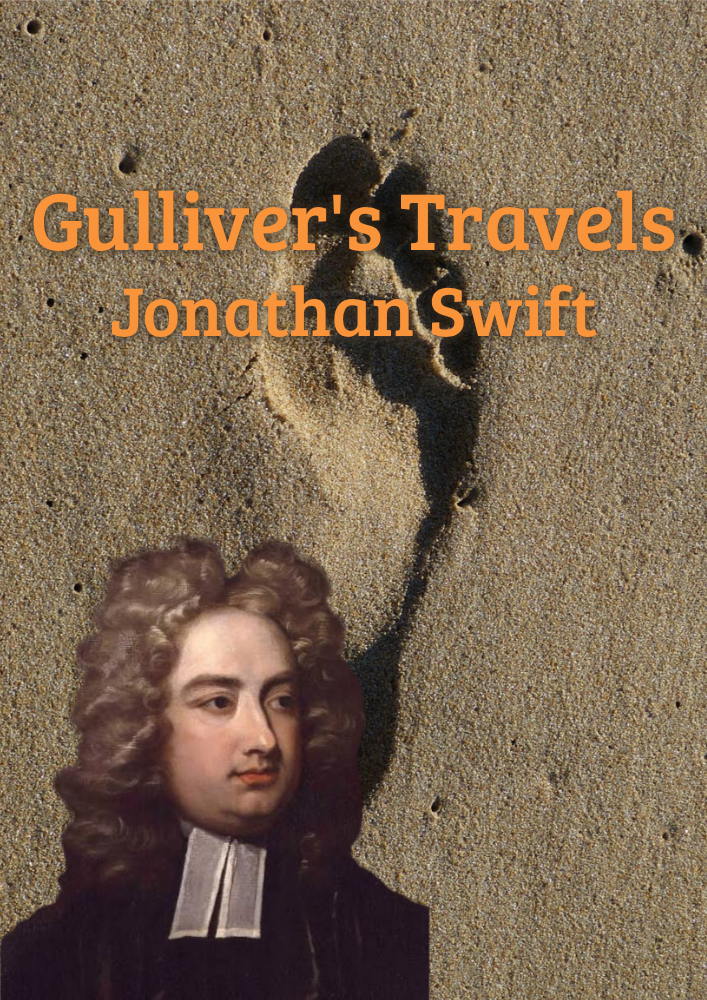
Work Background:
Gulliver's Travels, by Jonathan Swift, first appeared in 1726. Swift draws on his political career, Anglican commitments, and experience of English-Irish power while hiding the satirist behind Gulliver's increasingly unreliable travel testimony. Swift's imaginary voyages became templates for political satire and speculative travel while their darker arguments resist the children's-adventure form often imposed by abridgment. The four voyages repeatedly change scale, political assumptions, and the definition of reason. Editions marketed for children often extract Lilliput and omit the harsher satire of science, empire, and human pride. This context explains the work's choice of voice, structure, and genre, while helping readers recognize the literary setting and social institutions surrounding its first publication or performance. Readers may notice how public rules enter private judgment, how repeated images change meaning, and how form controls what can be known at each stage.
Story Overview:
Ship's surgeon Lemuel Gulliver recounts four voyages to societies that reverse familiar assumptions: tiny Lilliputians, giant Brobdingnagians, speculative projectors, and rational horses ruling degraded humanlike Yahoos. Each return makes his confidence in European civilization harder to sustain. This summary identifies only the central situation and direction without revealing the ending. As speakers, settings, scale, or social positions change, earlier events take on new meanings; the work's effect lies not only in its incidents but also in pacing, point of view, silence, and the distance between what characters understand and what readers can infer.
Director: Dave Fleischer
Production country: United States
Principal cast: Sam Parker, Pinto Colvig, Jack Mercer, and Lanny Ross
Difference from the book: The animated feature keeps Gulliver's giant arrival in Lilliput but replaces Swift's political satire with a princess romance, comic side characters, and songs.
Director: Rob Letterman
Production country: United States
Principal cast: Jack Black, Jason Segel, Emily Blunt, and Amanda Peet
Difference from the book: The protagonist becomes a modern mailroom worker and would-be travel writer; the film borrows Lilliputian scale while inventing a contemporary comedy and omitting the other voyages.
The selected full text is the verified digital edition numbered 829. Market titles include: Gulliver's Travels; Travels into Several Remote Nations of the World; Les Voyages de Gulliver; Gullivers Reisen; Los viajes de Gulliver; Gulliver's Travels (Chinese title). When choosing an edition, distinguish complete, abridged, annotated, modernized, and collected versions, and verify the translator, publisher, and year for each.
Swift's imaginary voyages became templates for political satire and speculative travel while their darker arguments resist the children's-adventure form often imposed by abridgment. Swift draws on his political career, Anglican commitments, and experience of English-Irish power while hiding the satirist behind Gulliver's increasingly unreliable travel testimony. These qualities place the book at a specific point in the author's career and in the development of its genre. Its influence rests on recognizable questions of language, structure, history, and judgment rather than on a vague label of “classic.” Reading the full text beside another translation, stage production, or film reveals what later editors, translators, actors, and directors preserve, explain, compress, or rearrange, and brings out formal effects that summaries often conceal.
Reading another work from the same author's career also shows which concerns persist and which methods change. The book remains open to interpretation, disagreement, and rereading because readers can return to its actual language and arrangement instead of allowing later reputation to replace the experience of reading.
Miva: the next reading experience beyond audiobooks
Listen like an audiobook, then ask anything, anytime.
Start Miva's narrationMiva does not just narrate. It keeps explaining based on what you ask.