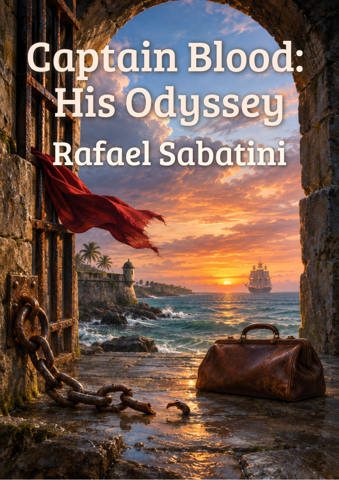
Background:
Published in 1922 and set in the late seventeenth century, the novel uses the Monmouth Rebellion, transportation, slavery, piracy, and imperial warfare as the route by which a physician becomes a sea captain.
The central tension:
Peter Blood is unjustly condemned and transported to Barbados, where political violence and forced labor push him toward escape and piracy. His medical ethics and tactical skill complicate the public label placed on him.
How the writing works:
An energetic omniscient narrator, historical figures, courtroom and battle scenes, strategic reversals, ironic commentary, and episodic maritime action create a romance shaped by legal injustice.
Peter Blood's appeal begins with an injustice: a physician treats a wounded rebel and is condemned as though medical care proved treason. Transportation to Barbados then reveals law, empire, and slavery not as background but as the machinery that manufactures a pirate. Blood's wit and tactical brilliance are satisfying because they answer institutions that have already abandoned justice.
Sabatini structures the novel as a sequence of reversals in status—doctor, prisoner, enslaved laborer, fugitive, captain, political problem. Medical knowledge remains important after the sword fights begin, preventing Blood from becoming only an action hero. Irony also separates the name imposed on him from the ethical code he tries to preserve.
The 1935 Michael Curtiz film created one of cinema's defining swashbucklers and made Errol Flynn a star, but it condenses a more episodic political career into romance and spectacle. Readers who return to the novel will find sharper attention to changing regimes and to the unstable line between piracy authorized by a flag and piracy condemned by it.
Blood's transformation begins with a legal absurdity: professional duty is interpreted as political allegiance. The sentence that sends him to Barbados makes the state, not personal appetite, the first author of his outlaw identity. His medical skill continues to matter after escape, giving him leverage in a world supposedly ruled by swords and ships. Wit, diagnosis, and strategic patience are as important to his command as physical courage.
The episodic structure repeatedly changes the flag under which violence becomes legal. A pirate may be condemned, recruited, pardoned, or renamed according to the needs of a government, and Blood's irony keeps that hypocrisy visible amid the action. The romance gains force because Arabella Bishop knew him first as a captive whose dignity survived humiliation. Readers looking for pace will find battles, reversals, and escapes; readers looking more closely will find a sustained argument about whether law deserves loyalty when it abandons justice.
Sabatini understands that a swashbuckler needs more than speed: it needs a hero whose intelligence changes the shape of danger. Blood often wins by reading an illness, a political shift, or an opponent's vanity before he draws a weapon. The historical upheavals keep resetting the moral map, so action never becomes empty choreography. Readers looking for an immediately enjoyable classic will find wit, romance, sea battles, and reversals; those who look further will see how carefully the novel distinguishes an imposed criminal name from a chosen ethical identity.
Director: Michael Curtiz
Production country: United States
Cast: Errol Flynn, Olivia de Havilland, Basil Rathbone
Difference from the book: compresses the novel's episodic career into a star-centered romance and reshapes several conflicts for a fast studio adventure.
This 31-chapter novel begins the Captain Blood sequence. Later story collections and continuations are separate works, not additions to its contents.
The book helped define the modern swashbuckler and remains useful for examining how adventure fiction converts political persecution into heroic mobility while simplifying colonial systems.
Miva: the next reading experience beyond audiobooks
Listen like an audiobook, then ask anything, anytime.
Start Miva's narrationMiva does not just narrate. It keeps explaining based on what you ask.