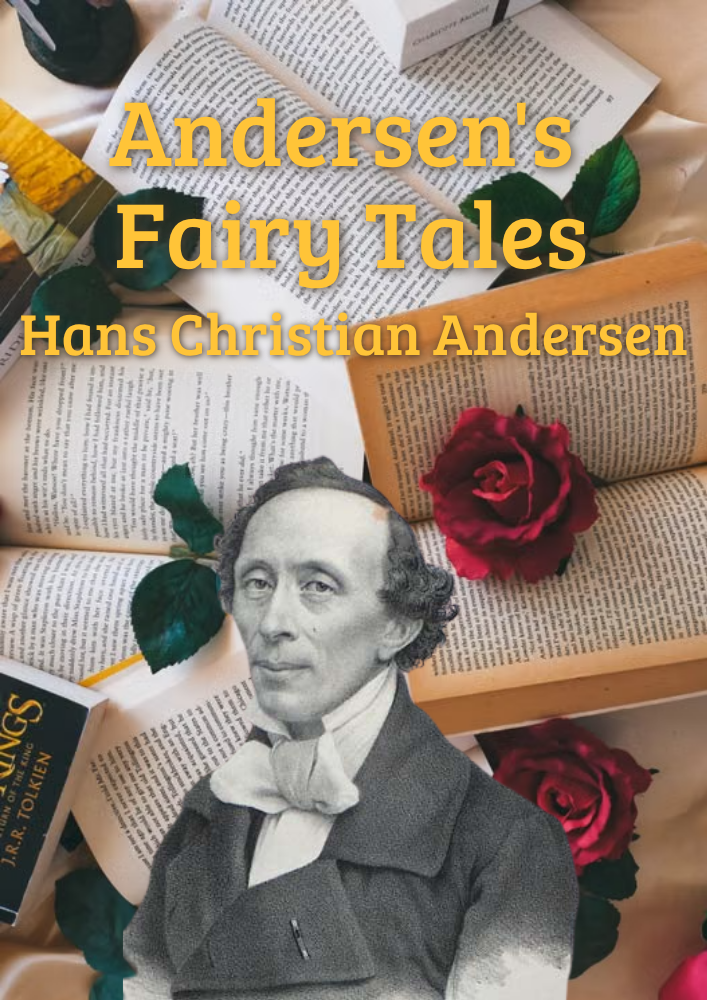
Book Introduction
Background:First issued in Danish in the nineteenth century, Andersen's tales helped establish the authored literary fairy tale as a form distinct from anonymous folklore. This English collection gathers stories from different points in his career; The Snow Queen first appeared in 1844 and is arranged as seven connected stories. The collection also shows how differently individual tales handle comedy, social cruelty, devotion, and loss. Reading the volume as a collection makes Andersen's range clearer than approaching one famous tale in isolation.
Story Summary:In The Snow Queen, Gerda travels through changing seasons and strange households to find Kay, whose sight and feelings have been altered by fragments of a malicious mirror. Her persistence turns a rescue journey into a test of memory, loyalty, and moral perception. Gerda's encounters do not merely delay the rescue; each offers a different model of attachment, forgetfulness, or possession. The restrained ending returns the travellers to ordinary time without erasing what the journey has changed.
Literary Features:The tale moves episodically, combining Christian imagery, folklore, domestic detail, and sharp shifts between warmth and cold. Objects, plants, and animals speak, while the mirror motif makes distorted vision part of the narrative structure. The plain forward motion of Gerda's journey supports layers that adult and younger readers can approach differently. The narrator often addresses the audience directly and can move from playful observation to severe judgment within a few lines. That flexibility helps the stories retain an oral immediacy while remaining carefully authored literary works.
Film and Television Adaptations
The Snow Queen (1957)
Directed by Lev Atamanov in the Soviet Union, this animated film features the voices of Maria Babanova, Yanina Zheymo, and Anna Komolova. It is notable for its influential hand-drawn visual design. The adaptation streamlines the seven-part tale and gives the journey a more continuous dramatic shape.
Frozen (2013)
Directed by Chris Buck and Jennifer Lee in the United States, with Kristen Bell, Idina Menzel, Jonathan Groff, and Josh Gad, the film was publicly developed from Andersen's premise but creates new sisters, a new kingdom, and a substantially different plot. Its relation to the tale is inspirational rather than a direct retelling.
Together the adaptations demonstrate two distinct approaches: direct condensation of the seven-part tale and free reinvention of its central image. They should therefore not be treated as equivalent witnesses to Andersen's plot.
Editions and Translations
The selected English volume is a multi-story collection, so its resource title is Andersen's Fairy Tales and The Snow Queen is one item in its contents. English editions vary in translator, selection, paragraphing, and treatment of Christian references. Readers comparing editions should check the named translator and confirm that all seven stories of The Snow Queen are present.
Illustrated editions may also alter the reader's emphasis by presenting the tale as nursery literature, Gothic fantasy, or a seasonal story. For textual comparison, an unabridged edition with a named translator and publication history is preferable.
The Author and the Work
Relationship Between the Author and the Work:Andersen repeatedly transformed remembered folklore, social unease, religious thought, and the experience of exclusion into compact imaginative narratives. The Snow Queen belongs to his mature period and shows his characteristic ability to place psychological and ethical pressure inside an apparently simple wonder tale. Its images of ice, roses, mirrors, and child travellers have supported repeated reinterpretation in theatre, ballet, animation, and illustration. The tale's continued adaptability rests on the tension between intimate feeling and an expansive symbolic landscape.