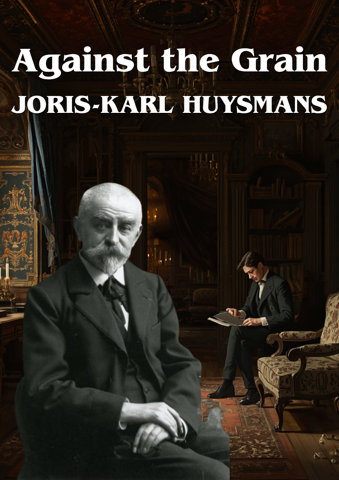
Published in 1884, Joris-Karl Huysmans' novel "Against the Grain" (also known as "À rebours") chronicles the life of Jean des Esseintes, the last scion of a decaying aristocratic family. Disgusted with the banality of Parisian society, des Esseintes retreats to a secluded villa, dedicating himself to isolated aesthetic contemplation. The narrative, largely devoid of traditional plot, meticulously details his eccentric experiments and refined tastes in art, literature, perfumes, and exotic flora. Through these elaborate creations, he constructs an artificial world designed to embody his profound rejection of bourgeois life and conventional morality. This seminal work is considered a groundbreaking example of Decadent literature, marking a significant departure from Naturalism and profoundly influencing figures such as Oscar Wilde and the Symbolist movement.
Reading ease score: 51.3 (10th to 12th grade). Somewhat difficult to read.
Jean Des Esseintes is the last scion of an ancient, noble French family. Over centuries, line-breeding and decadence have reduced this once-formidable lineage to a single frail, neurotic survivor. Having inherited a substantial fortune, Des Esseintes attempts to engage with late nineteenth-century Parisian high society, exploring its salons, artistic circles, and sensual pleasures. However, he quickly grows utterly disgusted with humanity. Finding noblemen degraded, the clergy commercialized, the rising bourgeoisie vulgar and corrupt, and the general public steeped in overwhelming mediocrity, he descends into profound boredom, physical exhaustion, and severe nervous illness. Determined to cut all ties with a world he despises, Des Esseintes sells his ancestral estate and purchases a secluded house in Fontenay-aux-Roses, near Paris. He transforms this home into an elaborate, self-contained sanctuary dedicated entirely to the cultivation of artificial beauty and aesthetic sensation. Believing that human artifice is vastly superior to the dull, repetitive order of nature, he methodically designs every aspect of his environment. He selects subtle wall colorings and specialized lighting to suit his delicate nerves, collects rare and decadent literature, gathers symbolic artwork, and creates intricate sensory experiences, including a mouth organ that dispenses combinations of liqueurs corresponding to musical chords, and complex scent compositions that evoke detailed landscapes. In one famous instance of aesthetic obsession, he encrusts the shell of a live tortoise with gold and precious gems to harmonize with the colors of a carpet, only for the creature to die under the weight of its luxurious burden. As Des Esseintes sinks deeper into solitude, his physical and mental health precipitously declines. His obsession with refined aestheticism gives way to vivid hallucinations, agonizing nightmares, severe stomach ailments, and overwhelming sensory distortions. He surrounds himself with exotic, monstrous plants that mimic human diseases, yet his nervous afflictions only intensify. In an effort to break his deteriorating isolation without truly returning to society, he plans a trip to London, inspired by reading Charles Dickens. However, after arriving at a Paris train station and visiting an English tavern, where the sounds, smells, and atmosphere satisfy his imagination completely, he decides the actual voyage would only disappoint him and returns to Fontenay without ever boarding the train. Des Esseintes’s health eventually collapses completely, rendering him incapable of digesting normal food. Forced to summon a physician, he receives a blunt, unavoidable ultimatum: he must abandon his solitary, artificial life at Fontenay and return to live among society in Paris, or face imminent physical breakdown and death. Realizing that his grand retreat has transformed from a refuge into a lethal prison, Des Esseintes reluctantly yields to the doctor's orders. As workmen pack away his cherished books, art, and furnishings, Des Esseintes is overcome by immense despair. His experiment in total isolation has failed, proving that artifice alone cannot sustain human life or shield the spirit from existential dread. Facing an impending return to the overwhelming tide of modern bourgeois mediocrity he so fiercely despises, and trapped between a lost religious faith and a cold, rational skepticism, Des Esseintes offers a desperate final prayer for divine pity upon his dark journey back into the world.
And the more Des Esseintes read Baudelaire, the more he felt the ineffable charm of this writer who, in an age when verse served only to portray the external semblance of beings and things, had succeeded in expressing the inexpressible in a muscular and brawny language; who, more than any other writer possessed a marvelous power to define with a strange robustness of expression, the most fugitive and tentative morbidities of exhausted minds and sad souls.Against the Grain Chapter III. It illuminates the spiritual and artistic kinship Des Esseintes feels with Baudelaire, highlighting the novel's thematic fascination with psychological decay, nuance, and the expression of complex inner states.
Once more, this so ardently desired and finally attained solitude had ended in a fearful distress. This silence which formerly would have appeared as a compensation for the stupidities heard for years, now weighed on him with an unendurable burden.Against the Grain Chapter XVI. The passage exposes the central tragedy of the protagonist's experiment: the very solitude he constructed as a sanctuary ultimately transforms into a prison of psychological torment.
The waves of human mediocrity rise to the sky and they will engulf the refuge whose dams I open. Ah! courage leaves me, my heart breaks! O Lord, pity the Christian who doubts, the sceptic who would believe, the convict of life embarking alone in the night, under a sky no longer illumined by the consoling beacons of ancient faith.Against the Grain Chapter XVI. Serving as the emotional climax of the novel, this passage powerfully captures the existential crisis of the late nineteenth-century intellectual caught between lost religious faith and an unbearable modern reality.
Nature had had her day, as he put it. By the disgusting sameness of her landscapes and skies, she had once for all wearied the considerate patience of æsthetes.Against the Grain Chapter III. This passage serves as a defining declaration of Decadent philosophy, succinctly encapsulating the protagonist's profound rejection of natural order in favor of human artifice and sensory manipulation.
The novel presents a distinct stylistic challenge due to its dense, highly descriptive prose and lack of conventional plot. Joris-Karl Huysmans employs an extensive vocabulary rich in specialized terminology, architectural phrasing, Latin literary citations, and detailed technical descriptions of art, perfumes, and botany. Readers accustomed to character-driven narratives may find the pacing slow, as entire chapters focus on Des Esseintes examining his library or arranging his furnishings. However, the reading difficulty is tempered by the vividness of its imagery and the razor-sharp irony underlying the protagonist's eccentric pursuits.
Published in 1884, the novel served as the definitive manifesto of the Decadent movement, marking a dramatic break from the dominant Naturalist school of Emile Zola. By shifting the focus of fiction entirely inward to an eccentric individual's inner psychological landscape and aesthetic theories, Huysmans redefined narrative possibilities. The work profoundly influenced late nineteenth-century literature, directly inspiring Oscar Wilde's The Picture of Dorian Gray, in which a mysterious yellow book corrupts the protagonist. It remains a masterwork of stylistic precision and a monumental portrait of fin-de-siècle cultural anxieties.
The conflict begins long before the novel opens, rooted in Des Esseintes's deep psychological revulsion toward every tier of French society. His early attempts to participate in aristocratic salons and bourgeois gatherings leave him drained and disgusted. Rather than engaging in active social rebellion, he chooses absolute retreat, turning his back on Paris to build a private universe at Fontenay. The dynamic then shifts from a social conflict to an internal struggle between his iron determination to remain isolated and his rapidly failing physical body, which steadily undermines his grand design.
For Des Esseintes, art is not merely an aesthetic pastime, but a vital medicine and a surrogate reality. He surrounds himself with works that reflect his own neurotic disposition, favoring the dark visions of Gustave Moreau, the haunting prints of Odilon Redon, and the obscure Latin prose of late antiquity. Through these carefully selected masterpieces, he attempts to stimulate his exhausted senses and ward off the profound boredom that threatens to consume him. Art becomes his primary shield against the mundane reality of the outside world.
Des Esseintes stands as the archetype of the anti-hero, combining hyper-intelligence with complete physical and moral paralysis. His absurdly elaborate experiments, such as pairing liqueurs to musical notes or designing disease-like botanical displays, are both fascinating and tragic. Readers are drawn to his uncompromising refusal to accept a mundane world, even as his eccentricities push him toward self-destruction. His personality offers an extraordinary study in eccentricity, melancholy, and intellectual ambition.
Everything the narrative has been building toward converges when the physical reality of Des Esseintes's failing health completely breaches his artificial sanctuary. The long-avoided confrontation between his uncompromising aesthetic ideals and the raw demands of physical survival reaches its peak in the final chapter. The specific command delivered by his physician, how Des Esseintes reacts as his carefully constructed refuge is dismantled around him, and the final prayer he utters before facing the world outside are precisely the emotional payoffs worth experiencing directly in the text.
Miva: the next reading experience beyond audiobooks
Listen like an audiobook, then ask anything, anytime.
Start Miva's narrationMiva does not just narrate. It keeps explaining based on what you ask.