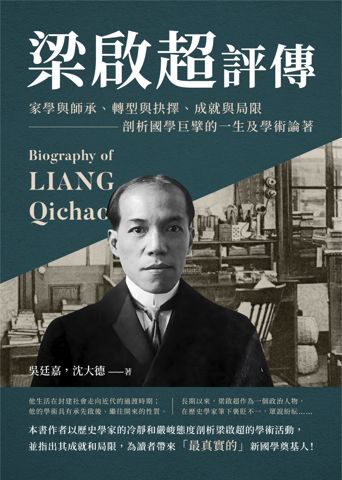
He lived during the transition from a feudal society to the modern era;
his scholarship possessed the quality of inheriting the past and ushering in the future.
For a long time, as a political figure, Liang Qichao has been viewed with mixed reviews by historians, sparking diverse opinions...
The authors of this book analyze Liang Qichao's academic activities with the calm and rigorous attitude of historians, pointing out his achievements and limitations to bring readers the "most authentic" founder of modern Chinese studies!
▎A Cradle Amidst Turmoil
The young Liang Qichao grew up in a peaceful cradle. This cradle was solid and sturdy, providing shelter from the wind and rain while allowing him to grow freely. A loving mother sang him lullabies, a knowledgeable grandfather instilled wisdom, and a strict father motivated him to strive for progress; a life of poverty tempered the will of the farm boy, worn-out scrolls formed the notes of a pastoral idyll, and tender family affection warmed his young soul. However, the world outside the cradle was not peaceful; China was on the eve of a great upheaval, and the entire world was caught in a storm.
▎Family Heritage and Mentorship
At the age of eighteen, Liang Qichao left Xuehaitang and became a disciple of Kang Youwei. The following year, Kang established the Wanmu Caotang, where Liang became his top student and served as his assistant. When Kang wrote "A Study of the Forged Classics of the Xin Learning," Liang handled the collation. When Kang wrote "A Study of Confucius as a Reformer," Liang served as a sub-editor. The four years at Wanmu Caotang were the turning point of Liang Qichao's life and scholarship. Under Kang Youwei's guidance, Liang resolutely abandoned Han learning and accepted reformist ideas and political propositions, creating the prerequisites for his later emergence as a prominent political theorist, propagandist, and social activist.
▎Transformation and Choices
Academically, he was insatiable, studying Western learning desperately to make up for his deficiencies in that area. He founded the Datong Translation Bureau in Shanghai, aiming to translate Western books and contemporary new theories on a grand scale. The "Shiwu Bao" (Chinese Progress) and the Shiwu Academy were his two main strongholds. Additionally, he actively participated in founding "Zhixin Bao" and "Nongxue Bao." During this period, Liang Qichao and his friends briefly showed a tendency toward excessive Westernization, but subconsciously, Liang felt the danger of this trend. Gradually, the idea of transforming Chinese learning with Western learning and reconstructing modern Chinese studies began to sprout in his mind.
▎Constitutional Elegy
From 1905 to 1919, Liang Qichao struggled and wavered in a continuous political whirlpool. His academic career was greatly disturbed and constrained. Contemporaries and later generations have given him mixed reviews because his experiences during this period were too complex, changed too quickly, and his merits and faults were too difficult to distinguish. Some say he constantly kept pace with the times; others say he was an opportunistic hypocrite who wavered between two sides. For Liang Qichao himself, being caught in the battle between the "today's self" and the "yesterday's self," the conflict between academia and politics, and the disputes of partisan politics made this the most painful period for his soul.
▎A Great Master of His Generation
Liang Qichao possessed rich knowledge and life experience. Whether in modern or traditional learning, he had his own independent insights and critical perspective, as well as the knowledge and ability to integrate the two. Although some of his views contained biased or one-sided statements, as a whole, his "return" was an attempt to find his specific position amidst the conflict between old and new cultures. With his unique charisma, he attracted a group of like-minded academic powerhouses. In the history of Chinese culture and scholarship, he was a shining pioneer, and his research results represent a turning point of epochal significance.
Book Features: This book uses chronological order as the longitude and academic disciplines as the latitude to study all the academic activities of the enlightenment master Liang Qichao. Living in the transition from feudalism to modernity, Liang Qichao's scope of research was extremely broad. The essence of his scholarship lay in inheriting the old to create the new and bridging China and the West, laying the foundation for modern academia. The authors observe and analyze him with a scientific attitude while approaching and understanding him with their hearts and emotions.
Miva: the next reading experience beyond audiobooks
Listen like an audiobook, then ask anything, anytime.
Start Miva's narrationMiva does not just narrate. It keeps explaining based on what you ask.