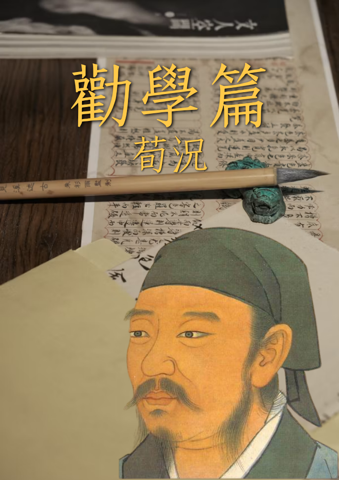
Positioning:
"Encouragement of Learning" (Quanxue) is the opening chapter of the extant Xunzi, revealing its core theme with the opening line: "Learning must never cease." Here, "learning" is not merely about acquiring knowledge or achieving fame, but about transforming one's judgment and actions through classics, rituals, teachers, reflection, and long-term practice. Beginning with metaphors like indigo being bluer than the plant it comes from and ice being colder than the water it is made of, the chapter describes learning as a process where materials are processed into a new state; human capacity is not fixed, nor can it mature naturally through talent alone.
Argumentation:
The text makes extensive use of visible and tangible metaphors. Climbing high allows for a broader view; shouting with the wind carries the voice further; using chariots and boats extends human reach. These illustrate that utilizing conditions does not mean passive reliance on tools, but knowing how to use external things to supplement one's own deficiencies. Accumulating earth to form a mountain, accumulating water to form a deep pool, and the idea that without accumulating single steps one cannot reach a thousand miles, shifts the focus to accumulation: grand results are not caused by a single leap, but by small steps in a consistent direction. The contrast between a thoroughbred and a hack, or between rotting wood and metal/stone, places persistence above temporary talent.
Learning and Character:
The latter half of the chapter discusses not just diligence, but also the content, method, and purpose of learning. Knowledge must enter the heart and manifest in the body and actions; it cannot remain between the ears and the mouth. Scholars must also stay close to appropriate teachers, respect the order of ritual, and judge when and how to respond. This makes the chapter not just a collection of motivational maxims, but a discourse on how knowledge transforms into character. If one only extracts "persistence" (qie er bu she) while ignoring ritual, teachers, and self-examination, the scope of the original thought is diminished.
Reading Method:
It is recommended to read the full text first, then re-read by metaphor groups: transforming materials, leveraging external things, ceaseless accumulation, choosing the environment, staying close to teachers and friends, and integration through ritual. Different ancient versions may have variations in characters or punctuation (e.g., "kui/kui", "rou/rong"); one should confirm the source text used and not mistake modern textbook excerpts for the complete chapter.
Adaptations:
No mainstream feature films or TV works based directly on the full text of "Encouragement of Learning" were found in professional databases; therefore, no fictional entries are provided. The work is most commonly disseminated through classroom recitations, calligraphy, animated shorts, lectures, or textbook excerpts. These forms usually focus on famous quotes like "blue from indigo," "single steps to a thousand miles," or "persistence," which serve as introductions but may disconnect the surrounding arguments.
Cross-media Reading:
When engaging with this text through recitation or visualization, pay special attention to the sense of momentum created by repetition, parallelism, and antithesis. The article does not statically list metaphors but moves from sensory experience toward virtue and the way of becoming a sage. Good adaptations should specify the scope of excerpts and the source text, avoiding the simplification of "Encouragement of Learning" into exam success or workplace efficiency.
Textual Scope:
"Encouragement of Learning" is not a unique title. Ancient records include a chapter of the same name in the Lüshi Chunqiu, and Zhang Zhidong of the Qing Dynasty also wrote a piece titled "Encouragement of Learning." This collection specifically includes the first chapter of the extant Xunzi, using the system of Yang Liang's annotations; it does not conflate other works of the same name or modern excerpts. The Chinese Text Project lists several base editions including the Sibu Congkan and Xunzi Jijie for cross-referencing.
Foreign Translations:
English readers can refer to Eric L. Hutton's full translation and Burton Watson's selected translations. The National Diet Library of Japan records Kato Joken's Xunzi: Modern Japanese Translation, with "Encouragement of Learning" listed first. The BnF records Ivan P. Kamenarović's bilingual Chinese-French Écrits de Maître Xun. While other languages have studies or partial introductions, no single definitive mainstream translation for this chapter is designated here. When choosing a translation, confirm if it is complete, selected, or a relay translation, and verify the translator, annotator, and publication year.
Copyright Note:
The original ancient Chinese text is in the public domain, but modern punctuation, collation, vernacular translations, foreign translations, guides, and annotations may be protected. This collection uses only verifiable Traditional Chinese source texts to compile the EPUB; modern translations from market data are not merged into the main text.
Attribution:
The Xunzi is traditionally attributed to the late Warring States thinker Xun Kuang, also known as Xun Qing. The extant book underwent long-term compilation; Liu Xiang of the Han Dynasty edited the chapters, and Yang Liang of the Tang Dynasty re-divided the volumes and provided annotations, forming the basis of the standard system. Therefore, metadata lists "Xunzi" as the author, without claiming the modern chapter order is the original form finalized by the author.
Philosophical Position:
"Encouragement of Learning" integrates education, habit, environment, teachers, and ritual, providing an entry point to understanding Xunzi's theory of human nature and political ethics. Its most enduring power comes not just from maxims, but from a rigorous question: Under what conditions can knowledge transform a person? The text's answer requires accumulation, discernment, closeness to teachers, honoring ritual, and practice to coexist. This allows it to remain relevant in modern educational contexts without being reduced to a simple slogan of "hard work leads to success."
Miva: the next reading experience beyond audiobooks
Listen like an audiobook, then ask anything, anytime.
Start Miva's narrationMiva does not just narrate. It keeps explaining based on what you ask.