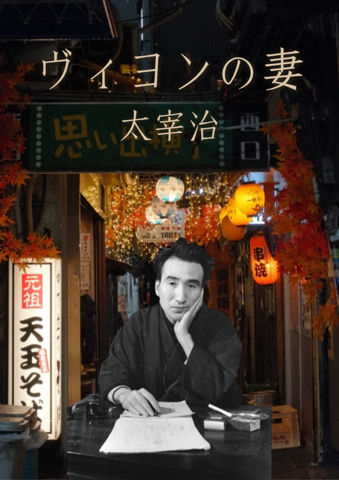
Background: Set in post-war Tokyo, this story observes a wandering, alcoholic writer husband through the first-person perspective of his wife. The focus of reading lies in the narrator's practical actions and the tension in the concluding statement, which avoids simplifying good and evil. Understanding the era of its creation and the history of its publication helps clarify how the story and its expressions responded to the times. Any alternative titles found by readers should be treated as supplementary information, while the standard title of the included text should be used consistently.
Plot & Content: Upon learning that her husband, Otani, stole money from a tavern, the wife, Satchan, begins working at the shop to repay the debt. From her perspective as she tries to rebuild their life, the fluctuations of marriage, poverty, and dignity are depicted. This provides an entry point for reading the development and form of the text, rather than a detailed plot summary or character list. The gap between what the narrator knows and what the reader can infer, as well as changes in time through the arrangement of chapters and songs, serve as clues for interpretation.
Literary Features: The wife's first-person narrative refuses to fix the husband's destructive behavior as either condemnation or glorification. Through brief dialogue, quick scene transitions, and the physical reality of labor, comicality and the will to survive coexist within misery. By examining the tone, pauses, and repetitions that disappear in a mere summary, the unique flavor of the work becomes clearer.
Encyclopedia
Author Biography: Osamu Dazai (1909–1948) was a novelist born in Aomori Prefecture who was active from the early Showa era through the immediate aftermath of the war. His real name was Shuji Tsushima. Using self-confessional first-person narratives, adaptations of classics and folklore, female perspectives, and a style that oscillated between humor and despair, he depicted the gap between personal shame and social roles. His major works include Run, Melos!, Tsugaru, The Setting Sun, and No Longer Human.
Relationship Between Author and Work: In this work, Dazai reconfigures the themes of a writer's life, marriage, and poverty—topics he handled repeatedly—through the active voice of the wife rather than the husband. It is significant that he handed material that appears self-confessional over to a different perspective.
Media Comparisons (Last 10 Years): No Longer Human: Osamu Dazai and Three Women (2019) is not a direct adaptation but a biographical film that reconstructs the latter half of Dazai's life. In contrast to the wife's first-person perspective in this work, the film presents the image of the writer and multiple women from an external viewpoint. By specifying the title and year and noting when it is not a direct adaptation, one can compare differences in focus depending on the medium and era.
Publisher
BookAI
Published
2026-09-16
Miva: the next reading experience beyond audiobooks
Listen like an audiobook, then ask anything, anytime.