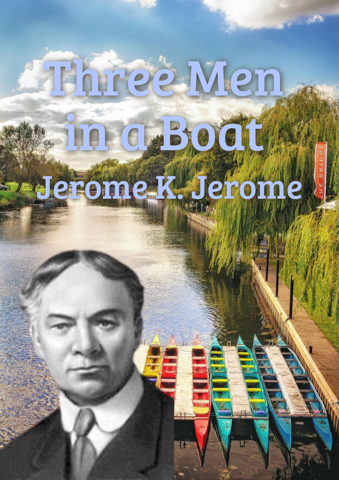
Historical background:
Jerome's 1889 book grew from an intended Thames travel guide into a comic narrative whose digressions overwhelmed practical instruction. The route remains geographically recognizable, but memory, anecdote, and mock expertise repeatedly interrupt forward motion.
Story introduction:
Three friends and a dog plan a boating holiday on the Thames. Rather than cataloging mishaps, the guide emphasizes the central comic mechanism: ordinary tasks become evidence of heroic incompetence because the narrator's confidence always exceeds events.
Literary form:
First-person timing, sudden digression, inflated analogy, deadpan lists, and shifts between lyrical landscape and bathos give the book its rhythm. Harris, George, and Montmorency function as comic relations within the narration, not as a detachable character directory.
Central themes:
Three friends and a dog plan a boating holiday on the Thames. Rather than cataloging mishaps, the guide emphasizes the central comic mechanism: ordinary tasks become evidence of heroic incompetence because the narrator's confidence always exceeds events. Beyond that immediate situation, Three Men in a Boat (To Say Nothing of the Dog) examines British humor, travel, Thames, friendship, boating, Victorian leisure. The work sits between travel writing and comic fiction and helped make recreational life a subject for modern humor. Its Thames geography supports continuing tourism and adaptation, while its narrative voice remains a model for comedy built from unreliable self-presentation. Together, these concerns give the conflict its moral and historical weight beyond the immediate plot.
Director: Ken Annakin
Production country: United Kingdom
Principal cast: Laurence Harvey, Jimmy Edwards, David Tomlinson
Why this version matters: This identifiable production provides a useful comparison between the selected text and a major screen interpretation associated with named filmmakers and performers.
Difference from the book: It adds an extended romantic plot and reshapes the episodic journey into a conventional feature-film arc. The change affects point of view, pacing, or the balance among mystery, romance, horror, and social context; viewers should therefore treat the film as an interpretation rather than a visual substitute for the novel.
Screen interpretation:
The named adaptation adds an extended romantic plot and reshapes the episodic journey into a conventional feature-film arc. For Three Men in a Boat (To Say Nothing of the Dog), that choice changes the weight given to British humor, travel, Thames, friendship, boating, Victorian leisure: visible action replaces some of the prose’s control over voice and delay, while the performances give particular faces and bodies to relationships that the book can keep uncertain. The screen version therefore creates a distinct emphasis rooted in this work’s specific narrative problem.
Edition history:
preserves 19 chapters and the full subtitle. Illustrated editions, school abridgments, dramatizations, and films often remove historical excursions or add romance; compare contents before assuming that a familiar river episode represents the complete book. Complete English text with subtitle and the named companions retained. The history of Three Men in a Boat (To Say Nothing of the Dog) is especially sensitive to its 19 chapters, because abridgment or revision can alter the balance among British humor, travel, Thames, friendship, boating, Victorian leisure.
Translation history:
Three Men in a Boat (To Say Nothing of the Dog) was written in en; this record uses the original-language text rather than a translation. Translations must recreate the book’s treatment of British humor, travel, Thames, friendship, boating, Victorian leisure, including differences of register, dialogue, and historically specific vocabulary that shape Jerome K. Jerome’s effects.
Place in literary history:
The work sits between travel writing and comic fiction and helped make recreational life a subject for modern humor. Its Thames geography supports continuing tourism and adaptation, while its narrative voice remains a model for comedy built from unreliable self-presentation.
Place in the author's career:
The work sits between travel writing and comic fiction and helped make recreational life a subject for modern humor. Its Thames geography supports continuing tourism and adaptation, while its narrative voice remains a model for comedy built from unreliable self-presentation. Within Jerome K. Jerome’s career, Three Men in a Boat (To Say Nothing of the Dog) is distinguished by an English comic travel narrative whose Thames itinerary repeatedly gives way to digression, mishap, anecdote, and mock seriousness. It gathers the author’s concerns into a structure where British humor, travel, Thames, friendship, boating, Victorian leisure interact instead of standing as separate messages.
Continuing influence:
Three Men in a Boat (To Say Nothing of the Dog) continues to influence later storytelling through its handling of British humor, travel, Thames, friendship, boating, Victorian leisure. The work sits between travel writing and comic fiction and helped make recreational life a subject for modern humor. Its Thames geography supports continuing tourism and adaptation, while its narrative voice remains a model for comedy built from unreliable self-presentation. Its afterlife shows how a historically specific work can generate new interpretations while the original retains complications that simplified cultural versions leave aside.
Miva: the next reading experience beyond audiobooks
Listen like an audiobook, then ask anything, anytime.
Start Miva's narrationMiva does not just narrate. It keeps explaining based on what you ask.