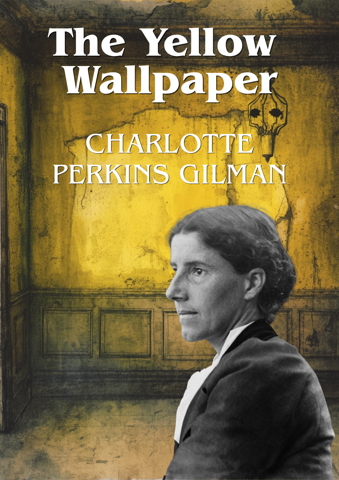
Charlotte Perkins Gilman's seminal short story, "The Yellow Wallpaper," published in January 1892, is a powerful work of feminist literature and psychological horror. It chronicles the descent into madness of a young woman, Jane, who is confined to an isolated country estate by her physician husband, John, as a supposed cure for her "temporary nervous depression." Forbidden from engaging in any intellectual activity, including writing, Jane secretly documents her experiences in a journal. Her only constant companion becomes the room's disturbing yellow wallpaper, whose grotesque patterns and perceived figures within it gradually consume her mind, reflecting her increasing isolation, oppression, and the societal constraints placed upon women in the late 19th century. The story serves as a profound critique of the patriarchal medical practices of the era and the stifling domestic sphere that often led to mental and emotional deterioration for women.
Reading ease score: 89.5 (6th grade). Easy to read.
In The Yellow Wallpaper, a young woman and her husband, John, take up residence in a grand, secluded summer mansion. John is a practical, high-standing physician, and he diagnoses his wife with a "temporary nervous depression" and a "slight hysterical tendency." To treat her, he prescribes a strict "rest cure," forcing her into absolute inactivity. She is forbidden from working, socializing, or exercising her creative mind. Although she secretly believes that satisfying work, excitement, and change would cure her, she hides her secret journal entries from John and his sister, Jennie, who aids in enforcing the regimented care. They set up their living quarters in a large, airy nursery at the top of the house. The room is lined with windows, but its floors are scratched, the furniture is damaged, the bed is heavy and nailed to the floor, and the windows are barred. Most unsettling of all is the wallpaper: an ancient, torn, yellow paper with an erratic, repulsive pattern that both disgusts and hypnotizes the narrator. John refuses her requests to change the paper or move to a lower room, arguing that giving in to her "fantasies" will only worsen her nervous disposition. Left alone for long stretches with nothing to occupy her thoughts, the narrator becomes consumed by the wallpaper's grotesque design. She spends endless hours tracing its chaotic, broken shapes. As the summer progresses, her mental fatigue deepens, and her perception of the pattern begins to shift under changing light. In the soft light of the moon, she starts to discern a hidden sub-pattern: the dim, shadowy figures of a woman stooping and creeping behind the main design, which resembles a set of suffocating bars. The narrator's obsession isolates her completely. She comes to believe the trapped woman is desperately shaking the pattern to get free. During the day, the creeping figure remains quiet, but by night, it moves constantly. Fearing that John and Jennie will notice her fixation or try to intervene, she keeps her observations secret, pretending to comply with their routines while secretly watching the wallpaper evolve. She resolves that she alone must help the woman escape from behind the bars. During the final days of their stay, John leaves for a night, giving the narrator the opportunity she has been waiting for. She locks herself inside the nursery and begins feverishly tearing and peeling the paper away from the walls. Stripping the paper transforms into an act of shared liberation; she feels as though she and the trapped woman are working together to tear down their prison. She secures a rope, locks the door, and throws the key onto the path outside under a plantain leaf. By the next morning, vast sections of the wallpaper lie shredded on the floor. When John arrives and pounds on the locked door, demanding to be let in, she calmly tells him where to find the key. He unlocks the door, opens it, and stops in utter horror. The narrator is crawling on all fours along the floorboards, tracing her hand against the wall. Completely merged with the woman in the wallpaper, she declares that she has finally escaped in spite of him and Jane, and that she has pulled off enough paper so they can never put her back. Overcome by shock, John faints dead away onto the floor, and she continues her rhythmic crawl, stepping over his motionless body every time she circles the room.
If a physician of high standing, and one’s own husband, assures friends and relatives that there is really nothing the matter with one but temporary nervous depression—a slight hysterical tendency—what is one to do?The Yellow Wallpaper Early in the story. This passage immediately establishes the central conflict of domestic patriarchy and medical dismissal, highlighting how the narrator's authentic psychological distress is invalidated by authority figures under the guise of care.
Personally, I believe that congenial work, with excitement and change, would do me good.The Yellow Wallpaper. It reveals the narrator's internal resistance and self-awareness, contrasting her intuitive understanding of her own mind with the oppressive medical consensus forced upon her.
Behind that outside pattern the dim shapes get clearer every day. It is always the same shape, only very numerous. And it is like a woman stooping down and creeping about behind that pattern.The Yellow Wallpaper. This iconic moment marks the externalization of her trapped psyche, transforming her feeling of domestic confinement into a vivid, gothic visual motif of a trapped female figure.
“I’ve got out at last,” said I, “in spite of you and Jane! And I’ve pulled off most of the paper, so you can’t put me back!”The Yellow Wallpaper. It serves as the story's dramatic climax, capturing the narrator's chaotic descent into total madness, a paradoxical state that functions as both a total mental breakdown and her ultimate liberation from male authority.
The Yellow Wallpaper is very accessible for modern readers. It has a high reading ease score and uses straightforward, first person journal entries that keep the language clear and direct. The story relies on atmospheric tension and psychological depth rather than complex vocabulary or archaic phrasing. Its short length allows readers to quickly immerse themselves in the narrator's inner world. The main challenge lies not in the words themselves, but in processing the unsettling psychological decline described in the text.
Charlotte Perkins Gilman's work is celebrated as a classic because it combines psychological horror with a sharp critique of nineteenth century gender roles and medical practices. Published in 1892, it drew attention to the harmful effects of the rest cure, a common medical treatment that forced women into complete passivity. The story transformed personal experience into a powerful allegory about patriarchal control and domestic confinement. Its vivid imagery, memorable central symbol, and lasting thematic relevance have made it a foundational text in American literature and feminist studies.
At the story's conclusion, the boundary between the narrator's inner world and her physical prison dissolves completely. After weeks of solitary confinement under her husband's strict medical oversight, the quiet tension in the top-floor nursery reaches a point of absolute rupture. The shadowy figure she has watched trapped behind the yellow paper finally demands to be released, driving her to an irreversible act of defiance. What awaits at the climax is not merely a moment of shocking psychological surrender, but a raw, horrifying spectacle of total liberation. When her husband finally forces his way through the locked door, he is confronted by a sight so profound and transformative that it utterly shatters the comfortable domestic authority he holds over her.
The yellow wallpaper serves as a symbol for the domestic and medical structures that confine the narrator. Its erratic pattern and dull yellow color evoke a sense of sickness, confusion, and restriction. The secondary figure trapped behind the outer lines represents the narrator herself, as well as women generally, struggling against societal limitations. As the narrator attempts to tear down the paper, her actions represent a desperate effort to dismantle the oppressive environment enforced by her husband and her doctors.
The story is semi-autobiographical and was directly inspired by Charlotte Perkins Gilman's personal experience. After suffering from severe postpartum depression, Gilman was prescribed a rest cure by a prominent specialist who ordered her to lie down after every meal and never touch a pen, brush, or pencil again. The treatment brought her close to a complete mental breakdown. She wrote the story to demonstrate the dangers of this medical practice and sent a copy to the doctor who had treated her.
The central conflict is between the narrator's need for mental stimulation and her husband's enforcement of total passivity. John believes that complete rest and submission to his medical orders will heal her, while the narrator intuitively senses that creative work and social interaction would restore her health. This disagreement creates an internal and external struggle, as she must hide her journal writing while residing in a room that constantly distresses her mind.
Miva: the next reading experience beyond audiobooks
Listen like an audiobook, then ask anything, anytime.
Start Miva's narrationMiva does not just narrate. It keeps explaining based on what you ask.