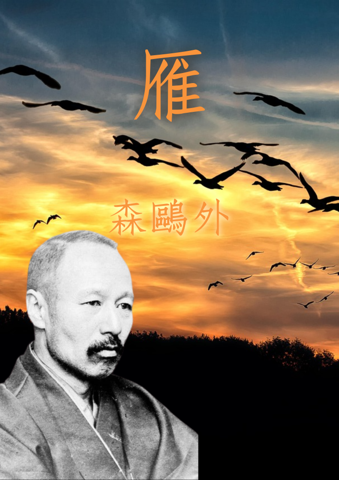
Background: The Wild Geese (Gan) is set in Tokyo around the 13th year of the Meiji era (1880). It is narrated by an observer recalling the relationship between a medical student named Okada, a woman named Otama, and the moneylender Suezō. Due to family and financial pressure, Otama becomes Suezō's mistress, moving into a seemingly stable life; however, she yearns to be respected and seen, developing subtle feelings for the young and upright Okada. The novel depicts a Tokyo of boarding houses, streets, ponds, and walking routes—concrete and everyday, yet governed everywhere by money and class.
Literary Features: Mori Ōgai uses a retrospective, observer-style narrative, keeping the story at a distance. The romance between Okada and Otama never truly begins; instead, it leaves a lingering resonance through misunderstandings, missed opportunities, and information gaps. The most brilliant aspect of the novel is how it portrays fate with such lightness: a single walk, a specific route, or an unspoken intention is enough to change a life. Otama is not a woman waiting to be saved; she observes, learns, and tries to find a better position for herself, but with so few resources at her disposal, every choice is forced into a state of dependence.
Summary: Reading The Wild Geese today, one finds it is not just about unrequited love, but also a novel about inequality of opportunity. Not everyone starts from the same line when discussing love, freedom, and dignity. Otama's loneliness stems from her seeing possibilities that she can hardly reach. This book is suitable for readers who enjoy delicate urban narratives and a sense of gentle melancholy, as well as those reflecting on how women pursue independence within limited circumstances. After becoming Suezō's mistress, Otama gains a stable home but loses her formal freedom. In her daily life, she notices Okada and yearns for his integrity and freshness. Their relationship is built on glances, routes, rumors, and coincidence rather than pursuit. Recalling this years later, the narrator makes the story feel like something that could have happened but was ultimately missed. It is not a tale of grand passion, but of a brief imagination of another life under the constraints of reality.
Miva: the next reading experience beyond audiobooks
Listen like an audiobook, then ask anything, anytime.
Start Miva's narrationMiva does not just narrate. It keeps explaining based on what you ask.