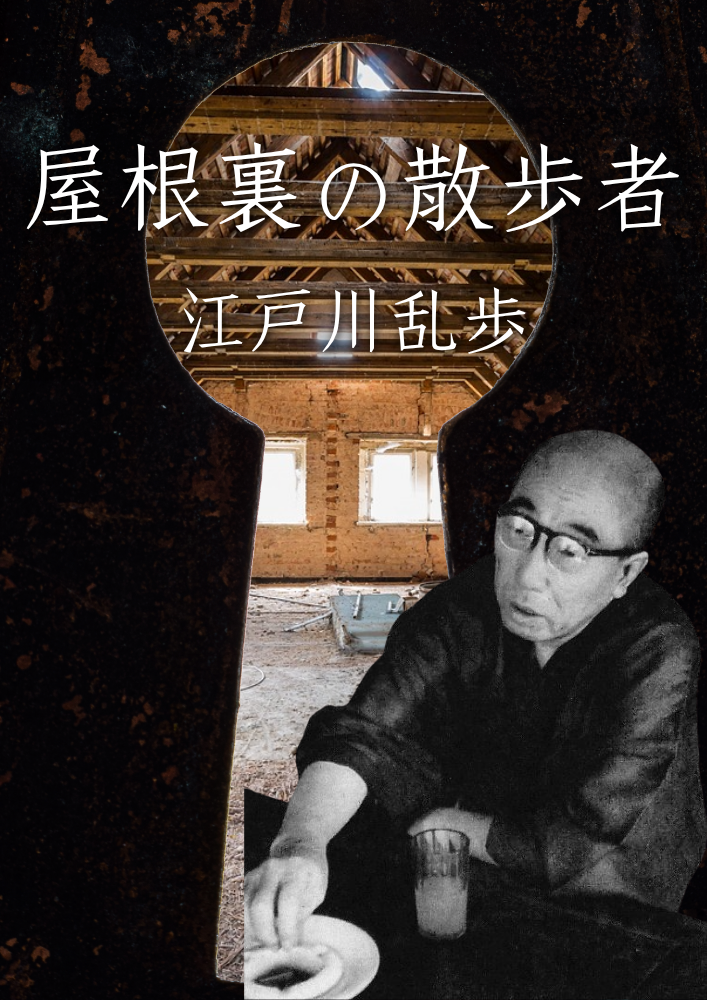
Work Guide
Background:Published in 1925, 'The Watcher in the Attic' (Yaneura no Sanposha) is a short detective story and one of Edogawa Ranpo's seminal early works. It transforms the modern space of urban collective housing into a stage for voyeurism and crime, depicting the unease of an alternate world existing just above everyday life. It is also a work featuring the detective Kogoro Akechi. In the Tokyo of that era, living spaces where strangers lived in close proximity, such as boarding houses and apartments, were expanding. Ranpo utilized this modernity as a criminal device where anonymity and secrets coexist.
Synopsis:Saburo Goda, bored with his life, discovers the pleasure of observing the private lives of other tenants through knotholes in the ceiling after entering the attic from his closet. Eventually, this secret passage transforms from a game of mere observation into the temptation of committing the perfect crime. Goda's actions progress in stages: from accidental discovery to habit, and finally to the consideration of feasibility. Readers follow not just the outcome of the crime, but the process by which boredom erodes ethical boundaries.
Literary Features:The story follows the psychology and actions of the perpetrator first, showing the reader the mechanics of the crime before juxtaposing it with the detective's reasoning, following an inverted detective story structure. The narrow settings—the attic, the closet, and the knothole—simultaneously generate the pleasure of the gaze and the fear of discovery. Within the concise narrative, the anonymity of urban life and the desire for transgression are closely linked. While the perspective remains close to Goda, the appearance of Akechi flips the dynamic, turning the observer into the observed. The physically thin ceiling boards serve as a symbol separating the social surface from hidden desires.
Film and Television Adaptations
The Watcher in the Attic (1970)
A Japanese film directed by Umetsugu Inoue, starring Renji Ishibashi and Junko Miyashita. Known as an adaptation that combines several Ranpo works, it expands the character relationships and period feel of the original short story, heightening the sensuality and criminal drama unique to cinema.
The Watcher in the Attic (1994)
A Japanese film directed by Akio Jissoji, starring Hiroshi Mikami, Masumi Miyazaki, and Kyusaku Shimada. While focusing on the voyeuristic structure of the original, it adds multiple Ranpo-esque motifs and dense aesthetic expression, also reconstructing the role of Kogoro Akechi.
Both films introduce elements from other works and new character relationships to expand the short story into a feature-length film. Consequently, readers returning to the original work from the movies will notice a strong contrast in its brevity and logical focus.
Editions and Translations
This text is the Japanese original, not a translation. Available texts include versions in old characters/kana and modern characters/kana; one must choose by checking the notation, furigana, and source text information. The edition in this metadata corresponds to the modern character/kana public domain text, with the title, character names, and notations based on the included file.
Versions with source information, original publication dates, and editorial notes are suitable for recitation or research, while the modern character/kana version is easier for general readers. In either case, one should verify that the appearances of Kogoro Akechi and the eight numerical sections are intact.
Author and Work
Relationship between Author and Work:This work encapsulates the themes Ranpo pursued from his early career: abnormal psychology, voyeurism, enclosed spaces, and the proximity of crime to play. Rather than a format that hides the mystery until the end, it pushes the boundaries between detective fiction and psychological fiction by showing how a perpetrator's desire progresses into crime. The concept of viewing the daily lives of others from an attic became an iconic image repeatedly cited in later Ranpo reception. This work is also a clear example of Ranpo's method of turning the city itself into a labyrinth on a short-story scale.