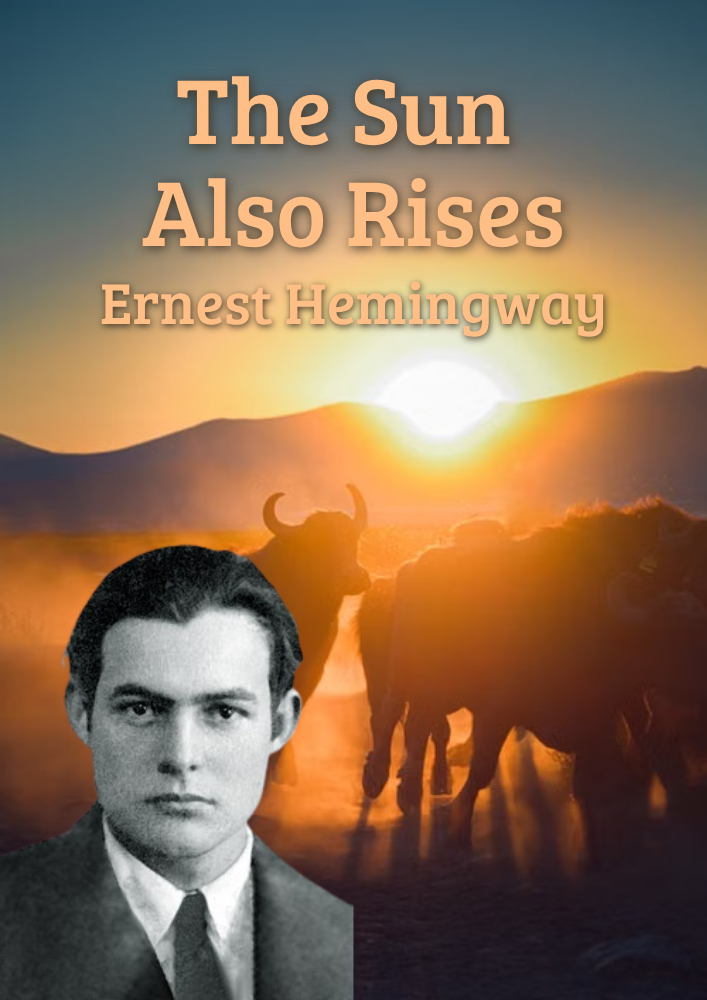
Background: Post-WWI Paris, bars, bullrings, and travel routes become the spiritual map of the Lost Generation. Hemingway portrays the seemingly hedonistic lives of post-war youth as an unhealable wound. The Sun Also Rises connects themes of Hemingway, the Lost Generation, Paris, bullfighting, post-war trauma, and the Jazz Age. It does not treat the era as mere decoration; instead, it allows social shifts, class pressures, post-war psyche, and modern urbanity to permeate the characters' tones, choices, and silences. Readers can thus understand why this work resonated in its time and see the cultural questions it addresses.
Synopsis: Jake Barnes, Brett Ashley, and others drink, travel, argue, and find themselves drawn to one another between Paris and Spain. Physical wounds from the war, emotional impossibility, and a weightless sense of values leave them profoundly lonely even in a crowd. As the story progresses, The Sun Also Rises relies not just on plot twists, but on character relationships, shifting perspectives, and the accumulation of scenes to build tension. Readers follow the protagonists through dilemmas of romance, travel, family, social life, or spiritual exploration, gradually witnessing how surface order is pulled by desire, memory, duty, and misunderstanding. Core plots are preserved here while avoiding spoilers of the most critical ending impact.
Literary Features: Readers can observe how Hemingway uses a stoic style to describe loss and understand how modern travel, alcohol, gender relations, and trauma constitute the core scenes of post-war literature. The sun also rises, but people may not truly recover. Regarding its literary features, what is noteworthy about The Sun Also Rises is not its abstract "classic" status, but how it utilizes narrative rhythm, symbolic imagery, character voices, and structural arrangements to make loneliness, disillusionment, or spiritual crises a tangible reading experience. It is also suitable for reading alongside other works of Modernism, the Jazz Age, and post-war literature to observe how different writers handled the individual within a fractured era.
Encyclopedia
Author's Life: Ernest Hemingway (1899-1961) was one of the most representative American novelists of the 20th century, having also served as a journalist and war correspondent. He is famous for his concise, restrained style and precise dialogue, often called the practitioner of the "Iceberg Theory": the colder the surface text, the deeper the trauma, desire, and loss beneath. His works repeatedly explore war, hunting, travel, male dignity, broken love, and spiritual fatigue, profoundly shaping the literary image of the Lost Generation. He was awarded the Nobel Prize in Literature in 1954. His creations belong not only to the entries of famous names in literary history but are also frequently reread in university courses, book clubs, and cross-cultural discussions; the narrative forms, character psychology, and observations of the era in his works still provide an effective entry point for understanding modern life.
Relationship between Author and Work: Hemingway's ability to write The Sun Also Rises is closely related to his era, creative concerns, and literary ambitions. This work concentrates the issues the author focused on for a long time—Hemingway, the Lost Generation, Paris, bullfighting, post-war trauma, and the Jazz Age—and transforms them into a readable experience through specific characters and narrative forms. It is not a simple projection of the author's biography, but the result of the author combining personal observation, temporal pressure, and formal experimentation. Therefore, when reading this book, it is best to pay attention to both the author's life background and how the text reforges that background into literary form.
Miva: the next reading experience beyond audiobooks
Listen like an audiobook, then ask anything, anytime.
Start Miva's narrationMiva does not just narrate. It keeps explaining based on what you ask.