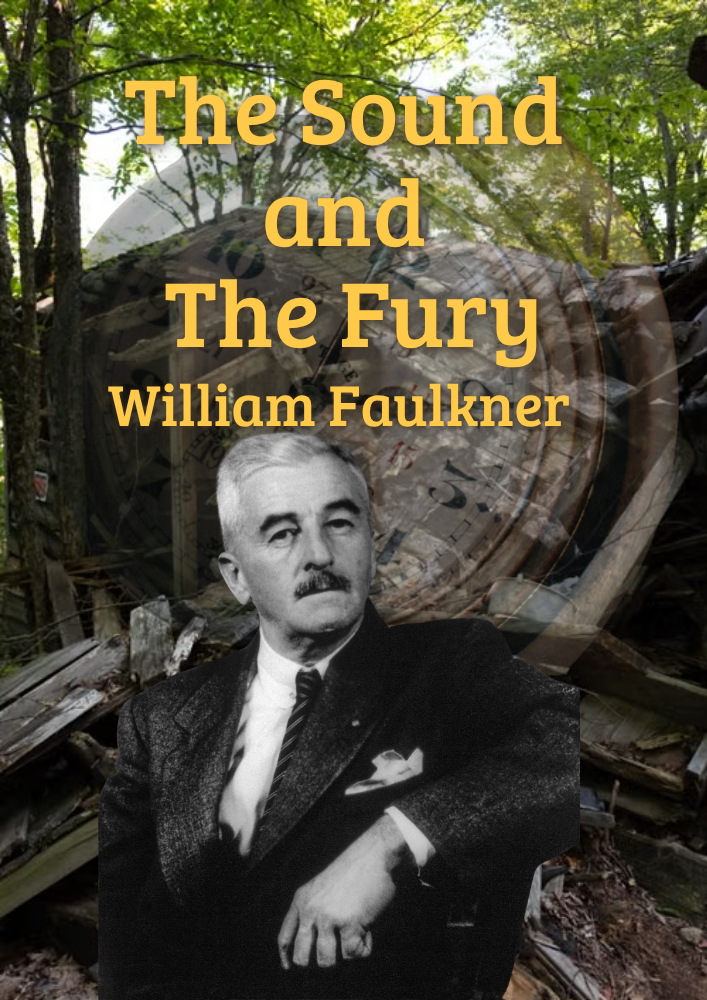
Background: The American South continued to decline within the class, racial, and familial order following the Civil War. Faulkner captures how the myths of the Old South rot through memory, guilt, and time via the disintegration of the Compson family. The emergence of The Sound and the Fury connects Faulkner, the American South, stream of consciousness, modernism, familial decay, and time. Rather than treating the era as decorative background, it allows social change, class pressure, post-war spirit, and modern urbanity to enter the characters' tones, choices, and silences. Readers can thus understand why this work resonated in its time and see the cultural issues it addresses.
Synopsis: The novel is divided into multiple narrative sections, piecing together the fate of Caddy and her family through the perspectives of Benjy, Quentin, Jason, and an external viewpoint. Time is shattered, and memories emerge out of order; readers must reconstruct the tragedy from fractured language. As the story progresses, The Sound and the Fury relies not just on plot twists, but on character relationships, shifting perspectives, and the accumulation of scenes to create tension. Readers follow the main characters into dilemmas of romance, travel, family, social life, or spiritual exploration, gradually seeing how the surface order is driven by desire, memory, duty, and misunderstanding. Core plots are preserved here, while avoiding premature disclosure of the most critical final impact.
Literary Features: This is a vital work for understanding High Modernist techniques. It demands patience and offers deep rewards: readers will see how form is not just a display of skill, but the only authentic expression of a disordered mind and a collapsing family. Regarding literary features, The Sound and the Fury is notable not for an abstract "classic" status, but for how it utilizes narrative rhythm, symbolic imagery, character voices, and structural arrangements to make loneliness, disillusionment, or spiritual crisis a felt reading experience. It is also suitable for reading alongside other modernist, Jazz Age, and post-war literary works to observe how different writers handle the individual within a fractured era.
Encyclopedia
Author's Life: William Faulkner (1897-1962) was a pivotal writer of Southern literature and High Modernist fiction, receiving the Nobel Prize in Literature in 1949. Centering his work on the fictional Yoknapatawpha County, he spent his career writing about the familial decay, racial violence, historical guilt, and temporal trauma of the American South. Faulkner's narratives often adopt multiple perspectives, fractured time, and dense interior language; reading requires patience, but allows the reader to feel that history is not a background, but a force still active within the characters. His creations belong not only to entries on masters of literary history but are also frequently revisited in university courses, book clubs, and cross-cultural discussions; the narrative forms, character psychology, and observations of the era in his works still provide valid entry points for understanding modern life.
Relationship Between Author and Work: The reason William Faulkner could write The Sound and the Fury is closely related to his era, his creative concerns, and his literary ambitions. This work concentrates the long-term interests of the author—Faulkner himself, the American South, stream of consciousness, modernism, familial decay, and time—and transforms them into a readable experience through specific characters and narrative forms. It is not a simple projection of the author's life, but the result of the author combining personal observation, the pressures of the era, and formal experimentation. Therefore, when reading this book, it is best to simultaneously note the author's life background and how the text reforges that background into literary form.
Miva: the next reading experience beyond audiobooks
Listen like an audiobook, then ask anything, anytime.
Start Miva's narrationMiva does not just narrate. It keeps explaining based on what you ask.