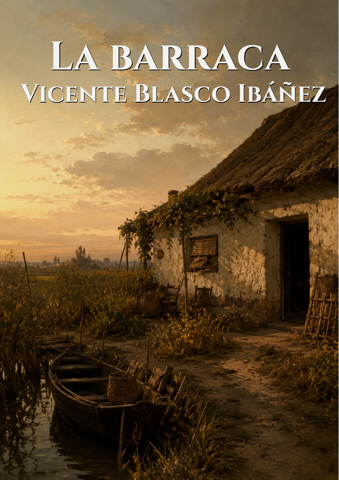
La barraca (The Shack or The Hut) is a novel by Valencian writer Vicente Blasco Ibáñez published in 1898 and considered one of the most important works of Spanish naturalism. It is part of the author’s so-called “Valencian cycle,” alongside novels such as Mayflower, Among Orange Trees, and Reeds and Mud, in which he portrays the rural life of the Valencian fertile plains (the huerta) with intense, social, and deeply human realism. Translated into English as The Shack or The Hut, the novel achieved enormous international popularity and sold over a million copies in the English-speaking world.
The story takes place in the huerta of Valencia, an agricultural landscape marked by irrigation canals, traditional shacks (barracas), and peasant poverty. It begins when the Barret family is evicted from their land for being unable to pay their debts to the owner, Don Salvador. Consumed by rage and humiliation, Barret murders the landlord and ends up in prison. From then on, the shack is cursed by the local inhabitants: no one wants to work that land for fear of collective rejection.
Sometime later, Batiste and his family arrive from outside the region and agree to occupy the abandoned shack in hopes of starting a new life. However, the neighbors consider them traitors for cultivating land marked by misfortune and injustice. What begins as hostile glares and rumors eventually turns into violence, social isolation, and collective hatred. Batiste's family is slowly pushed toward tragedy by a community unable to break the cycle of resentment and poverty.
Although La barraca is a rural novel, it actually functions as a social and political critique. Blasco Ibáñez shows how poor peasants end up fighting each other instead of rebelling against those truly responsible for their misery: the large landowners and power structures. The novel denounces the ignorance, fanaticism, and brutality born of social inequality, while simultaneously reflecting the daily life of the Valencian plains in great detail.
The influence of French naturalism, especially Émile Zola, is evident in the work. The characters appear conditioned by their environment, heritage, and social circumstances, as if they were inevitable products of the milieu in which they live. However, alongside this social harshness, Blasco Ibáñez introduces lyrical descriptions of the Valencian fields, irrigation systems, harvests, and the intimate relationship between the peasant and the land.
One of the most modern aspects of La barraca is its representation of collective violence. The novel does not present a single villain, but rather an entire community that turns fear and resentment into persecution. This vision of organized social hatred makes the work remain contemporary more than a century after its publication.
The novel had a huge cultural impact. It was adapted for cinema in Mexico in 1945 and, most notably, for Spanish television in 1979 in a famous series produced by Televisión Española. This adaptation, directed by León Klimovsky, was filmed near the Valencian Albufera and became one of the most important literary adaptations in Spanish television history.
Miva: the next reading experience beyond audiobooks
Listen like an audiobook, then ask anything, anytime.
Start Miva's narrationMiva does not just narrate. It keeps explaining based on what you ask.