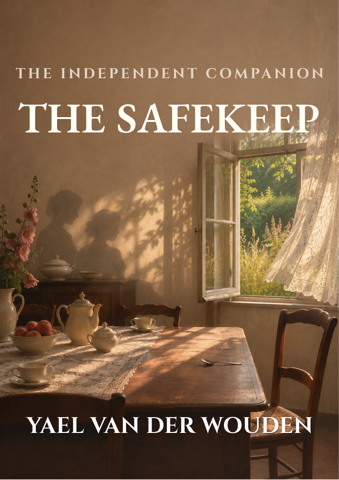
In 1961 Netherlands, Isabel lives a solitary life, strictly guarding the country house left by her mother, until her brother’s girlfriend Eva moves in, disrupting the order and awakening both desire and suspicion. This guide tracks the house, missing objects, postwar silence, and the relationship between the two women, while preserving the historical revelations that redefine ownership.
This independent guide follows Isabel’s inventory-like gaze over rooms and objects, recording what goes missing, what Eva changes, and how family claims conflict with postwar history, without revealing the documents that flip the narrative of ownership.
Winner of the 2025 Women’s Prize for Fiction; Winner of the National Jewish Book Award for Debut Fiction; Shortlisted for the 2024 Booker Prize; Shortlisted for the 2025 Dylan Thomas Prize; Shortlisted for the 2025 Aspen Words Literary Prize.
Isabel views the house left by her mother as a closed system, as if objects staying in their original places could prove family continuity and ownership. After Eva moves in, items disappear, routines crumble, and hostility becomes entangled with attraction; however, the history of the house cannot be understood through desire alone. Private conflicts gradually link to the war, property confiscation, and who is permitted to remember. The novel stays close to Isabel’s perspective, making her interpretations seem like facts until details begin to rebel. The guide tracks rooms, objects, family claims, and the difference between observation and projection, supplementing necessary postwar background without revealing key documents. Ideal for readers of psychological literature, queer historical fiction, domestic suspense, and architecture as a carrier of political memory.
The reading difficulty of the novel lies in how Isabel’s obsession with order dictates the narrative tone, making it easy for readers to mistake her suspicions for objective information. The guide contrasts missing items, room usage, family conversations, and Eva’s reactions point-by-point, ensuring the threads of desire and history remain identifiable before the final revelation.
Rooms and objects carry a history the family is unwilling to narrate; the guide tracks when domestic details shift from atmosphere to evidence.
Isabel’s hostility and attraction influence what she believes she sees; the notes distinguish between observation and projection.
The novel asks who can claim a house belongs to them after occupation and persecution; the guide provides background without leaking the decisive documents.
On a first read, one can separate Isabel’s judgments from the actually visible objects to avoid taking hostility as fact; after finishing, one can re-examine room usage, missing items, and family conversations to understand when private desire and public history began to overlap.
Version Statement: This product is an independently produced chapter guide and summary, not the full text of the original work; it is recommended as a review and reading aid to be used alongside the complete work.
Miva: the next reading experience beyond audiobooks
Listen like an audiobook, then ask anything, anytime.
Start Miva's narrationMiva does not just narrate. It keeps explaining based on what you ask.