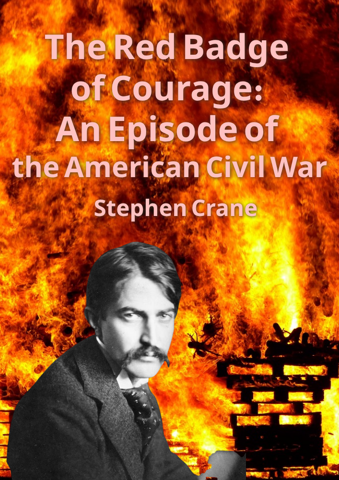
When Crane writes about war, the true battlefield is often within the soldier's mind.
Set against the backdrop of the American Civil War, Stephen Crane's The Red Badge of Courage depicts the fear, desertion, shame, delusions, and eventual re-engagement of young soldier Henry Fleming. The novel shatters traditional heroic narratives, portraying courage as an unstable, chaotic, and self-deceptive psychological process. Henry longs for a wound to serve as proof of bravery, yet must confront his own ignoble motives on the actual battlefield. Using impressionistic imagery, color-driven language, and a narrative style closely tied to consciousness, the work presents war as a fragmented, noisy, and unreliable state. Crane does not portray war as a clear stage for justice, but rather as a site of sensory overload and group pressure, where humans are often dominated by fear before laboring to interpret their actions as brave.
Crane's innovation lies in compressing the grand narrative of war into a single soldier's shifting perceptions. The intersection of gunfire, smoke, color, mass movement, and fleeting thoughts prevents the reader from gaining a stable overview of the battlefield, forcing them instead into Henry's panicked consciousness. This approach gives the work a modern feel: it is in no hurry to define a hero, asking instead how individuals fabricate stories about themselves amidst terror.
In the context of this book list, it moves the "wilderness trial" into the psychology of the battlefield: self-reinvention is not an outward conquest, but a reassembly of self-understanding amidst fear and shame.
This gives the novel its lasting power: it doesn't ask the reader to worship bravery, but to understand how bravery is temporarily pieced together in the midst of chaos.
It deconstructs the heroic narrative, leaving behind a more authentic and unsettling psychological scene.
Readers will remember not the tactical overview of the battle, but how a person loses and reconstructs their self-image within it.
Miva: the next reading experience beyond audiobooks
Listen like an audiobook, then ask anything, anytime.
Start Miva's narrationMiva does not just narrate. It keeps explaining based on what you ask.