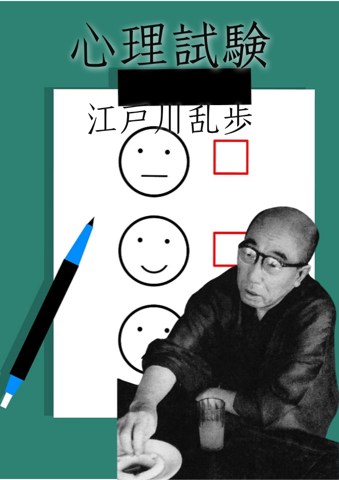
Background: An inverted detective story where Kogoro Akechi reads the gaps in psychology and speech after the criminal reveals their plan. The core of the story lies not just in the titular test, but in the discrepancy between prepared responses and unconscious reactions. Considering the era of its creation and the history of its publication, it is easy to see how the narrative responded to its contemporary context. While readers may find alternative titles via search, these are considered supplementary, and the standard title of the collected text is used consistently.
Narrative and Content: Seiichiro Fukiya, a university student, plans a meticulous crime and even prepares for the psychological test used in the investigation. However, Kogoro Akechi focuses on a small reaction distinct from the test results themselves. This guide serves as an entry point for reading the development and form of the text, rather than a detailed summary of the ending or a character list. The difference between what the narrator knows and what the reader can infer, as well as shifts in time indicated by chapters or song sequences, serve as clues for interpretation.
Literary Features: Using the inverted mystery format—where the culprit and plan are revealed first—the reader's interest shifts from identifying the murderer to psychological slips. It is unique in that it relies on the gap between prepared answers and impulsive words rather than numerical test data. By examining the tone, pauses, and repetitions that disappear in a mere summary, the specific flavor of the work becomes clearer.
Encyclopedia
Author Biography: Edogawa Ranpo (1894–1965), real name Taro Hirai, was a leading writer, critic, and editor of Japanese detective fiction. Active under a pen name inspired by Edgar Allan Poe, he depicted codes, locked rooms, disguises, perverse psychology, and the spectacle of the city in diverse forms. In his early short stories, he introduced Kogoro Akechi, linking criminal psychology with logical reasoning. Later, he developed a series for children centered on the Boy Detectives Club and the Fiend with Twenty Faces, and after the war, he devoted himself to the activities of the Detective Writers Club of Japan and the nurturing of new talent.
Relationship between Author and Work: Ranpo experimented with the inverted format, showing the criminal's preparation first so that Akechi could read the discrepancies between psychology and speech. He was more interested in the process of a self-conscious mind collapsing while trying to outsmart a testing apparatus than in the apparatus itself.
Media Comparisons (Last 10 Years): While not a direct adaptation, the reasoning methods can be compared to the film "Don't Say Mystery" (2023). This work uses an inverted structure to show the culprit's preparation and unconscious reactions, while the film unravels contradictions in testimony through dialogue and family history. When comparing across media and eras, specific titles and years are provided, and if not a direct adaptation, differences in focus are compared as thematic readings.
Publisher
BookAI
Published
2026-09-16
Miva: the next reading experience beyond audiobooks
Listen like an audiobook, then ask anything, anytime.