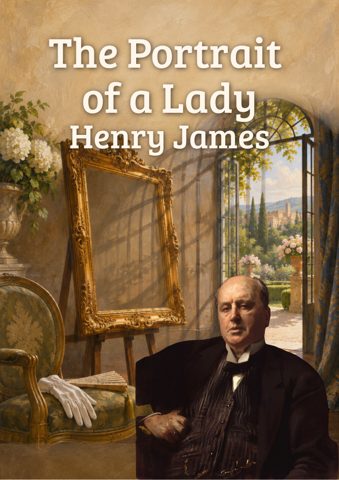
Background:
First published in book form in 1881, the novel places an American woman's wish for freedom within transatlantic wealth, travel, marriage, taste, and the unequal information available inside social relationships.
The central tension:
Isabel Archer arrives in Europe determined to preserve possibility and independence. An inheritance expands her choices while also making her the object of plans she cannot fully see.
How the writing works:
Third-person narration closely aligned with Isabel, extended scenes of consciousness, delayed disclosure, symbolic rooms and objects, and shifts in social perspective turn freedom into a problem of interpretation.
Isabel Archer arrives in Europe believing that freedom means keeping possibilities open. An inheritance appears to enlarge that freedom, but it also makes her newly useful to people who possess more social knowledge than she does. James turns a familiar story of choice into a study of unequal information: formal consent can coexist with manipulation when one person understands the game and another understands only the ideal.
The novel's long central movement depends on changes in perception rather than external action. Rooms, portraits, collections, and arrangements of furniture reveal how aesthetic taste can become a form of control. Madame Merle's social fluency and Gilbert Osmond's cultivated stillness are compelling because Isabel initially reads them as alternatives to vulgar convention.
The complete novel spans two volumes. Read continuously across the volume break: the second half transforms earlier scenes by revealing the cost of judgments that once looked generous or romantic. Jane Campion's film externalizes Isabel's inner life through montage and fantasy, but the novel's deepest suspense remains grammatical—the moment a perception becomes an irreversible knowledge.
Isabel's imagination is the source of both her appeal and her danger. She wants experience without premature definition, and James lets that desire feel generous rather than foolish. The inheritance seems to remove practical limits, but money increases the number of people able to translate their interests into opportunities for her. Madame Merle and Osmond do not simply deceive Isabel; they offer aesthetic and emotional forms that her idea of freedom has not taught her to question.
The novel's famous intensity comes from watching perception change after action has hardened into consequence. A room, a portrait, or an arrangement of objects can reveal a marriage more completely than an argument. James delays information so that readers must revise earlier admiration alongside Isabel. Her eventual knowledge does not automatically create an exit, and that resistance to easy rescue is essential. The book asks whether moral freedom can survive inside obligations one now understands differently, a question more unsettling than the marriage plot that carries it.
This is a novel to enter for its spaciousness and continue for its tightening design. Early possibilities feel almost limitless; gradually the same rooms, relationships, and aesthetic choices acquire the pressure of a trap. James does not ask us to despise Isabel for being deceived. He makes us remember why the deception resembled the life she wanted. Readers drawn to psychological depth, morally ambiguous friendship, and the consequences of choices made under unequal knowledge will find the book's long attention not an obstacle but its chief source of suspense.
Director: Jane Campion
Production country: United Kingdom / United States
Cast: Nicole Kidman, John Malkovich, Barbara Hershey
Difference from the book: compresses the novel's social field and uses stylized fantasy and montage to externalize Isabel's inward life.
The complete novel has 55 chapters across two volumes. Because James later revised it for the New York Edition, scholarly quotation should identify the textual state used.
The novel endures as a searching account of agency: choices can be formally free yet shaped by money, aesthetics, secrecy, and social scripts that the chooser has not authored.
Miva: the next reading experience beyond audiobooks
Listen like an audiobook, then ask anything, anytime.
Start Miva's narrationMiva does not just narrate. It keeps explaining based on what you ask.