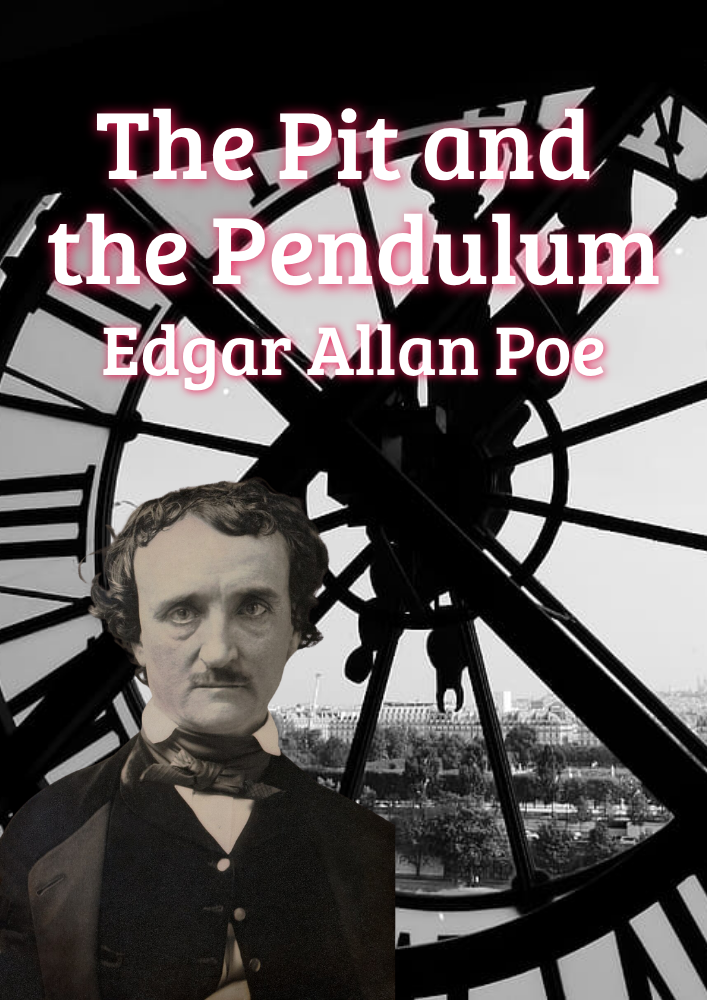
Work Background:
The Pit and the Pendulum, by Edgar Allan Poe, first appeared in 1842. Poe's theory of concentrated effect appears here in the restriction of knowledge to one prisoner's senses and in the carefully timed succession of threats. The tale is a defining example of psychological terror built from sensory uncertainty rather than supernatural explanation, and its title has become a durable image of approaching danger. A first-person narrator measures terror through bodily sensation, darkness, sound, and narrowing space. The tale withholds biography so that perception and the mechanics of confinement carry the narrative. This context explains the work's choice of voice, structure, and genre, while helping readers recognize the literary setting and social institutions surrounding its first publication or performance. Readers may notice how public rules enter private judgment, how repeated images change meaning, and how form controls what can be known at each stage.
Story Overview:
An unnamed prisoner of the Spanish Inquisition awakens in darkness and tries to understand the chamber intended to kill him. Each escape reveals another mechanism of confinement, so the story advances through perception, measurement, bodily fear, and rapidly narrowing choices. This summary identifies only the central situation and direction without revealing the ending. As speakers, settings, scale, or social positions change, earlier events take on new meanings; the work's effect lies not only in its incidents but also in pacing, point of view, silence, and the distance between what characters understand and what readers can infer.
Director: Roger Corman
Production country: United States
Principal cast: Vincent Price, John Kerr, Barbara Steele, and Luana Anders
Difference from the book: Poe's brief prison ordeal becomes the climax of a new Gothic family mystery; the film invents Nicholas Medina, his castle, and most of the plot.
Director: Stuart Gordon
Production country: United States
Principal cast: Lance Henriksen, Rona De Ricci, Jonathan Fuller, and Oliver Reed
Difference from the book: The film builds a Spanish Inquisition narrative around Torquemada and an accused woman, retaining the pendulum device but replacing Poe's anonymous inward monologue with an ensemble plot.
The selected full text is the verified digital edition numbered 2148. Market titles include: The Pit and the Pendulum; The Pit and the Pendulum: A Tale; Le Puits et le Pendule; El pozo y el péndulo; 陷阱與鐘擺. When choosing an edition, distinguish complete, abridged, annotated, modernized, and collected versions, and verify the translator, publisher, and year for each.
The tale is a defining example of psychological terror built from sensory uncertainty rather than supernatural explanation, and its title has become a durable image of approaching danger. Poe's theory of concentrated effect appears here in the restriction of knowledge to one prisoner's senses and in the carefully timed succession of threats. These qualities place the book at a specific point in the author's career and in the development of its genre. Its influence rests on recognizable questions of language, structure, history, and judgment rather than on a vague label of “classic.” Reading the full text beside another translation, stage production, or film reveals what later editors, translators, actors, and directors preserve, explain, compress, or rearrange, and brings out formal effects that summaries often conceal.
Reading another work from the same author's career also shows which concerns persist and which methods change. The book remains open to interpretation, disagreement, and rereading because readers can return to its actual language and arrangement instead of allowing later reputation to replace the experience of reading.
Miva: the next reading experience beyond audiobooks
Listen like an audiobook, then ask anything, anytime.
Start Miva's narrationMiva does not just narrate. It keeps explaining based on what you ask.