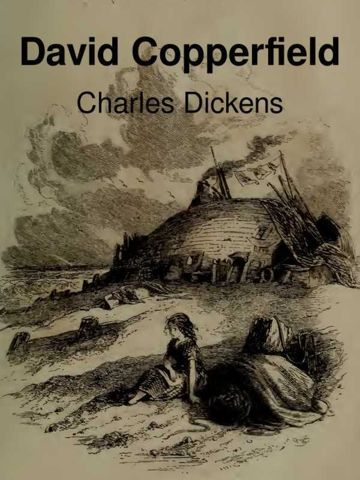
Charles Dickens's 'The Personal History of David Copperfield' is a classic bildungsroman, originally published as a serial between 1849 and 1850. Narrated by the protagonist, David Copperfield, the novel chronicles his life journey from a naive orphan to a successful author in Victorian England. David's early life is marked by hardship and cruelty following his mother's remarriage to the tyrannical Edward Murdstone. He endures a harsh boarding school, child labor in a London factory, and the loss of his loved ones. Seeking refuge with his eccentric but kind-hearted aunt, Betsey Trotwood, David finds a chance for a new beginning. However, he continues to face numerous challenges, including the manipulative schemes of the villainous Uriah Heep and a series of complex relationships that profoundly shape his character and path toward self-discovery and adulthood.
Reading ease score: 78.8 (7th grade). Fairly easy to read.
David Copperfield is born in Blunderstone, Suffolk, six months after the death of his father. On the night of his birth, his eccentric great-aunt, Betsey Trotwood, visits the house expecting a grandniece. Horrified to discover the newborn is a boy, she departs in indignation. Young David spends his earliest years in quiet happiness, raised by his devoted mother, Clara, and their loyal, warm-hearted housekeeper, Clara Peggotty. This tranquil childhood shatters when Clara marries the cold, stern Edward Murdstone. Mr. Murdstone and his equally cruel sister, Jane, move into the home and enforce a harsh regime of tyranny. During a lesson in which David struggles to perform under pressure, Mr. Murdstone severely beats him; in desperation, David bites his stepfather’s hand. As punishment, he is sent away to Salem House, a grim boarding school run by the brutal headmaster Mr. Creakle. There, David forms pivotal friendships with Tommy Traddles and the charismatic, aristocratic James Steerforth. Tragedy strikes when David’s mother and her infant child pass away. Discarded by his stepfather, ten-year-old David is sent to London to work in a damp warehouse owned by Murdstone and Grinby. During this miserable period, he lodgings with the eccentric, perpetually insolvent Wilkins Micawber, who remains ever optimistic that "something will turn up." When the Micawbers leave London to escape debt, David runs away on foot to Dover to throw himself on the mercy of his aunt, Betsey Trotwood. Aunt Betsey takes David in, shields him from the Murdstones, and renames him "Trotwood Copperfield." Under her care and the companionship of her gentle friend Mr. Dick, David thrives. She sends him to school in Canterbury, where he lodges with her lawyer, Mr. Wickfield, and meets Wickfield’s sweet, selfless daughter, Agnes, as well as the insidious, scheming clerk Uriah Heep. As David grows into manhood, he enters a legal apprenticeship in London, falls passionately in love with Dora Spenlow, the sweet but childish daughter of his employer, and eventually marries her. Concurrently, dark turns unfold in the lives of those around him. Steerforth betrays David’s trust by seducing and eloping with Little Em'ly, the adopted niece of Peggotty’s brother, plunging the seaside Peggotty family into heartbreak. Meanwhile, Uriah Heep uses deception and blackmail to usurp Mr. Wickfield's business and fortunes. Through perseverance, David learns shorthand, becomes a successful reporter, and eventually a renowned author. With the assistance of Mr. Micawber and Traddles, Uriah Heep’s fraudulent schemes are exposed, restoring Mr. Wickfield’s honor and Aunt Betsey’s lost wealth. Tragic losses follow: Dora succumbs to a frail illness and dies young, while a violent storm at Yarmouth claims the lives of both Ham Peggotty and Steerforth. To heal from his profound grief, David travels abroad across Europe for several years, reflecting deeply on his past struggles and personal growth. Upon returning to England, he realizes that his lifelong affection for Agnes Wickfield has matured into true, enduring love. The two marry, finding profound happiness and raising a family together. Mr. Peggotty, Emily, and the Micawber family emigrate to Australia to start anew, ultimately achieving prosperity and peace.
Whether I shall turn out to be the hero of my own life, or whether that station will be held by anybody else, these pages must show.The Personal History of David Copperfield Chapter 1. It establishes the fundamental thematic framework of self-determination, identity, and personal agency that drives the entire narrative.
What I had to do, was, to take my woodman’s axe in my hand, and clear my own way through the forest of difficulty, by cutting down the trees until I came to Dora.The Personal History of David Copperfield Chapter 36. It serves as a powerful metaphor for perseverance, emotional maturity, and the triumph of individual resolve over life's hardships.
Annual income twenty pounds, annual expenditure nineteen nineteen six, result happiness. Annual income twenty pounds, annual expenditure twenty pounds ought and six, result misery.The Personal History of David Copperfield Chapter 12. It succinctly captures Dickensian character comedy while delivering an enduring, universally recognizable piece of practical life advice.
The novel is widely considered one of Charles Dickens's most accessible works, earning a comfortable reading ease score suitable for middle school readers and adults alike. Written in the first person, the narrative adopts a conversational, reflective tone that invites the reader directly into David's inner world. While the text reflects nineteenth-century vocabulary and sentence structures, the prose remains clear, engaging, and rich with humor. Dickens balances emotional depth with lively dialogue, making the expansive narrative flow naturally across its chapters.
The work stands as a masterpiece of Victorian fiction due to its profound characterization, social commentary, and autobiographical resonance. As a seminal bildungsroman, it captures the universal human experience of growing up, confronting hardship, and learning to navigate the complexities of love and ambition. Dickens draws heavily from his own childhood experiences in a blacking factory, lending an unmatched authenticity to David's early struggles. Furthermore, the novel introduced some of the most famous figures in English literature, including Mr. Micawber and Uriah Heep, whose distinct voices continue to resonate across generations.
Dickens utilizes David's journey to critique several pressing Victorian social problems, most notably the harsh reality of child labor and the mistreatment of orphans. Through David's time at Murdstone and Grinby's warehouse, the novel exposes the cruel economic system that exploited young children in industrial London. Additionally, the narrative highlights the flawed legal and financial institutions of the era, such as debtors' prisons, while examining the rigid class barriers that allowed wealthy figures to prey upon vulnerable working-class families without immediate consequence.
The novel is Dickens's most explicitly autobiographical work, sharing numerous direct parallels with the author's personal history. Like David, Dickens suffered the humiliation of working in a factory as a young boy while his father was incarcerated in a debtors' prison. David's later careers as a legal clerk, a shorthand parliamentary reporter, and ultimately a successful author mirror Dickens's own professional trajectory. By weaving his personal memories into David's narrative, Dickens transformed his private hardships into a transcendent piece of art.
The enduring appeal of the relationships stems from the vivid contrast between genuine affection and manipulative self-interest. David's growth is shaped by contrasting pairs: the superficial charm of James Steerforth against the quiet integrity of Tommy Traddles, and the childlike innocence of Dora Spenlow against the steady, wise guidance of Agnes Wickfield. These dynamic character intersections create constant narrative tension, showing how personal choices and the influence of companions shape a person's moral character over time.
At the culmination of David's long journey lies the quiet resolution of a life rebuilt from hardship, grief, and emotional growth. What awaits in these ultimate chapters is not merely the exposure of past deceptions, but a profound homecoming of the heart where scattered lives converge and long-standing debts of devotion are honored. Every trial David experienced finds its true purpose as quiet clarity replaces years of uncertainty. Read these final pages for yourself to experience the complete resolution of his story.
Miva: the next reading experience beyond audiobooks
Listen like an audiobook, then ask anything, anytime.
Start Miva's narrationMiva does not just narrate. It keeps explaining based on what you ask.