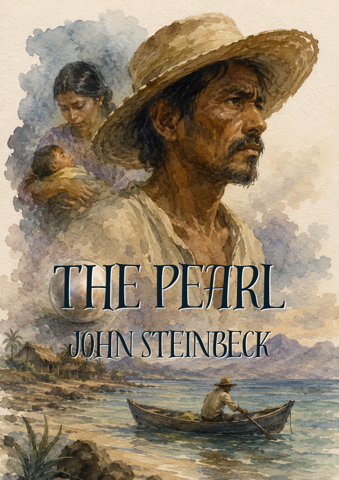
The Pearl — Extended Book Introduction
The Pearl is a short novel by John Steinbeck, first published in 1947. Although relatively brief, it is widely regarded as one of Steinbeck’s most powerful and symbolic works. The story combines the simplicity of a folk tale with deep philosophical and social criticism, exploring themes such as greed, poverty, colonial oppression, fate, morality, and the fragile nature of human hope.
The novella originated from a Mexican folk legend Steinbeck heard during his travels in Baja California in 1940. Fascinated by the story’s tragic structure and moral implications, Steinbeck transformed it into a literary parable that reflects both individual human weakness and broader systems of exploitation. Before its publication as a novella, the story first appeared in 1945 under the title The Pearl of the World.
The story takes place in La Paz, a coastal town whose economy historically depended on pearl diving. Steinbeck deliberately chose this setting because it reflects a world divided by class, race, and colonial power. The indigenous fishermen live in poverty while wealthy colonial authorities — represented by the doctor, priest, and pearl dealers — maintain control over wealth and knowledge. Through this contrast, Steinbeck critiques systems that keep marginalized communities trapped in dependence and inequality.
At the center of the story is Kino, a poor pearl diver who lives peacefully with his wife Juana and their infant son Coyotito. Their modest life changes dramatically after Coyotito is stung by a scorpion. When the local doctor refuses to treat the child because the family is poor and indigenous, Kino becomes desperate to find a pearl valuable enough to pay for medical care and secure a better future for his family.
Kino’s discovery of an enormous pearl — “The Pearl of the World” — initially appears miraculous. He dreams of education for Coyotito, proper clothing, marriage in a church, and freedom from poverty. For the first time, he imagines escaping the social limitations imposed upon him. However, the pearl quickly becomes a destructive force. It attracts greed, violence, envy, manipulation, and betrayal from nearly everyone around him.
As the story progresses, Steinbeck transforms the pearl into a powerful symbol. At first, it represents hope and opportunity, but gradually it becomes associated with corruption and evil. The same object that promises liberation ultimately destroys Kino’s peace, his morality, and his family. Steinbeck suggests that wealth itself is not inherently evil, but human desire and social corruption can poison even the purest dreams.
One of the novella’s greatest strengths is its symbolic structure. Nearly every element functions on multiple levels:
The scorpion represents sudden evil entering innocent life.
The pearl symbolizes both hope and destruction.
The sea reflects fate, nature, and the unpredictable forces of life.
Kino’s canoe symbolizes cultural identity and survival.
Music repeatedly appears as an emotional and psychological motif, revealing Kino’s inner state.
Steinbeck’s writing style in The Pearl is intentionally simple, almost biblical in tone. The language resembles oral storytelling traditions and traditional myths, making the story feel universal and timeless. Because of this style, the novella is often described as a parable or modern fable. Yet beneath its apparent simplicity lies sophisticated social commentary about colonialism, capitalism, racism, and the human tendency toward self-destruction.
The relationship between Kino and Juana is also central to the novel. Juana often acts as the voice of intuition, wisdom, and moral clarity. She recognizes the danger of the pearl long before Kino does and repeatedly urges him to destroy it. Kino, meanwhile, becomes increasingly consumed by pride, ambition, and the desire to challenge the social order. Their conflict reflects a deeper philosophical tension between acceptance and aspiration, tradition and change.
The novella reaches its tragic climax when Kino, hunted by trackers who want the pearl, attempts to protect his family by fleeing into the mountains. In the chaos of violence, Coyotito is accidentally killed. The ending is devastating because Kino finally realizes that the pearl has brought not salvation but irreversible suffering. Returning to La Paz with his dead child, he throws the pearl back into the ocean — a symbolic rejection of greed, illusion, and corrupted ambition.
Critically, The Pearl has long been praised for its emotional power, accessibility, and thematic richness. It is one of Steinbeck’s most widely taught works in schools because its straightforward narrative allows readers to engage with complex moral and social questions. Scholars have interpreted the novella through many lenses, including Marxist criticism, colonial studies, psychology, religious symbolism, and existential philosophy.
The book also reflects Steinbeck’s broader literary concerns. Like many of his major works, it focuses on ordinary people struggling against forces larger than themselves — poverty, economic systems, violence, and fate. Similar themes appear in The Grapes of Wrath, Of Mice and Men, and East of Eden, though The Pearl expresses them in a more compressed and symbolic form.
The novella has been adapted multiple times into film and theater. The most famous adaptation is the 1947 Mexican film La Perla, which Steinbeck himself helped develop. The story’s universal themes and tragic structure have allowed it to remain culturally influential for decades.
Today, The Pearl continues to endure because it speaks to timeless human experiences: the desire for dignity, the seduction of wealth, the fear of losing one’s humanity, and the painful realization that dreams can become destructive obsessions. Though short in length, the novella carries the emotional and philosophical weight of a much larger work, making it one of the defining achievements of twentieth-century American literature.
Miva: the next reading experience beyond audiobooks
Listen like an audiobook, then ask anything, anytime.
Start Miva's narrationMiva does not just narrate. It keeps explaining based on what you ask.