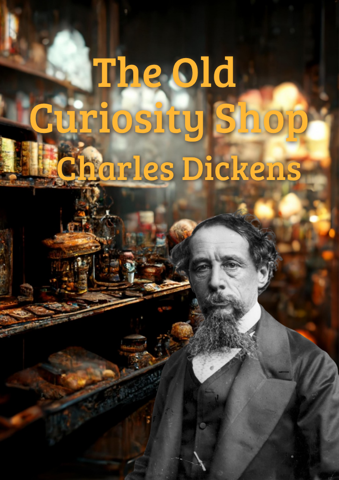
Historical background:
Dickens serialized this novel in Master Humphrey's Clock in 1840–1841. Its mixture of a vulnerable child, debt, urban commerce, travel, grotesque comedy, and public spectacle reflects a publication rhythm designed to shift tone and location across weekly installments.
Story introduction:
A girl and her grandfather leave a curiosity shop under pressure from debt and pursue an uncertain journey through English towns and entertainments. The overview withholds later outcomes and concentrates on how economic dependence turns movement itself into danger.
Literary form:
Dickens alternates sentimental pathos with caricature, crowds, theatrical episodes, and threatening interiors. The episodic road structure can feel uneven in a single volume, but that unevenness records serial suspense and the novel's movement among different reading publics.
Central themes:
A girl and her grandfather leave a curiosity shop under pressure from debt and pursue an uncertain journey through English towns and entertainments. The overview withholds later outcomes and concentrates on how economic dependence turns movement itself into danger. Beyond that immediate situation, The Old Curiosity Shop examines Charles Dickens, serial fiction, debt, childhood, travel, Victorian Britain. The book occupies an early point in Dickens's career when serialized publication and public response closely shaped narrative expectation. Its afterlife in illustration, theatre, film, and television demonstrates how different media redistribute its balance of sentiment, grotesque humor, and social precarity. Together, these concerns give the conflict its moral and historical weight beyond the immediate plot.
Director: Brian Percival
Production country: United Kingdom
Principal cast: Sophie Vavasseur, Derek Jacobi, Toby Jones
Why this version matters: This identifiable production provides a useful comparison between the selected text and a major screen interpretation associated with named filmmakers and performers.
Difference from the book: It compresses the novel's episodic travels and broad secondary cast into a feature-length television drama. The change affects point of view, pacing, or the balance among mystery, romance, horror, and social context; viewers should therefore treat the film as an interpretation rather than a visual substitute for the novel.
Screen interpretation:
The named adaptation compresses the novel's episodic travels and broad secondary cast into a feature-length television drama. For The Old Curiosity Shop, that choice changes the weight given to Charles Dickens, serial fiction, debt, childhood, travel, Victorian Britain: visible action replaces some of the prose’s control over voice and delay, while the performances give particular faces and bodies to relationships that the book can keep uncertain. The screen version therefore creates a distinct emphasis rooted in this work’s specific narrative problem.
Edition history:
presents the complete English novel in 73 chapters. Editions derived from Master Humphrey's Clock may include framing material, while children's versions shorten comic and theatrical subplots; compare opening, chapter sequence, and illustrations before declaring versions equivalent. Complete English novel; selected file is compared by chapter sequence rather than cover title alone. The history of The Old Curiosity Shop is especially sensitive to its 73 chapters, because abridgment or revision can alter the balance among Charles Dickens, serial fiction, debt, childhood, travel, Victorian Britain.
Translation history:
The Old Curiosity Shop was written in en; this record uses the original-language text rather than a translation. Translations must recreate the book’s treatment of Charles Dickens, serial fiction, debt, childhood, travel, Victorian Britain, including differences of register, dialogue, and historically specific vocabulary that shape Charles Dickens’s effects.
Historical resonance:
The circulation of The Old Curiosity Shop has repeatedly foregrounded Charles Dickens, serial fiction, debt, childhood, travel, Victorian Britain. Serial, illustrated, classroom, screen-related, and digital forms divide attention differently across 73 chapters; this changing material life helps explain why some episodes became cultural shorthand while other parts of Charles Dickens’s design remain discoveries for new readers.
Place in literary history:
The book occupies an early point in Dickens's career when serialized publication and public response closely shaped narrative expectation. Its afterlife in illustration, theatre, film, and television demonstrates how different media redistribute its balance of sentiment, grotesque humor, and social precarity.
Place in the author's career:
The book occupies an early point in Dickens's career when serialized publication and public response closely shaped narrative expectation. Its afterlife in illustration, theatre, film, and television demonstrates how different media redistribute its balance of sentiment, grotesque humor, and social precarity. Within Charles Dickens’s career, The Old Curiosity Shop is distinguished by an English novel first serialized in Master Humphrey's Clock, combining travel, melodrama, grotesque comedy, debt, spectacle, and urban vulnerability. It gathers the author’s concerns into a structure where Charles Dickens, serial fiction, debt, childhood, travel, Victorian Britain interact instead of standing as separate messages.
Continuing influence:
The Old Curiosity Shop continues to influence later storytelling through its handling of Charles Dickens, serial fiction, debt, childhood, travel, Victorian Britain. The book occupies an early point in Dickens's career when serialized publication and public response closely shaped narrative expectation. Its afterlife in illustration, theatre, film, and television demonstrates how different media redistribute its balance of sentiment, grotesque humor, and social precarity. Its afterlife shows how a historically specific work can generate new interpretations while the original retains complications that simplified cultural versions leave aside.
Miva: the next reading experience beyond audiobooks
Listen like an audiobook, then ask anything, anytime.
Start Miva's narrationMiva does not just narrate. It keeps explaining based on what you ask.