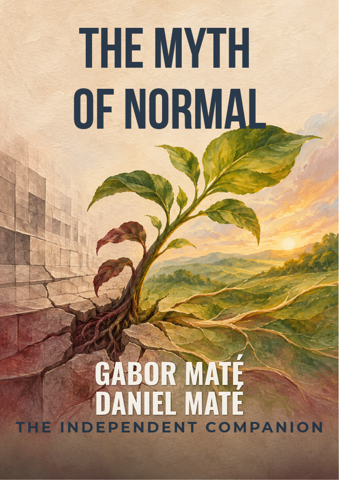
A society can normalize chronic stress, isolation, and disconnection while treating their consequences as purely individual failures. Gabor Maté, with Daniel Maté, argues that trauma, culture, development, and health must be considered together.
The book asks an uncomfortable question: what if many behaviors praised as normal—constant productivity, emotional suppression, self-sacrifice, disconnection from bodily signals—are adaptations to an unhealthy environment? That reframing expands illness beyond individual weakness and places personal suffering inside families, institutions, and culture.
New York Times, Sunday Times, and international bestseller, with more than one million copies sold.
The guide tracks the authors' definitions of trauma, child development, stress physiology, addiction, medicine, social inequality, authenticity, and their proposed path toward wholeness.
Maté argues that behaviors rewarded by a stressed culture may still estrange people from bodily needs, emotion or authenticity. The guide traces this provocative claim without presenting every cultural diagnosis as settled medical consensus.
The book distinguishes what happens from what happens inside a person as a result. Following this definition helps readers connect attachment, development, addiction and chronic stress while also noticing where the authors move from evidence to interpretation.
Self-compassion and reconnection appear alongside criticism of work, inequality, racism and medical systems. This lens prevents healing from being reduced either to private mindset or to social critique, and asks what level of change each chapter actually proposes.
Because the book ranges across medicine, developmental psychology, biography and social criticism, a chapter guide is valuable for separating reported evidence, clinical experience, metaphor and recommendation. It suits readers who want the full architecture of the argument without treating a sweeping synthesis as a personal diagnosis. Open the full book when you want to follow the transitions between patient stories, developmental theory, physiology and social criticism. Those transitions are where the argument is most ambitious—and where careful readers should slow down.
Many links discussed are complex, multifactorial, or debated. The authors' synthesis is not a diagnosis and should not replace medical or psychiatric evaluation, treatment, or prescribed medication.
Edition notice: This is an independent chapter guide and summary, not the original book. It is designed for review and reading support and is best used alongside the full work.
Miva: the next reading experience beyond audiobooks
Listen like an audiobook, then ask anything, anytime.
Start Miva's narrationMiva does not just narrate. It keeps explaining based on what you ask.