Historical background:
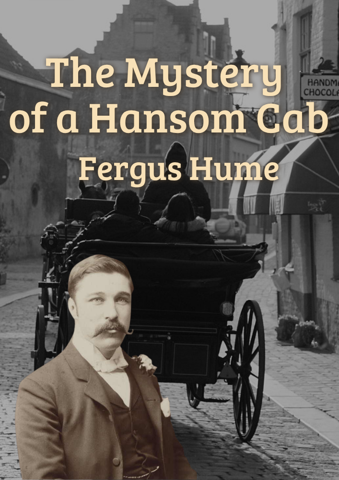
Hume wrote the novel in Melbourne and first published it in 1886. The revised edition preserved by the complete public-domain edition includes a preface correcting myths about the author's identity and earnings, making publication history part of the selected text rather than background decoration.
Story introduction:
A passenger is found dead after a night journey in a hansom cab, and identification becomes the first problem before motive can be tested. Police inquiry, legal defense, testimony, and social concealment move the case across different parts of Melbourne.
Literary form:
The novel opens with documentary forms—a newspaper report and inquest material—before shifting among investigation, courtroom logic, and melodrama. Urban transport is more than scenery: the enclosed moving cab creates anonymity while the city generates witnesses and records.
Central themes:
A passenger is found dead after a night journey in a hansom cab, and identification becomes the first problem before motive can be tested. Police inquiry, legal defense, testimony, and social concealment move the case across different parts of Melbourne. Beyond that immediate situation, The Mystery of a Hansom Cab examines detective fiction, Melbourne, hansom cab, evidence, newspapers, colonial city. The novel became an international publishing success before Sherlock Holmes dominated the market. Its importance lies not in a claim to invent detection but in showing how a colonial city, newspaper publicity, police procedure, and fashionable society could sustain a full-length crime narrative. Together, these concerns give the conflict its moral and historical weight beyond the immediate plot.
Director: Shawn Seet
Production country: Australia
Principal cast: John Waters, Marco Chiappi, Jessica De Gouw
Why this version matters: This identifiable production provides a useful comparison between the selected text and a major screen interpretation associated with named filmmakers and performers.
Difference from the book: It condenses the novel's procedural sequence and social subplots for a feature-length television mystery. The change affects point of view, pacing, or the balance among mystery, romance, horror, and social context; viewers should therefore treat the film as an interpretation rather than a visual substitute for the novel.
Screen interpretation:
The named adaptation condenses the novel's procedural sequence and social subplots for a feature-length television mystery. For The Mystery of a Hansom Cab, that choice changes the weight given to detective fiction, Melbourne, hansom cab, evidence, newspapers, colonial city: visible action replaces some of the prose’s control over voice and delay, while the performances give particular faces and bodies to relationships that the book can keep uncertain. The screen version therefore creates a distinct emphasis rooted in this work’s specific narrative problem.
Edition history:
identifies itself as a revised edition and contains the author's preface plus 29 chapters. Readers should retain Australian place names and compare early colonial printings before using later British or American editions as evidence for wording. 4223 identifies this as a revised edition and preserves Fergus Hume's preface. The history of The Mystery of a Hansom Cab is especially sensitive to its preface and 29 numbered chapters, because abridgment or revision can alter the balance among detective fiction, Melbourne, hansom cab, evidence, newspapers, colonial city.
Translation history:
The Mystery of a Hansom Cab was written in en; this record uses the original-language text rather than a translation. Translations must recreate the book’s treatment of detective fiction, Melbourne, hansom cab, evidence, newspapers, colonial city, including differences of register, dialogue, and historically specific vocabulary that shape Fergus Hume’s effects.
Place in literary history:
The novel became an international publishing success before Sherlock Holmes dominated the market. Its importance lies not in a claim to invent detection but in showing how a colonial city, newspaper publicity, police procedure, and fashionable society could sustain a full-length crime narrative.
Place in the author's career:
The novel became an international publishing success before Sherlock Holmes dominated the market. Its importance lies not in a claim to invent detection but in showing how a colonial city, newspaper publicity, police procedure, and fashionable society could sustain a full-length crime narrative. Within Fergus Hume’s career, The Mystery of a Hansom Cab is distinguished by an English-language Australian detective novel that begins with a cab murder and moves between police procedure, legal strategy, newspaper evidence, and Melbourne society. It gathers the author’s concerns into a structure where detective fiction, Melbourne, hansom cab, evidence, newspapers, colonial city interact instead of standing as separate messages.
Continuing influence:
The Mystery of a Hansom Cab continues to influence later storytelling through its handling of detective fiction, Melbourne, hansom cab, evidence, newspapers, colonial city. The novel became an international publishing success before Sherlock Holmes dominated the market. Its importance lies not in a claim to invent detection but in showing how a colonial city, newspaper publicity, police procedure, and fashionable society could sustain a full-length crime narrative. Its afterlife shows how a historically specific work can generate new interpretations while the original retains complications that simplified cultural versions leave aside.
Miva: the next reading experience beyond audiobooks
Listen like an audiobook, then ask anything, anytime.
Start Miva's narrationMiva does not just narrate. It keeps explaining based on what you ask.