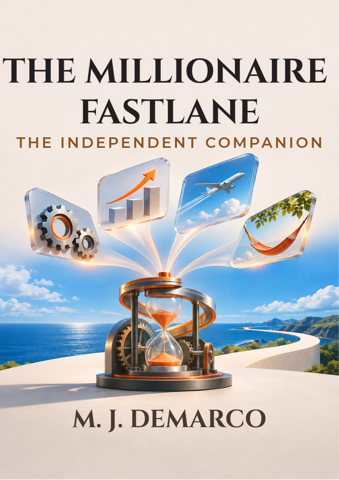
The traditional promise is to save for decades and wait for freedom to arrive late in life; however, when time is the scarcest asset, this path is not necessarily safe. MJ DeMarco advocates for replacing wages with value, control, scale, and systems.
DeMarco's anger toward traditional advice provides a powerful push, but the book is most valuable when rhetoric is converted into business mechanisms. Need, Control, Entry, Time, and Scale can all be tested; urgency alone does not create market demand.
The author's preserved list pages record that this book once reached #1 in the Amazon Kindle category; this is a retail chart record for a specific date and not a formal award.
The guide organizes the Sidewalk, Slowlane, and Fastlane, the CENTS framework, Producers vs. Consumers, and Need, Entry, Control, Scale, and Time.
The Sidewalk, Slowlane, and Fastlane describe how consumption, wages, ownership, and scale utilize time. They are suitable for diagnosing choices but should not become moral labels for individuals under different constraints.
Control, Entry, Need, Time, and Scale reveal businesses that rely entirely on platforms, short-term trends, or the founder's personal labor. The true test is applying these five conditions to specific ideas rather than just memorizing CENTS.
This book opposes passive waiting, yet building systems may still require years of execution and enduring demand uncertainty. The possibility of forming leverage faster should be separated from promises of easy, fast, or guaranteed wealth.
First, understand the three paths, then put a real idea through CENTS one by one: who controls the distribution, what the entry barrier protects, whose need is being solved, whether income exists after the founder leaves, and how value expands. This exercise reveals where there is only passion and no actual business mechanism.
Suitable for readers considering entrepreneurship or questioning the path of accumulating wealth through wages alone. It is not a get-rich-quick guide, nor does it constitute a reason to dismiss stable work, diversified investment, or structural constraints. Converting the book's urgency into customer research and operational evidence is most valuable.
This is a discourse on entrepreneurship, not a forecast of returns. Failure, survivor bias, capital, regulations, market power, health, and inequality of starting points can all change outcomes.
Version Statement: This product is an independently produced chapter guide and summary, not the full original text; it is recommended to be used alongside the complete work as a supplement for review, discussion, and reading.
Miva: the next reading experience beyond audiobooks
Listen like an audiobook, then ask anything, anytime.
Start Miva's narrationMiva does not just narrate. It keeps explaining based on what you ask.