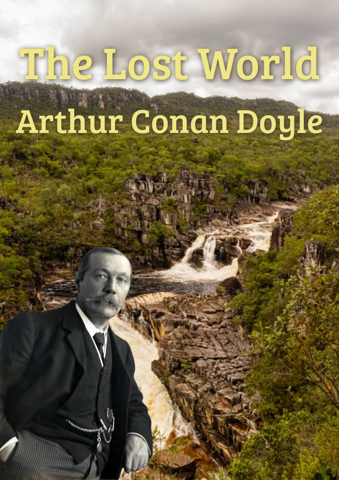
Background:
Published in 1912, the novel draws on contemporary exploration reports, evolutionary debate, museum culture, journalism, and imperial competition. Doyle created Professor Challenger as a forceful counterweight to Sherlock Holmes: a scientist whose brilliance is inseparable from vanity, aggression, and theatrical self-promotion.
What kind of book is it?
Reporter Edward Malone joins Challenger and two other explorers on an expedition to a South American plateau where prehistoric life may have survived. The book treats discovery as both scientific evidence and media spectacle, while its racial and colonial language reflects the period that produced it.
Literary style:
A retrospective newspaper narrative combines expedition diary, scientific demonstration, comic confrontation, cliff-hanger plotting, and competing male performances. The frame asks not only whether an extraordinary claim is true, but what institutions and audiences will accept as proof.
Reading focus:
The novel's real engine is the conversion of an extraordinary claim into acceptable evidence. Challenger possesses conviction before he has an audience willing to believe him; Malone, by contrast, begins as a reporter seeking experience and must learn what observation can establish. Cameras, specimens, notebooks, witnesses, and public demonstration all matter because discovery has to travel from the plateau to institutions at home. The expedition members also represent competing styles of authority: scientific combativeness, skeptical expertise, aristocratic sportsmanship, and journalistic narration. Their arguments keep the prehistoric creatures from becoming the book's only attraction. Readers can track how the plateau rearranges these men's confidence, especially when familiar categories prove inadequate. The enclosed ecosystem appears isolated, yet the expedition carries metropolitan ambition, racial hierarchy, and the appetite for spectacle into it. That tension explains why later films often preserve the dinosaurs while simplifying the novel's concern with publicity and proof. Returning to the newspaper frame reveals a story not merely about finding a lost world, but about manufacturing public belief in one.
Director: Harry O. Hoyt/Production: United States
Principal cast: Wallace Beery, Bessie Love, Lewis Stone
Why this adaptation:
This feature is a landmark of Willis O'Brien's stop-motion work and the first feature-length screen adaptation of Doyle's Challenger novel.
One important difference:
uses stop-motion dinosaurs, adds a romantic triangle, and brings a captured creature to London for a large urban climax.
Edition focus:
Complete editions should retain all sixteen chapters and the newspaper frame, which makes proof, publicity, and Challenger's self-presentation part of the adventure.
Reading recommendation:
An edition with notes on early paleontology and exploration culture helps distinguish Doyle's scientific context from the dinosaur imagery created by later films.
Cultural significance:
The plateau full of surviving prehistoric creatures became a durable template for dinosaur and hidden-ecosystem stories. Later cinema amplified the creatures, while the novel's journalism, proof-making, and imperial assumptions remain essential to understanding the original design.
Relationship between author and work:
Doyle used Challenger to escape the expectations created by Sherlock Holmes and to stage scientific proof as a public, journalistic performance rather than a private act of detection.
Miva: the next reading experience beyond audiobooks
Listen like an audiobook, then ask anything, anytime.
Start Miva's narrationMiva does not just narrate. It keeps explaining based on what you ask.