Work Background:
Homer Eon Flint’s The Lord of Death and the Queen of Life belongs to the formative period of planetary science fiction, when writers treated the neighboring planets as spaces in which entire alternative histories could be imagined. A small expedition leaves Earth in a sky-car and turns astronomical travel into an encounter with unfamiliar landscapes, ruined cities, engineered environments, and evidence of civilizations shaped by conditions very different from humanity’s own. The speculative geography is no longer scientifically current, but it preserves the freedom with which early genre fiction transformed the solar system into a comparative study of possible societies.
Reading Focus:
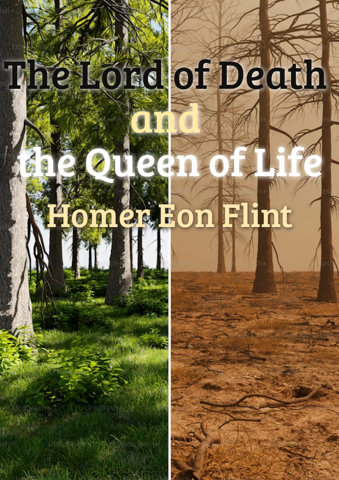
The paired figures named in the title organize the novel’s central contrast. Death is not merely an individual event but the fate of a civilization whose power and knowledge have failed to secure its future; life is represented through another social order and another answer to the problem of survival. The explorers must interpret material traces, technologies, and testimony before they can understand what happened. Readers should watch how the narrative converts discovery into judgment: every extraordinary machine or custom also becomes evidence in an argument about ambition, cooperation, violence, and the responsibilities created by superior knowledge.
The book mixes travel narrative, scientific conjecture, lost-world motifs, and moral allegory. Its rapid sequence of wonders reflects pulp-era storytelling, yet the planetary settings are more than colorful backdrops. By placing different models of civilization side by side, Flint asks whether technological advancement is the same thing as social maturity. The expedition’s observers bring assumptions from Earth, and the limits of those assumptions are repeatedly exposed by what they encounter. The most productive way to read the novel is therefore neither as a reliable forecast of Mercury or Venus nor as pure escapism, but as an early thought experiment that projects human political anxieties onto imagined worlds.
No screen adaptation is currently included.
The selected item is an English public-domain text attributed to Homer Eon Flint. Its contents and narrative structure were compared with an independent scan, while later commercial reprints were used only as bibliographic context. Because the consulted records did not establish the original publication year to the required standard, that field remains blank rather than borrowing a date from a later edition. The selected text is in its original language and therefore has no translator.
Readers comparing editions should verify that both title-linked planetary episodes are present and that the chapter order has not been shortened or silently rearranged. Searchable digital text is convenient for names, technical vocabulary, and recurring social arguments; a page-image source is stronger evidence for title-page data and original arrangement. Later paperback publication demonstrates continued circulation but does not determine the identity or date of the first version. Research in the required language markets did not confirm a mainstream translation with a verifiable combination of translator, publisher, year, and complete textual basis, so no translation is asserted.
Flint’s distinctive contribution here is to make interplanetary travel a device for comparing civilizations. The machinery that enables the voyage supplies adventure, but the lasting question concerns how societies use power once they possess it. Ruins, survivals, and contrasting planetary orders allow the novel to dramatize historical rise and collapse on a scale larger than a single nation. That design places the work within planetary romance while giving it a recognizable strand of social speculation.
The novel is valuable as evidence of a moment before later astronomy narrowed the fictional possibilities of the nearby planets. Its imagined Mercury and Venus reflect period assumptions, yet their unreality is part of the historical interest: they show how early science fiction used incomplete knowledge as room for ethical experiments. Reading the whole work reveals that its many inventions serve a connected comparison between destructive mastery and life-preserving organization rather than a random catalogue of marvels.
Miva: the next reading experience beyond audiobooks
Listen like an audiobook, then ask anything, anytime.
Start Miva's narrationMiva does not just narrate. It keeps explaining based on what you ask.