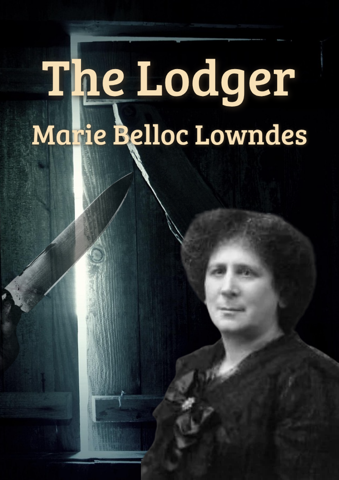
Historical background:
Lowndes expanded a 1911 short story into the 1913 novel, drawing on cultural memory of the Whitechapel murders without naming the historical killer as a character. The viewpoint stays close to an economically precarious lodging-house couple, making rent and respectability sources of suspense.
Story introduction:
A quiet stranger rents rooms just as reports of a serial murderer dominate London. His habits create fear, but the household's need for income makes suspicion difficult to admit and even harder to act upon.
Literary form:
The novel builds tension through restricted knowledge, newspaper cries, domestic routines, overheard movement, and Mrs. Bunting's divided self-persuasion. Readers know only what the household can observe, so ethical compromise grows through small acts rather than a conventional detective chase.
Central themes:
A quiet stranger rents rooms just as reports of a serial murderer dominate London. His habits create fear, but the household's need for income makes suspicion difficult to admit and even harder to act upon. Beyond that immediate situation, The Lodger examines crime fiction, suspense, London fog, lodging house, suspicion, moral compromise. The book became a foundational lodging-house thriller because it relocates public terror into rooms that must still be cleaned, heated, and paid for. Its influence is visible in repeated film and radio versions, yet its distinctive achievement remains the landlady's compromised perspective. Together, these concerns give the conflict its moral and historical weight beyond the immediate plot.
Director: Alfred Hitchcock
Production country: United Kingdom
Principal cast: Ivor Novello, Marie Ault, June Tripp
Why this version matters: This identifiable production provides a useful comparison between the selected text and a major screen interpretation associated with named filmmakers and performers.
Difference from the book: It makes the lodger a romantic lead and resolves suspicion more decisively than the novel's domestic psychological focus. The change affects point of view, pacing, or the balance among mystery, romance, horror, and social context; viewers should therefore treat the film as an interpretation rather than a visual substitute for the novel.
Screen interpretation:
The named adaptation makes the lodger a romantic lead and resolves suspicion more decisively than the novel's domestic psychological focus. For The Lodger, that choice changes the weight given to crime fiction, suspense, London fog, lodging house, suspicion, moral compromise: visible action replaces some of the prose’s control over voice and delay, while the performances give particular faces and bodies to relationships that the book can keep uncertain. The screen version therefore creates a distinct emphasis rooted in this work’s specific narrative problem.
Edition history:
contains 26 English chapters. It should be distinguished from Lowndes's earlier short story and from adaptations that turn the lodger into an innocent romantic hero; those changes reverse the novel's emphasis on uncertainty within the household. Complete English text from 2014. The history of The Lodger is especially sensitive to its 26 numbered chapters, because abridgment or revision can alter the balance among crime fiction, suspense, London fog, lodging house, suspicion, moral compromise.
Translation history:
The Lodger was written in en; this record uses the original-language text rather than a translation. Translations must recreate the book’s treatment of crime fiction, suspense, London fog, lodging house, suspicion, moral compromise, including differences of register, dialogue, and historically specific vocabulary that shape Marie Belloc Lowndes’s effects.
Place in literary history:
The book became a foundational lodging-house thriller because it relocates public terror into rooms that must still be cleaned, heated, and paid for. Its influence is visible in repeated film and radio versions, yet its distinctive achievement remains the landlady's compromised perspective.
Place in the author's career:
The book became a foundational lodging-house thriller because it relocates public terror into rooms that must still be cleaned, heated, and paid for. Its influence is visible in repeated film and radio versions, yet its distinctive achievement remains the landlady's compromised perspective. Within Marie Belloc Lowndes’s career, The Lodger is distinguished by an English psychological crime novel that places a respectable lodging-house couple beside murders modeled on the cultural memory of Jack the Ripper. It gathers the author’s concerns into a structure where crime fiction, suspense, London fog, lodging house, suspicion, moral compromise interact instead of standing as separate messages.
Continuing influence:
The Lodger continues to influence later storytelling through its handling of crime fiction, suspense, London fog, lodging house, suspicion, moral compromise. The book became a foundational lodging-house thriller because it relocates public terror into rooms that must still be cleaned, heated, and paid for. Its influence is visible in repeated film and radio versions, yet its distinctive achievement remains the landlady's compromised perspective. Its afterlife shows how a historically specific work can generate new interpretations while the original retains complications that simplified cultural versions leave aside.
Miva: the next reading experience beyond audiobooks
Listen like an audiobook, then ask anything, anytime.
Start Miva's narrationMiva does not just narrate. It keeps explaining based on what you ask.